

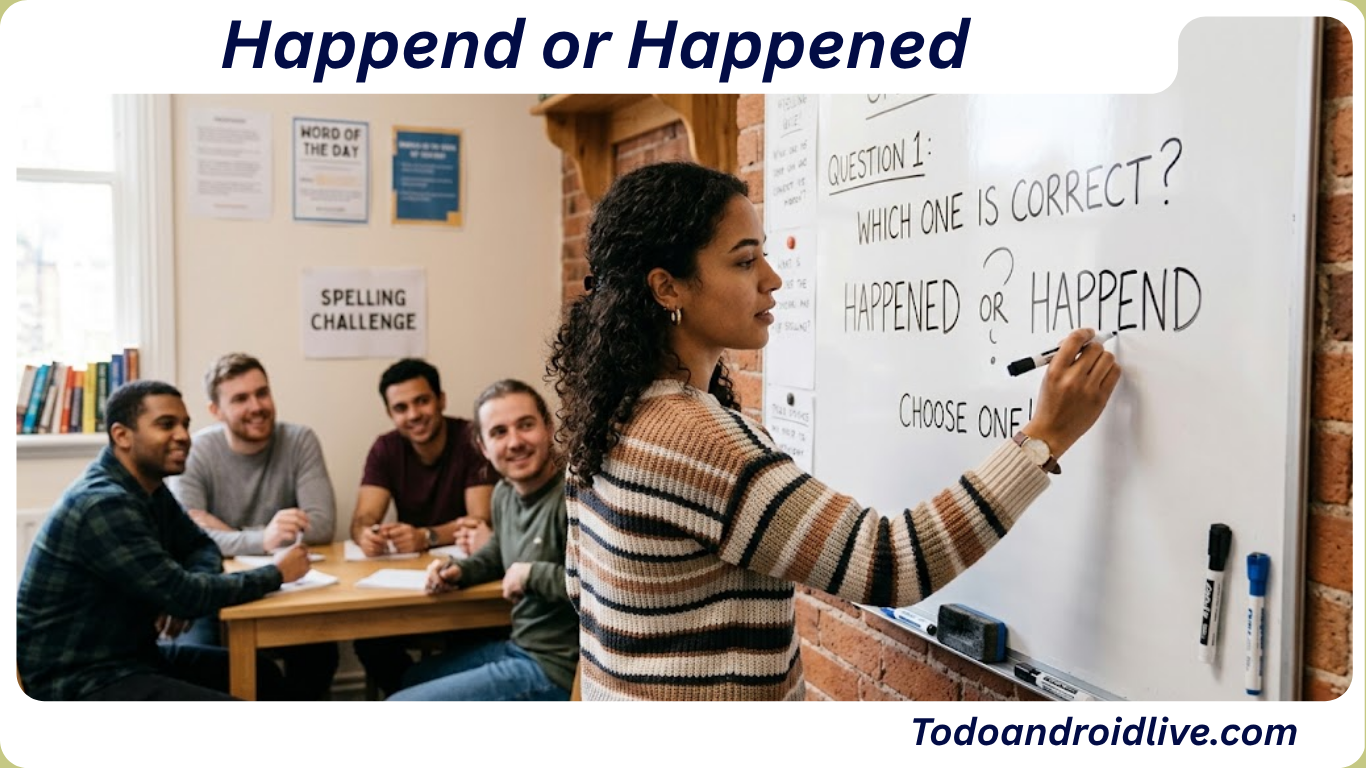
The English language has many words that are easy to misspell, even when people use them every day. One common example is the confusion between happend or happened. The two forms look almost identical, but only one is correct in standard English.
The correct spelling is happened. It is the past tense and past participle of happen, which means to take place, occur, or come about. For example, “Something unexpected happened yesterday” describes an event that took place in the past.
The incorrect form happend usually appears when someone forgets the letter e in the past-tense ending -ed. Although the mistake is common in typing and informal messages, it is not an accepted alternative spelling.
Understanding how the word is formed, when to use it, and how it differs from other verb forms can help you write more accurately. This guide explains the spelling, definition, pronunciation, grammar, common mistakes, and practical examples of happened.
Happend or Happened: Which Spelling Is Correct?
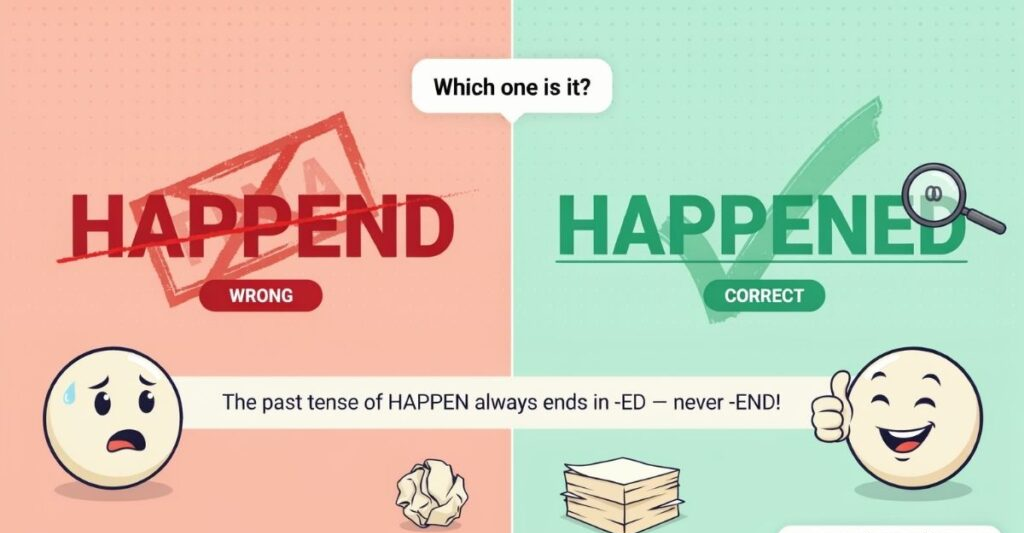
Happened is the correct spelling. Happend is a misspelling and should not be used when describing something that occurred in the past.
Here are some examples:
- Correct: What happened yesterday?
- Incorrect: What happend yesterday?
- Correct: The meeting happened on Monday.
- Incorrect: The meeting happend on Monday.
- Correct: Something unusual happened at school.
- Incorrect: Something unusual happend at school.
The difference is the letter e before the final d. In standard English, the past tense of happen is formed by adding -ed to the original verb.
The spelling rule is simple:
Happen + ed = Happened
Remembering this pattern makes it easier to recognize the correct form whenever you are unsure whether to write happend or happened.
What Does Happened Mean?
Happened is the past tense and past participle of the verb happen. It means that something took place, occurred, or came about.
The word can describe many types of events, including daily activities, unexpected situations, personal experiences, and historical events.
Consider these examples:
- The concert happened last night.
- A small mistake happened during the test.
- Something interesting happened on our trip.
- The change happened after several meetings.
- The accident happened before sunrise.
Each sentence describes an event associated with the past.
Happened Definition
A simple definition of happened is “took place” or “occurred.”
Also Read: Cancel or Cancelled: Correct Spelling, Meaning, Differences, and Examples (2026)
For example, the sentence “The celebration happened on Saturday” means that the celebration took place on Saturday.
In the question “What happened to my phone?”, the speaker wants to know what occurred or why the phone is no longer in its expected condition.
Happened does not necessarily describe something negative. It can refer to good, bad, ordinary, or unexpected events.
For example:
- A wonderful opportunity happened to come along.
- The power outage happened during the storm.
- The ceremony happened as planned.
The exact meaning depends on the context of the sentence.
Is Happened a Verb?
Yes, happened is a verb form. More specifically, it is the simple past form and the past participle of happen.
It can be used in different grammatical structures.
Examples:
- Simple past: The event happened yesterday.
- Present perfect: Something has happened.
- Past perfect: The problem had happened before we arrived.
These forms describe events from different time perspectives, but they all use the same spelling of happened.
Why Is Happened the Correct Spelling?
To understand the spelling, begin with the base verb happen.
The word happen contains six letters: H-A-P-P-E-N. Because it is a regular verb, its simple past tense is formed by adding -ed.
The result is happened.
HAPPEN + ED = HAPPENED
The important point is that the ending is -ed, not simply -d. The letter e must remain in the word.
Why Is Happend Wrong?
Happend is incorrect because it leaves out the e in the past-tense ending.
Some people may think that adding d to happen is enough. However, the regular past tense of this verb requires -ed.
Compare the forms:
- Happen: the base verb
- Happened: the correct past form
- Happend: an incorrect spelling
Other regular verbs follow the same general pattern:
- Open → opened
- Listen → listened
- Explain → explained
- Visit → visited
- Happen → happened
Learning the base word and its ending together can prevent this mistake.
Why Does Happened Have Two P’s?
The base verb happen already contains two p’s. Adding -ed does not remove either letter or change the spelling of the original word.
The correct form is happened, not hapened or happenned.
A helpful way to remember it is to divide the word into two parts:
HAPPEN + ED
First, spell happen correctly. Then add ed. This method helps you avoid missing letters and adding unnecessary ones.
Happen vs. Happened: What Is the Difference?
Happen and happened are forms of the same verb, but they are used differently.
Happen is the base form. It appears in general statements, future expressions, and sentences with certain helping verbs.
Happened describes a past event or functions as a past participle with an auxiliary verb.
Examples:
- Mistakes happen to everyone.
- The mistake happened yesterday.
- What will happen next?
- What happened last night?
- Did anything happen while I was away?
The correct choice depends on the tense and structure of the sentence.
When Should You Use Happen?
Use happen when describing events generally or when another verb determines the tense.
Examples:
- Accidents happen sometimes.
- What might happen tomorrow?
- Problems can happen without warning.
- I want to know what will happen next.
- Did the same thing happen before?
Notice that happen appears after did in the final example. The helping verb did already marks the question as past tense, so the main verb stays in its base form.
When Should You Use Happened?
Use happened when describing an event that occurred in the past.
Examples:
- The meeting happened yesterday.
- Something strange happened last night.
- The delay happened during the morning.
- I remember what happened at school.
- The change happened after the discussion.
Happened also appears with has, have, and had.
For example, “Something has happened” uses the present perfect tense. “Something had happened before we arrived” uses the past perfect tense to show that one event occurred before another past event.
Happen, Happens, Happened, and Happening
Understanding the main forms of this verb makes choosing the correct spelling easier.
| Verb form | Usage | Example |
| Happen | Base form | Mistakes happen. |
| Happens | Present tense with he, she, or it | It happens often. |
| Happened | Past tense or past participle | It happened yesterday. |
| Happening | Ongoing action or event | It is happening now. |
Use happens with a singular third-person subject in the simple present. Use happening when describing an event in progress or when the sentence structure requires the -ing form.
Examples:
- This happens every year.
- The same problem happened last month.
- The problem is happening again.
- These things happen sometimes.
Each form has a specific grammatical purpose, so they cannot always replace one another.
How to Use Happened in a Sentence
Happened is common in everyday conversation, schoolwork, emails, news reports, and professional writing. The examples below show how the word fits different situations.
Examples in Everyday Conversation
- What happened at the store?
- I do not know what happened.
- Something funny happened during lunch.
- The problem happened while we were traveling.
- Nobody understood why the change happened.
These sentences use happened to ask about or describe events in the past.
Examples in Text Messages
- Wait, what happened?
- I cannot believe that happened!
- Tell me what happened yesterday.
- Something strange happened last night.
- What happened after I left?
The spelling remains the same in informal communication. Short sentences, emojis, and casual punctuation do not change the correct form.
Examples in School and Academic Writing
- The experiment happened during the final week of the course.
- Several important events happened during the period.
- The change happened before the new policy was introduced.
- The discussion happened after the lecture.
For formal academic writing, words such as occurred or took place may sometimes sound more precise. However, happened is a correct English verb when used appropriately.
Examples in Business and Professional Writing
- The system failure happened shortly after the update.
- The meeting happened as scheduled.
- The error happened because incorrect information was entered.
- Please explain what happened before the deadline.
Clear professional writing depends on choosing the correct verb and explaining the situation accurately. The word happened itself is acceptable in formal communication.
Common Spelling and Grammar Mistakes
Several mistakes are associated with happen and happened. Some involve spelling, while others involve choosing the wrong verb form.
Happend vs. Happened
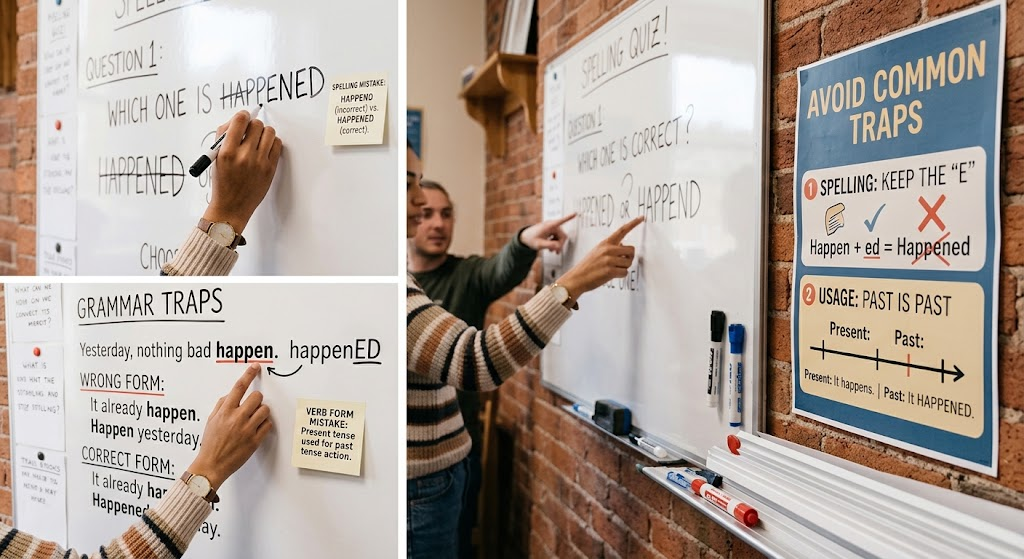
Incorrect: The event happend on Friday.
Correct: The event happened on Friday.
The incorrect form is missing the e in the ending -ed.
Hapened vs. Happened
Incorrect: What hapened to the document?
Correct: What happened to the document?
The base verb happen contains two p’s, and both remain in happened.
Happenned vs. Happened
Incorrect: Something happenned during the trip.
Correct: Something happened during the trip.
Do not add an extra n. The correct spelling is happened.
Did Happen vs. Did Happened
This is a grammar mistake rather than a simple spelling mistake.
Also Read:Christine Harrell
Incorrect: What did happened yesterday?
Correct: What happened yesterday?
Also correct: What did happen yesterday?
In ordinary conversation, “What happened yesterday?” is the more natural question. The form “What did happen?” is possible when the speaker wants to emphasize or clarify the event.
After did, the main verb generally takes its base form.
Examples:
- Did it happen again?
- Why did the meeting happen so late?
- The event did happen as planned.
- The event did not happen yesterday.
Avoid writing did happened because did already carries the past-tense marking.
Has Happened vs. Had Happened
Both forms are correct, but they express different time relationships.
Has happened is the present perfect form. It connects a past event to the present.
Example: Something has happened to the schedule.
Had happened is the past perfect form. It describes an event that occurred before another past event.
Example: The problem had happened before we changed the settings.
Choosing between these forms depends on the intended meaning.
Happen vs. Happening
Happen is the base form, while happening is the -ing form.
Examples:
- What will happen next?
- What is happening now?
- The same thing can happen again.
- Something unusual is happening outside.
Use happening when the sentence describes an ongoing event or requires the -ing form.
Happened Pronunciation: How Do You Say It?
Happened is commonly pronounced approximately as “HAP-und,” with the main stress on the first syllable.
A simple pronunciation guide is HAP-ənd. The exact sound varies slightly by accent.
The ending -ed does not form a separate, strongly pronounced syllable in happened. Instead, it is generally pronounced with a /d/ sound.
English has three common pronunciations of the -ed ending:
- /t/, as in walked
- /d/, as in played
- /ɪd/, as in wanted
Happened follows the /d/ pattern.
This difference between spelling and pronunciation may explain why some people leave out the e when typing the word. However, spelling should not be based only on how a word sounds.
Remember that the written form is always happened in standard English.
British English vs. American English Spelling
There is no spelling difference between British and American English for happened.
Both varieties use the same standard form. Canadian, Australian, and New Zealand English also use happened.
| English variety | Correct spelling |
| American English | Happened |
| British English | Happened |
| Canadian English | Happened |
| Australian English | Happened |
| New Zealand English | Happened |
Some words have regional spelling differences, such as color and colour or center and centre. Happened is not one of those words.
The pronunciation may vary between speakers, but the accepted spelling does not change.
If you are writing for an American audience, use happened. The same rule applies when writing for readers in the United Kingdom and other English-speaking countries.
Happened vs. Occurred: Which Word Should You Use?
Happened and occurred have similar meanings, but they can differ in tone and context.
Happened is common in everyday speech and general writing. Occurred is often preferred in formal, scientific, technical, or official contexts.
Examples:
- A delay happened during the trip.
- A delay occurred during the trip.
Both sentences communicate a similar idea, although occurred may sound more formal.
Other alternatives include:
| Alternative | Typical use | Example |
| Took place | An event at a particular time or location | The ceremony took place on Sunday. |
| Developed | A situation that formed or changed | A problem developed during testing. |
| Emerged | Something that appeared or became noticeable | A new concern emerged. |
| Came about | Something resulting from circumstances | The change came about gradually. |
| Unfolded | Events developing over time | The story unfolded over several days. |
These words are not interchangeable in every situation. A problem may develop over time, while a ceremony takes place at a particular time and location.
For a simple question, “What happened?”, the verb happened is usually the most natural choice.
Happened Synonyms and Related Words
If you are looking for another word for happen or happened, several alternatives may fit your sentence.
Common options include occurred, took place, transpired, developed, emerged, and came about.
For example, instead of writing “The event happened yesterday,” you could write “The event took place yesterday.”
Instead of “A problem happened during the process,” you could write “A problem developed during the process.”
The best synonym depends on the meaning you want to express. Occurred is often a close alternative, while developed suggests a situation that formed or changed over time.
There is no single opposite of happened that works in every context. Depending on the sentence, you might use did not occur, failed to happen, or was prevented.
Examples:
- The meeting happened. / The meeting did not occur.
- The plan happened as expected. / The plan failed to materialize.
- The accident happened. / The accident was prevented.
These expressions communicate different contrasts, so select the one that accurately reflects the situation.
How to Remember the Correct Spelling of Happened
The easiest memory trick is to learn the base verb and then add the regular past-tense ending.
HAPPEN + ED = HAPPENED
Keep these three points in mind:
- The base verb is happen.
- The base verb contains two p’s.
- The past-tense ending is -ed, not just -d.
You can also remember a common question: “What happened?”
Seeing and using the correct form in a complete sentence can help you recognize it more quickly when writing.
Test Your Spelling
Choose the correct form in each sentence.
- What (happend / happened) after the game?
- Did the same thing (happened / happen) yesterday?
- Something unusual has (happen / happened).
- The problem is (happened / happening) again.
- The meeting (happend / happened) last week.
Answers:
- Happened
- Happen
- Happened
- Happening
- Happened
The exercise checks both spelling and grammar. A word may be spelled correctly but still be the wrong form for a particular sentence.
Is Happend Ever Correct in English?
Happend is not an accepted standard spelling of the past tense of happen.
Also Read: Tomorrows or Tomorrow’s: Meaning, Differences, Grammar Rules, and Examples
You may encounter it in online searches, social media comments, usernames, or informal messages because people sometimes make typing mistakes. Its appearance in these contexts does not make it a correct spelling.
When describing an event that took place in the past, use happened.
- Standard: I wonder what happened.
- Nonstandard: I wonder what happend.
An unusual exception may occur when Happend is deliberately used as a brand name, username, or creative label. In that case, it functions as a chosen name rather than the ordinary past-tense verb.
For normal English writing, the distinction is clear: happened is correct, and happend is a misspelling.
Frequently Asked Questions About Happend or Happened
How do you spell happened correctly?
The correct spelling is H-A-P-P-E-N-E-D. Start with happen and add -ed to form the past tense. Happend is missing the e in the ending.
What is the past participle of happen?
The past participle is happened. It is used in constructions such as has happened, have happened, and had happened.
Can happened be used without a time expression?
Yes. A sentence does not need to mention a specific time. For example, “I cannot explain what happened” is correct because the context may already make the time clear.
Is “What has happened?” grammatically correct?
Yes. It uses the present perfect tense and often asks about an event whose effects matter now. “What happened?” generally asks more directly about a past event.
Is “This is happened” correct English?
No, not when you mean that an event took place. Write “This happened” or “This has happened,” depending on the intended meaning.
What is the difference between “what happened” and “what has happened”?
“What happened?” usually asks about a past event. “What has happened?” often focuses on an event that has a connection to the present.
Is happened a regular or irregular verb?
Happen is a regular verb. Its simple past tense and past participle are both happened, formed by adding -ed to the base verb.
Should I write happened or had happened?
Use happened for a past event when no earlier-past relationship needs to be shown. Use had happened when an event occurred before another past event.
Can I use happened in a formal essay?
Yes. Happened is a standard English verb and is acceptable in formal writing. Occurred or took place may sometimes be more precise, depending on the subject.
Why do people confuse happened with happend?
The words look similar, and the -ed ending is not pronounced as a separate syllable in happened. People may forget the e while typing or rely too heavily on pronunciation.
Conclusion
When choosing between happend or happened, use happened. It is the standard spelling of the past tense and past participle of happen, a regular English verb meaning to take place or occur.
The spelling is easier to remember when you separate the word into its two parts: happen and ed. Keep both p’s in the base verb and include the e in the past-tense ending.
It is also important to use the correct grammatical form. Write “The event happened yesterday,” but use “Did the event happen yesterday?” because did is followed by the base verb.
The spelling remains the same in American, British, Canadian, Australian, and New Zealand English. Whether you are writing a message, school assignment, email, or professional report, happened is the correct choice.
Remember the rule: happen + ed = happened. This simple pattern will help you avoid the common misspelling happend and write with greater confidence.