

English spelling can be confusing when two words look almost identical but have different meanings. One common example is “tomorrows or tomorrow’s.” The only visible difference is an apostrophe, yet that small mark changes how the word functions in a sentence.
Writers often face this question when discussing tomorrow’s weather, tomorrow’s forecast, a meeting scheduled for the next day, or plans for the future. Students may also wonder whether “tomorrows” is a real word or simply a spelling mistake.
The good news is that both forms are correct in the right context. The important thing is to understand whether you are referring to something associated with the next day or using the plural form to describe multiple future days.
This guide explains the grammar rules, meanings, examples, common mistakes, and differences between the two spellings. It also covers related expressions, including tomorrow’s date, tomorrow’s temperature, and tomorrow’s events, so you can choose the correct form with confidence.
Tomorrows or Tomorrow’s: What Is the Difference?
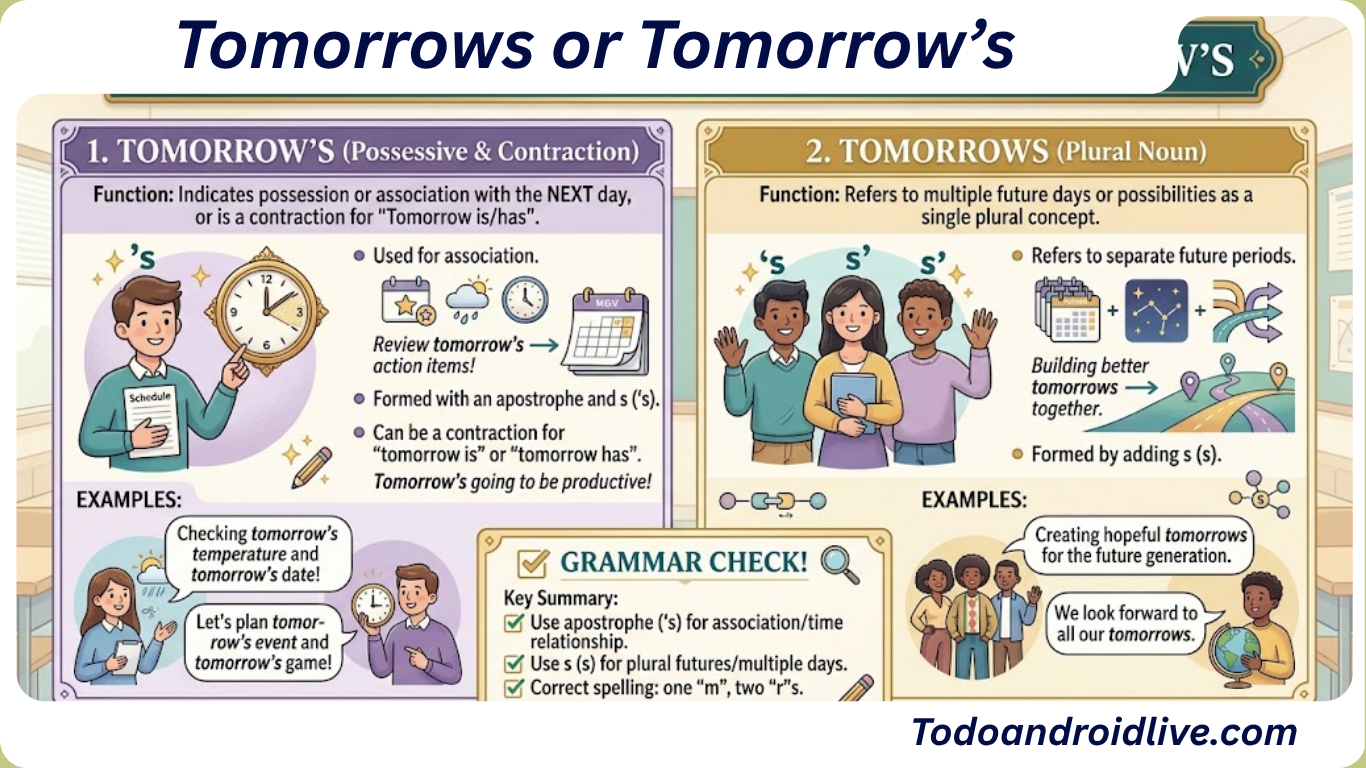
The main difference between tomorrows and tomorrow’s is grammatical. Tomorrow’s is the possessive form of tomorrow and is also commonly used to describe something scheduled for the next day. Tomorrows is the plural form, referring to multiple future days or possible futures.
Here is a quick comparison:
| Word | Grammatical form | Meaning | Example |
| Tomorrow’s | Possessive form | Connected with or belonging to the next day | Tomorrow’s forecast looks promising. |
| Tomorrows | Plural noun | Multiple future days or futures | We hope for brighter tomorrows. |
In ordinary writing, tomorrow’s is much more common. You will see it in emails, calendars, news reports, school assignments, weather updates, and work schedules.
The plural form tomorrows is less common because people do not usually count individual future days as separate nouns. It appears more often in reflective, literary, motivational, or figurative writing.
For example, “Tomorrow’s meeting starts at nine” refers to a specific event scheduled for the next day. By contrast, “We are working toward better tomorrows” refers to the future in a broad sense.

Remember that the apostrophe is not optional when you need the possessive form.
What Does Tomorrow’s Mean?
Tomorrow’s is formed by adding an apostrophe and an s to the word tomorrow. It commonly describes a thing, event, condition, or activity associated with the next calendar day.
For example:
- Tomorrow’s weather may be warmer than today’s.
- Tomorrow’s appointment has been moved to the afternoon.
- I have already prepared tomorrow’s lesson.
- The team discussed tomorrow’s game plan.
- Tomorrow’s deadline gives us very little time.
In each sentence, tomorrow’s identifies something connected with the following day.
Is Tomorrow’s Always About Ownership?
No. This is an important grammar distinction.
Also Read: Businesses or Business’s: Spelling, Grammar Rules, Possessive Forms, and Examples
Possessive forms often indicate ownership, as in “Sarah’s book.” However, a possessive noun can also show a relationship, association, time, or other connection.
Tomorrow’s meeting does not mean that tomorrow physically owns the meeting. It means the meeting is scheduled for that day.
The same principle applies to these expressions:
- Tomorrow’s schedule: the schedule for the next day.
- Tomorrow’s weather: the weather expected on the next day.
- Tomorrow’s opportunity: an opportunity that may arise the next day.
- Tomorrow’s deadline: a deadline that falls on the next day.
- Tomorrow’s forecast: the forecast for the next day.
This use is natural in English, even though the relationship is not literal ownership.
Can Tomorrow’s Describe Something Happening in the Future?
Yes. Tomorrow’s usually refers to the next day, but it can also describe future possibilities in a broader or figurative sense.
For example, “Tomorrow’s technology may change how people work” discusses technology in the future rather than a specific event scheduled for the following day.
Context determines the exact meaning.
What Does Tomorrows Mean?
Tomorrows is the plural form of the noun tomorrow. It refers to multiple future days or, figuratively, several possible futures.
Although the word is grammatically correct, it is less common in everyday English than tomorrow’s.
Consider these examples:
- The choices we make today may shape our tomorrows.
- The community hopes for brighter tomorrows.
- Young people deserve opportunities for better tomorrows.
- Their dreams gave them hope for the tomorrows ahead.
In these sentences, tomorrows does not refer to a list of specific dates. Instead, it represents future experiences, opportunities, or periods of life.
Is Tomorrows a Real Word?
Yes. Tomorrows is a valid plural noun, not simply a misspelling of tomorrow’s.
However, its use depends on the sentence.
Correct: “We cannot predict all our tomorrows.”
Incorrect for the intended meaning: “I checked tomorrows weather before leaving home.”
The second sentence needs tomorrow’s because the writer means the weather expected on the next day.
Can You Use Tomorrows in Everyday Conversation?
You can, but it may sound unusual if you are referring to ordinary daily plans.
For example, “We need to prepare for tomorrow’s presentation” sounds natural in a workplace.
“We need to prepare for our tomorrows” sounds more reflective or poetic. It may work in a motivational speech, but it would be unusual in a routine business email.
Use the plural when you genuinely mean multiple futures, rather than using it as a substitute for the possessive form.
Why Does the Apostrophe Matter?
An apostrophe can change the grammatical role of a word. In this case, it helps distinguish a possessive form from a plural noun.
Compare the following sentences:
- Tomorrow’s class starts at 8 a.m.
- Our tomorrows may look different from our pasts.
In the first sentence, tomorrow’s describes a class associated with the next day.
In the second sentence, tomorrows is a plural noun representing multiple possible futures.
Removing the apostrophe from the first sentence changes the intended meaning and makes the wording incorrect for standard English.
Is the Apostrophe Used for Plurals?
Usually, no. Standard English does not use an apostrophe simply to make an ordinary noun plural.
For example:
- One book, two books.
- One student, several students.
- One tomorrow, several tomorrows.
The apostrophe appears in tomorrow’s because the word is possessive or functions as a time-related modifier, not because it is plural.
This rule also helps explain why “tomorrow’s” is correct in “tomorrow’s forecast,” while “tomorrows” is correct in “our tomorrows.”
How to Use Tomorrow’s Weather and Tomorrow’s Forecast
Weather-related searches are a common reason people use tomorrow’s in a sentence. These expressions refer to weather conditions predicted for the following day.
Tomorrow’s Weather
Tomorrow’s weather means the expected weather on the next day.
Examples:
- Tomorrow’s weather may include light rain.
- We should check tomorrow’s weather before planning the picnic.
- Tomorrow’s weather looks suitable for an outdoor event.
The possessive form is correct because weather is being associated with a particular day.
Tomorrow’s Forecast
Tomorrow’s forecast means a prediction about weather conditions for the next day.
Examples:
- Tomorrow’s forecast calls for cloudy skies.
- The local station has updated tomorrow’s forecast.
- Please check tomorrow’s weather forecast before driving.
Both “tomorrow’s forecast” and “tomorrow’s weather forecast” are grammatically correct.
A forecast is a prediction, not a guarantee. Actual weather conditions may differ from what the forecast suggests.
What Is the Difference Between Tomorrow’s Weather and Tomorrow’s Forecast?
These expressions are closely related but have slightly different meanings.
Tomorrow’s weather refers to the weather conditions expected or experienced on the next day. Tomorrow’s forecast refers to the prediction about those conditions.
For example, a person might ask, “What’s tomorrow’s weather?” when they want a general idea of the conditions. They might ask, “What is tomorrow’s forecast?” when they want the official weather prediction.
Both questions are natural in everyday American English.
What About Tomorrow’s Temperature?
Tomorrow’s temperature refers to the expected temperature for the following day.
Examples:
- Tomorrow’s temperature may reach 75°F.
- Check tomorrow’s temperature before choosing your clothes.
- The forecast suggests that tomorrow’s temperature will be lower than today’s.
Because temperature predictions can change, check an up-to-date local forecast when making real plans.
The apostrophe remains necessary because tomorrow’s describes the temperature associated with the next day.
How to Use Tomorrow’s Date Correctly
Tomorrow’s date means the calendar date of the day after today.
For example, if today is October 15, 2026, tomorrow’s date is October 16, 2026.
Examples include:
- Please enter tomorrow’s date on the application.
- I need to confirm tomorrow’s date before booking the appointment.
- The teacher asked us to write tomorrow’s date on the assignment.
The apostrophe is correct because the date is associated with tomorrow.
What Is Tomorrow’s Date?
“What is tomorrow’s date?” is a grammatically correct question asking for the calendar date of the next day.
“What’s tomorrow’s date?” is its common conversational form.
The two expressions have the same basic meaning. The longer version sounds slightly more formal, while the shorter one is common in everyday speech.
When answering this question, remember that the date depends on the current local date and time zone.
Is Tomorrow Date Correct?
“Tomorrow date” is understandable, but it is not the standard grammatical form for this question in ordinary English.
Better options include:
- What is tomorrow’s date?
- What date is it tomorrow?
- Can you confirm the date for tomorrow?
For professional writing, use a complete question or a clear phrase such as “the date of tomorrow’s appointment.”
How Tomorrow’s Is Used for Events, Meetings, and Schedules
Tomorrow’s is useful whenever an activity or arrangement is associated with the next day.
Tomorrow’s Event
Tomorrow’s event refers to an event planned for the following day.
Examples:
- The organizers have confirmed tomorrow’s event schedule.
- Please arrive early for tomorrow’s event.
- We still need to finalize the arrangements for tomorrow’s celebration.
The phrase can refer to a business conference, school activity, sports competition, concert, or private gathering.
Tomorrow’s Meeting
Tomorrow’s meeting means a meeting scheduled for the next day.
Examples:
- I will prepare the presentation for tomorrow’s meeting.
- Have you reviewed the agenda for tomorrow’s meeting?
- The manager sent the documents before tomorrow’s meeting.
Writing “tomorrows meeting” without the apostrophe is incorrect when this meaning is intended.
Tomorrow’s Schedule
Tomorrow’s schedule refers to the planned activities for the next day.
Examples:
- I reviewed tomorrow’s schedule before going to bed.
- Tomorrow’s schedule includes two appointments.
- Please send me tomorrow’s work schedule.
This expression is common in offices, schools, healthcare settings, and personal planning.
Tomorrow’s Game and Sports Events
The same rule applies to sporting events.
Also Read:Detroit Pistons vs San Antonio Spurs Match Player Stats: Box Score, Top Performers, and Game Results
Examples:
- Tomorrow’s game begins at 7 p.m.
- The coach discussed tomorrow’s match with the players.
- Fans are checking tomorrow’s sports schedule.
Phrases such as “tomorrow’s NFL games,” “tomorrow’s World Cup games,” and “the starting lineup for tomorrow’s NASCAR race” use the possessive form correctly because they refer to events connected with the next day.
However, a schedule or lineup can change. For accurate information, consult the relevant league, competition, team, or official event organizer.
British English vs. American English: Tomorrows or Tomorrow’s
There is no standard spelling difference between British and American English for these two forms.
Both varieties use tomorrow’s as the possessive form and tomorrows as the plural noun.
| Grammar point | American English | British English |
| Possessive form | Tomorrow’s | Tomorrow’s |
| Plural form | Tomorrows | Tomorrows |
| Next-day weather | Tomorrow’s weather | Tomorrow’s weather |
| Next-day meeting | Tomorrow’s meeting | Tomorrow’s meeting |
| Multiple future days | Our tomorrows | Our tomorrows |
The difference is not regional. It is grammatical.
An American writer might say, “Tomorrow’s forecast looks clear,” while a British writer might use exactly the same sentence.
Similarly, a writer in either country could use “brighter tomorrows” in a poem, speech, or reflective passage.
Does AP Style Require Tomorrow’s?
The standard possessive spelling is tomorrow’s. The apostrophe is needed when the word describes something associated with the next day.
For example, “Tomorrow’s meeting has been postponed” follows standard possessive grammar.
If you are writing for a newspaper, school, or professional publication, follow its complete style guide for matters such as capitalization, dates, and time formatting. The basic distinction between tomorrow’s and tomorrows does not change.
Common Mistakes When Writing Tomorrows or Tomorrow’s
Many spelling errors occur because writers focus on the word’s sound rather than its grammatical function.
Here are common mistakes and their corrections.
| Incorrect or unclear sentence | Correct sentence | Reason |
| I checked tomorrows weather. | I checked tomorrow’s weather. | The weather is associated with the next day. |
| Tomorrows meeting starts at nine. | Tomorrow’s meeting starts at nine. | The apostrophe marks the possessive form. |
| We hope for better tomorrow’s. | We hope for better tomorrows. | The sentence refers to multiple futures. |
| Please prepare tomorrows schedule. | Please prepare tomorrow’s schedule. | The schedule is for the next day. |
| Our tomorrow’s may be uncertain. | Our tomorrows may be uncertain. | A plural noun is needed, not a possessive modifier. |
Mistake 1: Leaving Out the Apostrophe
Incorrect: “Tomorrow weather will be warm.”
Better: “Tomorrow’s weather will be warm.”
In ordinary standard English, the possessive form is needed when tomorrow describes the weather.
Mistake 2: Adding an Apostrophe to a Plural
Incorrect: “We look forward to brighter tomorrow’s.”
Correct: “We look forward to brighter tomorrows.”
The phrase describes multiple possible futures. It does not indicate ownership.
Mistake 3: Assuming Every Future Reference Needs an Apostrophe
Not every sentence about the future requires tomorrow’s.
For example:
- We will meet tomorrow.
- I will finish the project tomorrow.
- Tomorrow is a holiday.
These sentences use tomorrow as an adverb or noun, not as a possessive modifier. An apostrophe would be unnecessary.
Mistake 4: Confusing Tomorrow’s With Tomorrows in Headlines
Headlines sometimes use shortened or creative language, but standard grammar still applies.
“Tomorrow’s Top 25 Today” may be a title or program name, depending on the context. That does not make tomorrows interchangeable with tomorrow’s in ordinary sentences.
When editing headlines, check whether the phrase is a proper title, a brand name, or a regular grammatical expression before changing its spelling.
Is Tomorrow’s a Contraction?
Tomorrow’s can function as a possessive form or as a contraction of “tomorrow is” or “tomorrow has” in suitable contexts.
This distinction is important because the apostrophe does not always indicate possession.
For example:
- Possessive: Tomorrow’s weather looks pleasant.
- Contraction: Tomorrow’s going to be busy.
- Contraction: Tomorrow’s been set aside for training.
In the first sentence, tomorrow’s describes the weather associated with the next day.
In the second sentence, tomorrow’s means “tomorrow is.”
In the third sentence, tomorrow’s means “tomorrow has.”
The surrounding words help you identify the intended meaning.
How Can You Tell Whether Tomorrow’s Is Possessive or a Contraction?
Try expanding the sentence.
If “Tomorrow’s going to be busy” becomes “Tomorrow is going to be busy,” the apostrophe represents a contraction.
If “Tomorrow’s weather looks pleasant” is rewritten as “The weather associated with tomorrow looks pleasant,” the word functions possessively.
This test is helpful when proofreading, especially because both uses have the same spelling.
A Simple Method for Choosing the Correct Form
You can usually decide between tomorrows and tomorrow’s by examining what the sentence means.
Step 1: Identify the Meaning
Ask yourself whether you mean something related to the next day or multiple future days.
If you mean the next day’s weather, meeting, date, or schedule, tomorrow’s is generally correct.
If you mean multiple possible futures, tomorrows may be appropriate.
Step 2: Check the Word That Follows
When tomorrow appears before a noun, the possessive form is often required.
Examples:
- Tomorrow’s appointment.
- Tomorrow’s forecast.
- Tomorrow’s deadline.
- Tomorrow’s temperature.
However, remember that tomorrow’s can also be a contraction before words such as “going” or “been.”
Step 3: Test the Sentence Without the Apostrophe
Consider the sentence “I need tomorrow’s report.”
If you write “I need tomorrows report,” the intended meaning becomes unclear and the spelling is incorrect in standard usage.
By contrast, “We are hopeful about our tomorrows” uses a valid plural noun.
Step 4: Read the Sentence Aloud
Reading aloud can help you recognize the intended meaning, although the two spellings usually sound identical.
The final decision should be based on grammar, not pronunciation alone.
Related Expressions and Long-Tail Search Questions
Also Read: Personel or Personnel: Which Spelling Is Correct?
The word tomorrow appears in many everyday questions and search phrases. Understanding the possessive form helps you write them correctly.
| Expression | Meaning or use |
| Tomorrow’s weather | Weather expected on the next day |
| Tomorrow’s forecast | A prediction for the next day |
| What’s tomorrow’s weather? | A casual question about the next day’s weather |
| What is tomorrow’s forecast? | A question about the next day’s predicted conditions |
| Tomorrow’s temperature | The expected temperature for the next day |
| Tomorrow’s date | The calendar date of the next day |
| What is tomorrow’s National Day? | A question about a national observance on the next day |
| Tomorrow’s NFL games | Football games scheduled for the next day |
| Tomorrow’s World Cup games | World Cup matches scheduled for the next day |
| Starting lineup for tomorrow’s NASCAR race | The starting lineup for a race scheduled for the next day |
These phrases illustrate the same grammatical pattern: tomorrow’s identifies something associated with the following day.
Questions such as “What’s tomorrow’s temperature?” and “What’s tomorrow’s National Day?” are also grammatically correct. Their answers depend on the location, calendar, event schedule, or date being discussed.
Some phrases, such as “Tomorrow’s Scholar” or “Tomorrow Joe,” may refer to a publication, product, title, or name. Their intended meaning cannot be determined from the wording alone, so they should be checked in context rather than treated as standard grammar examples.
Frequently Asked Questions About Tomorrows or Tomorrow’s
Is “tomorrows” grammatically correct?
Yes. Tomorrows is the plural form of tomorrow and can refer to multiple future days or possible futures. It is less common than tomorrow’s in everyday writing.
Can tomorrow’s mean “tomorrow is”?
Yes. In a sentence such as “Tomorrow’s going to be a long day,” tomorrow’s is a contraction of “tomorrow is.” Context helps distinguish it from the possessive form.
Should I write tomorrow’s or tomorrows in a calendar entry?
Use tomorrow’s when describing an item scheduled for the next day, such as “Tomorrow’s appointment.” If the calendar simply displays the word “Tomorrow” as a date label, no apostrophe is needed.
Is “tomorrow’s” correct before a proper noun?
It can be, depending on the sentence. For example, “Tomorrow’s World Cup match” is grammatically correct. Capitalization and spelling of official event names should follow the event’s established name.
Can a sentence contain both tomorrow’s and tomorrows?
Yes, if each form has a different grammatical role. For example: “Tomorrow’s decisions may influence our tomorrows.” The first describes decisions associated with the next day, while the second refers to possible future experiences.
Does the apostrophe change how tomorrow’s is pronounced?
No. Tomorrow’s and tomorrows are generally pronounced the same way in ordinary speech. Their meanings and grammatical functions differ in writing.
Is tomorrow’s used in formal writing?
Yes. Tomorrow’s is appropriate in academic, business, journalistic, and other formal writing when the possessive form is needed. Tomorrows can also be correct in formal literary or reflective writing when referring to multiple futures.
Conclusion
Choosing between tomorrows and tomorrow’s becomes straightforward once you understand the role of the apostrophe.
Tomorrow’s is the standard form for describing something associated with the next day, including the weather, forecast, date, temperature, meeting, or schedule. It can also represent a contraction of “tomorrow is” or “tomorrow has” in the right sentence.
Tomorrows is the plural form of tomorrow. It is useful when discussing multiple future days or possible futures, especially in literary and figurative writing.
Neither form is universally correct in every situation. The right choice depends on what you want to express.
When proofreading, identify the meaning first, examine the sentence structure, and check whether the word is possessive, plural, or a contraction. This simple habit will help you use both forms accurately in everyday communication.