

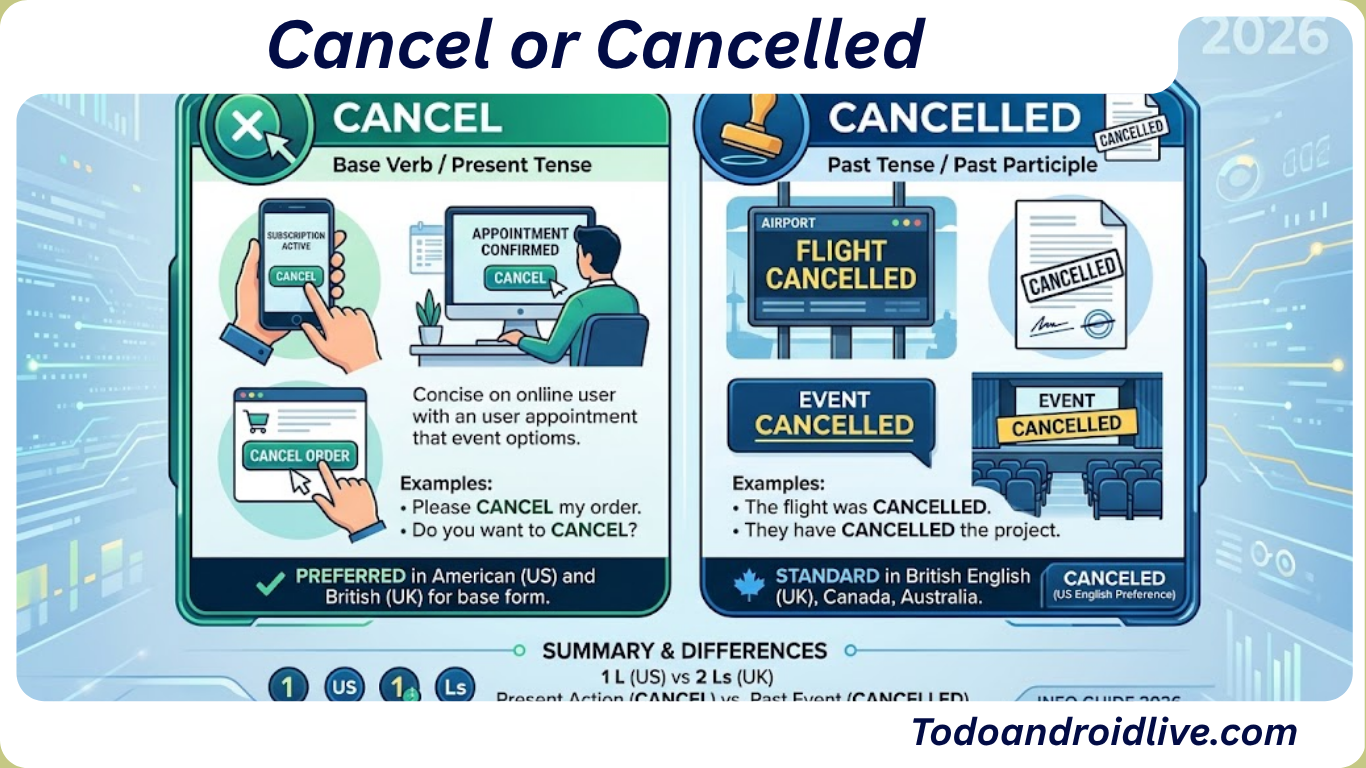
Is it cancel or cancelled? Is canceled the correct spelling, or should you write cancelled? These are common questions because English uses different spelling rules in the United States and the United Kingdom. Although the words look slightly different, both forms can be correct depending on your audience.
The word cancel is the base form of a verb that means to stop, call off, or end a planned activity, service, or arrangement. When describing something that has already been stopped, American English generally uses canceled, while British English usually uses cancelled.
The same difference appears in canceling and cancelling. However, the noun cancellation is normally spelled with two Ls in both American and British English.
If you are searching for cancel or cancelled, this guide explains the cancel correct spelling rules, the difference between canceled and cancelled, related word forms, and examples that make each form easy to understand.
Cancel or Cancelled: Which Spelling Is Correct?
Both cancel and cancelled are correct English words, but they are used differently in a sentence. Cancel is the base verb, while cancelled is the past-tense and past-participle form commonly used in British English.
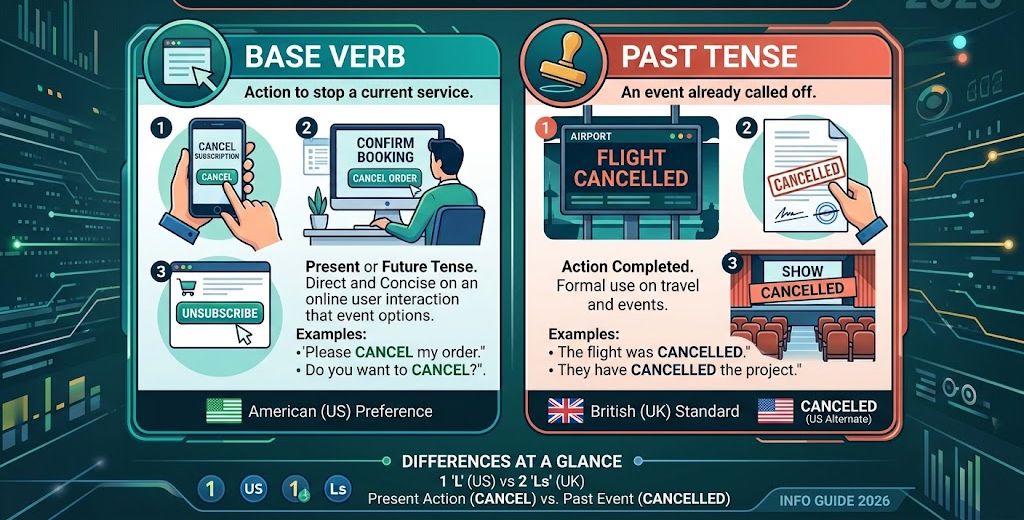
In American English, the past-tense form is generally spelled canceled.
Here is the simple rule:
- American English: cancel, canceled, canceling.
- British English: cancel, cancelled, cancelling.
- Both varieties: cancellation.
For example:
- American English: I canceled my doctor’s appointment.
- British English: I cancelled my doctor’s appointment.
- Both varieties: I need to cancel my appointment.
If you want to know the correct spelling of cancelled or canceled, remember that the choice depends on the English variety you are following. Neither past-tense spelling is universally wrong.
Canceled vs. Cancelled: Understanding the Difference
The difference between canceled and cancelled is regional spelling. Both words have the same meaning, pronunciation, and grammatical function.
American English generally prefers canceled, with one L. British English usually prefers cancelled, with two Ls.
When to Use Canceled
Use canceled when writing for an American audience or following a US English style guide.
Examples:
Also Read: Christine Harrell
- The airline canceled the flight because of bad weather.
- Sarah canceled her gym membership last week.
- The school canceled classes because of heavy snow.
- The company canceled its product launch.
These examples demonstrate the correct spelling of canceled in everyday and professional writing.
When to Use Cancelled
Use cancelled when writing for a British audience or following British English conventions.
Examples:
- The football match was cancelled because of rain.
- James cancelled his hotel booking.
- The school cancelled the outdoor activity.
- The company cancelled its scheduled meeting.
If you are asking, “Is cancelled spelled correctly?” the answer is yes. It is the standard British English form.
Quick Comparison Table
| Word Form | American English | British English |
| Base verb | Cancel | Cancel |
| Past tense | Canceled | Cancelled |
| Past participle | Canceled | Cancelled |
| Present participle | Canceling | Cancelling |
| Noun | Cancellation | Cancellation |
| Adjective | Cancelable | Cancellable |
This table covers the most common forms and helps explain the correct spelling of canceled or cancelled in different situations.
How to Spell Cancel Correctly
The correct spelling of cancel is the same in American and British English. The word contains one L and is used when someone wants to stop an activity, order, booking, or service.
Examples:
- I need to cancel my subscription.
- Please cancel the duplicate order.
- We may cancel the event tomorrow.
- You can cancel your reservation online.
The base form also follows modal verbs such as can, could, will, would, should, and must.
For example, “You should cancel the booking” is correct, while “You should cancelled the booking” is incorrect.
If you are searching for cancel correct spelling, the answer is straightforward: write cancel when the sentence requires the base form of the verb.
Cancel, Cancels, and Canceled
These forms have different grammatical uses.
- Cancel: I want to cancel the order.
- Cancels: She cancels unnecessary appointments.
- Canceled: He canceled the meeting yesterday.
- Cancelled: He cancelled the meeting yesterday in British English.
The correct spelling of the past tense of cancel depends on the regional style. The grammatical tense, however, depends on when the action takes place.
How to Spell Canceling or Cancelling Correctly
Both canceling and cancelling are correct spellings. The preferred form depends on whether you use American or British English.
American English generally uses canceling, with one L. British English normally uses cancelling, with two Ls.
Canceling in American English
Examples:
- I am canceling my subscription.
- The airline is canceling several flights.
- We are canceling the event due to severe weather.
- He is canceling his appointment.
These sentences show the correct spelling of canceling in US English.
Cancelling in British English
Examples:
- I am cancelling my subscription.
- The airline is cancelling several flights.
- We are cancelling the event because of the weather.
- He is cancelling his appointment.
If you want to know how to spell cancelling correctly, remember that the British form normally contains two Ls.
The same rule applies when comparing cancelling and canceling. Both are accepted, but writers should follow one spelling convention consistently.
Cancellation or Cancelation: What Is the Correct Spelling?
The standard spelling of the noun is cancellation, with two Ls. This spelling is preferred in both American and British English.
The word cancelation, with one L, is also recorded as a less common variant. However, cancellation is the safer choice for school assignments, business writing, websites, and formal documents.
Examples:
- The cancellation of the concert disappointed many fans.
- Your cancellation request has been received.
- The airline announced the cancellation of several flights.
- There is no cancellation fee for this booking.
If you are wondering how to spell cancellation correctly, use cancellation in most situations.
What Is a Cancellation?
A cancellation is the act or result of stopping something that was planned, booked, scheduled, or previously arranged.
For example, cancel is the verb in “I will cancel my reservation.” Cancellation is the noun in “The cancellation was confirmed this morning.”
The noun is common in travel, business, education, subscriptions, and customer service.
Examples include:
- Flight cancellation
- Appointment cancellation
- Order cancellation
- Subscription cancellation
- Event cancellation
The correct spelling of the word cancellation remains the same in American and British English.
How Do You Spell Cancellation or Cancelation?
If you are asking how do you spell cancellation or cancelation, the preferred answer is cancellation.
Although cancelation is an accepted variant in some references, it is much less common. Using cancellation helps maintain consistency with standard dictionaries and familiar professional usage.
For most writers, there is no practical advantage to choosing the less common form.
Why Are Canceled and Cancelled Spelled Differently?
The difference comes from the spelling conventions that developed in American and British English.
British English commonly doubles the final L when adding endings such as -ed and -ing to cancel. This produces cancelled and cancelling.
American English usually retains one L in these forms, producing canceled and canceling.
Similar differences appear in other words.
Also Read: Tomorrows or Tomorrow’s: Meaning, Differences, Grammar Rules, and Examples
| Base Word | American English | British English |
| Travel | Traveled | Travelled |
| Label | Labeled | Labelled |
| Signal | Signaled | Signalled |
| Cancel | Canceled | Cancelled |
| Model | Modeled | Modelled |
These examples illustrate a common regional pattern. They do not mean that every English verb follows exactly the same rule.
The important point is that canceled and cancelled developed as accepted regional forms. You do not need to change the spelling of the base verb cancel itself.
Which Spelling Should You Use in American English?
If your audience is in the United States, use American spelling consistently.
The usual choices are:
- Cancel
- Canceled
- Canceling
- Cancellation
- Cancelable
For example, an American website would normally write, “Your order was canceled,” rather than “Your order was cancelled.”
The same applies to emails, news articles, school assignments, business reports, and customer support messages.
Canceled or Cancelled in AP Style
The Associated Press Stylebook generally follows American English spelling conventions. Therefore, canceled and canceling are the usual choices in AP-style writing.
Examples:
- The event was canceled on Monday.
- Organizers are canceling the second performance.
- The cancellation affected hundreds of customers.
If you are writing for a newspaper or organization, follow its current style guide rather than relying only on personal preference.
Common Spelling Mistakes With Cancel
Even when writers know the difference between American and British spelling, they may choose the wrong grammatical form.
Using Cancelled Instead of Cancel
Incorrect: I need to cancelled my reservation.
Correct: I need to cancel my reservation.
The phrase need to requires the base form of the verb.
Using Cancel Instead of Canceled
Incorrect: She cancel the appointment yesterday.
Correct in American English: She canceled the appointment yesterday.
Correct in British English: She cancelled the appointment yesterday.
The word yesterday indicates a past action, so the sentence needs the past tense.
Confusing Cancellation and Cancelation
Preferred: The cancellation was confirmed.
Less common variant: The cancelation was confirmed.
For standard writing, cancellation is the recommended choice.
Mixing American and British Spelling
Inconsistent: The company canceled one event and is cancelling another.
Consistent American English: The company canceled one event and is canceling another.
Consistent British English: The company cancelled one event and is cancelling another.
A document should follow a consistent spelling style unless there is a specific reason to quote or reproduce another variety of English.
Cancel or Cancelled in Everyday Examples
Practical examples make it easier to understand which form belongs in each sentence.
Emails and Messages
- American: I canceled my appointment this morning.
- British: I cancelled my appointment this morning.
- Both: Please cancel my reservation.
- Both: Your cancellation has been confirmed.
Travel and Flights
- American: The airline canceled the flight.
- British: The airline cancelled the flight.
- Both: The cancellation caused delays for passengers.
Business and Subscriptions
- American: The customer canceled the service.
- British: The customer cancelled the service.
- Both: Your cancellation request is being processed.
School and Work
- American: The teacher canceled the class.
- British: The teacher cancelled the class.
- Both: We may cancel tomorrow’s meeting.
These examples demonstrate that the spelling changes with regional conventions, while the meaning remains the same.
Cancelable or Cancellable: Which Is Correct?
Both cancelable and cancellable are accepted spellings of an adjective meaning that something can be canceled.
American English commonly prefers cancelable, while British English commonly uses cancellable.
Examples:
Also Read: Businesses or Business’s: Spelling, Grammar Rules, Possessive Forms, and Examples
- The ticket is cancelable under the stated conditions.
- This reservation is cancellable before the deadline.
The spelling does not determine whether a refund is available. Cancellation policies may include restrictions, fees, or deadlines, so readers should check the actual terms before canceling a booking or service.
Frequently Asked Questions About Cancel or Cancelled
What is the correct spelling of cancelled or canceled?
Both spellings are correct. American English normally uses canceled, while British English normally uses cancelled.
Is canceled the correct spelling in the United States?
Yes. Canceled is the standard American English spelling of the past tense and past participle of cancel.
Is cancelled the correct spelling in British English?
Yes. Cancelled is the standard British English spelling for the past tense and past participle of cancel.
What is the correct spelling of cancellation?
Cancellation is the standard spelling in both American and British English. It normally contains two Ls.
Is cancelation spelled correctly?
Cancelation is recognized as a less common variant, but cancellation is much more widely preferred. Use cancellation for most formal and everyday writing.
Is cancelling or canceling correct?
Both forms are correct. Canceling is standard in American English, while cancelling is standard in British English.
What is the correct spelling of the past tense of cancel and travel?
In American English, the usual spellings are canceled and traveled. In British English, they are cancelled and travelled.
Is cancelled correct in AP Style?
AP Style generally follows American English conventions, so canceled and canceling are the standard choices.
What is the difference between cancel and cancellation?
Cancel is a verb that describes stopping something. Cancellation is a noun that refers to the act or result of stopping it.
How do you spell cancelación in English?
The Spanish word cancelación is usually translated as cancellation in English. The appropriate translation may vary slightly with the sentence.
Conclusion
The correct spelling of cancel or cancelled depends on grammar and regional English conventions. Cancel is the base verb in both varieties. American English generally uses canceled and canceling, while British English usually prefers cancelled and cancelling.
The noun cancellation is normally spelled with two Ls in both varieties, making it the preferred answer to questions about the correct spelling of cancellation or cancelation. Similarly, both cancelable and cancellable are accepted, with different regional preferences.