
Choosing the right word can make a difference in clear, professional writing. If you have ever wondered whether to write unattentive or inattentive, the confusion is understandable. Both forms look reasonable because English uses different prefixes to express negative meanings.
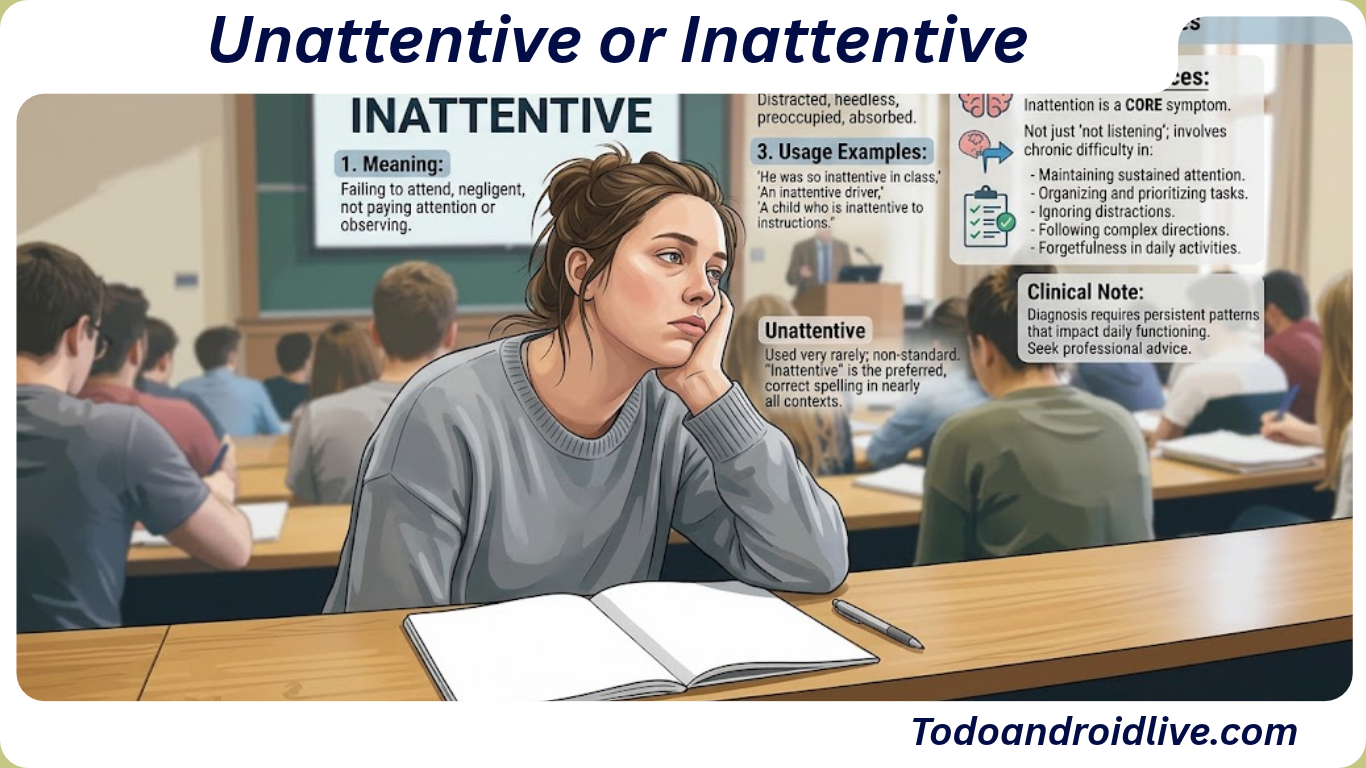
However, the two spellings are not equally common in modern English. Inattentive is the established, widely accepted choice in everyday communication, education, and professional writing. Unattentive appears occasionally, but it is uncommon and is generally best avoided when you want standard, natural English.
The meaning of inattentive also goes beyond spelling. It describes someone who struggles to give proper attention to a person, task, instruction, or detail. The word frequently appears in discussions about school performance, workplace behavior, driving safety, and attention-deficit/hyperactivity disorder (ADHD).
Understanding the correct spelling, definition, and context will help you use the word confidently. This guide explains the difference between inattentive and unattentive, provides practical examples, explores related vocabulary, and clarifies the connection between inattention and inattentive ADHD.
Unattentive or Inattentive: Which Is Correct?
Inattentive is the preferred spelling in contemporary English. It describes a person who is not paying attention, is easily distracted, or fails to notice important information.
Unattentive is an uncommon alternative. Although readers can usually understand what it means, it is not the usual choice in modern standard writing.
Consider these examples:
- Correct and natural: The student was inattentive during the science lesson.
- Uncommon: The student was unattentive during the science lesson.
The first sentence sounds natural to most English speakers. The second communicates a similar idea but uses a much less familiar form.
When deciding whether inattentive or unattentive is correct for your writing, choose inattentive. It is the safer option for school assignments, emails, reports, articles, and other situations where standard spelling matters.

Why Is Inattentive the Preferred Form?
English contains many negative prefixes, including in-, un-, dis-, and non-. These prefixes can change the meaning of a word by expressing an opposite, an absence, or a lack of a quality.
For example:
- Attentive becomes inattentive.
- Happy becomes unhappy.
- Agree becomes disagree.
- Fiction becomes nonfiction.
Because both in- and un- can express negative meanings, it may seem logical to use either prefix with attentive. However, English word formation does not allow every prefix to be attached naturally to every word.
Inattentive is the established form that readers recognize and expect. The uncommon form unattentive may look logical, but that does not make it the best choice in ordinary writing.
Is Unattentive Always Incorrect?
It is more accurate to describe unattentive as rare or nonstandard in general contemporary usage than to claim that the sequence of letters can never occur in English.
The important distinction is between a form that is occasionally encountered and one that is widely established. Inattentive is the conventional choice for most readers and writing situations.
If your goal is clear communication, there is little reason to choose the less familiar alternative.
Inattentive Meaning and Definition
The word inattentive is an adjective that describes someone who does not give enough attention to a person, activity, instruction, or situation.
In simple terms, inattentive means not paying attention.
Also Read: Congrats or Congratulations: Meaning, Correct Spelling, and How to Use Each Word
A person may be inattentive because they are distracted, preoccupied with their thoughts, tired, or focused on something else. The word can also describe behavior that overlooks important details.
Define Inattentive in Simple English
The definition of inattentive is failing to pay proper attention or showing a lack of attention.
For example, imagine a teacher explaining a new mathematics problem. One student keeps looking out the window and misses the instructions. You could describe that student as inattentive during the explanation.
Similarly, an employee who repeatedly overlooks details in a report may be described as inattentive when completing that particular task.
The word describes behavior in context. It does not automatically mean that someone is unintelligent, careless in every situation, or unwilling to learn.
What Does Inattentive Mean in Different Situations?
The meaning of inattentive can vary slightly depending on the situation.
In school: An inattentive student may miss instructions, overlook details, or struggle to remain focused during a lesson.
At work: An inattentive employee may overlook an important email, enter information incorrectly, or fail to notice a change in a document.
In a conversation: An inattentive listener may miss part of what another person says because their thoughts are elsewhere.
While driving: An inattentive driver may fail to notice a road sign, pedestrian, or change in traffic conditions.
In relationships: An inattentive person may forget a detail someone shared or appear distracted during an important conversation.
In each example, inattentive describes a lack of attention. The word alone does not explain why the behavior happened.
Inattention Meaning: Understanding the Related Noun
Inattention is the noun form of inattentive. It refers to a lack of attention or the act of failing to focus adequately on something.
For example:
- The accident investigation examined whether inattention contributed to the incident.
- Her inattention to small details caused errors in the final report.
- Frequent inattention during lessons made it harder to follow the instructions.
The distinction is simple:
| Word | Part of speech | Meaning |
| Attentive | Adjective | Paying attention |
| Inattentive | Adjective | Not paying enough attention |
| Attention | Noun | The act or ability of focusing |
| Inattention | Noun | A lack of attention |
| Inattentively | Adverb | In a way that shows a lack of attention |
| Inattentiveness | Noun | The quality or state of being inattentive |
These related forms are useful when you want to discuss attention without repeating the same word in every sentence.
For example, instead of writing, “The student was inattentive because the student did not pay attention,” you could write, “The student’s inattention made it difficult to follow the lesson.”
Both sentences communicate a similar idea, but the second is more concise.
Inattentive vs. Unattentive: Main Differences
The difference between inattentive and unattentive is mainly a matter of established usage, familiarity, and standard spelling.
| Feature | Inattentive | Unattentive |
| Modern usage | Common and established | Rare |
| Meaning | Not paying attention | Generally understood to mean the same thing |
| Standard writing | Recommended | Usually avoided |
| Academic writing | Natural choice | Unusual choice |
| Professional communication | Preferred | May appear to be a spelling error |
| Best option for SEO content | Yes | Use mainly when discussing the spelling itself |
The distinction is important because two words can communicate a similar meaning without being equally suitable in modern writing.
If you are editing an article, reviewing a school assignment, or preparing a professional document, use inattentive unless a specific historical or stylistic context requires otherwise.
British English vs. American English
Unlike spelling differences such as color and colour, inattentive does not have separate standard American and British spellings.
Both American English and British English commonly use inattentive.
Examples in American English:
- The student was inattentive during the class discussion.
- The driver appeared inattentive at the intersection.
Examples in British English:
- The pupil was inattentive during the lesson.
- The employee seemed inattentive during the meeting.
The vocabulary surrounding the sentence may differ by region, such as student and pupil, but the spelling inattentive remains the same.
For writers targeting a United States audience, inattentive is the appropriate choice. The same recommendation applies to British, Canadian, and Australian English.
Examples of Inattentive in Everyday Writing
Understanding a definition is helpful, but seeing the word used in complete sentences makes its meaning easier to remember.
Inattentive in School
Students may occasionally lose focus during lessons, particularly when a topic is difficult or a classroom is distracting.
Examples:
- The inattentive student missed the teacher’s instructions.
- His inattentive behavior during the lesson made the assignment harder to complete.
- The teacher noticed that several students had become inattentive near the end of the class.
- An inattentive reader may overlook an important detail in a passage.
These examples describe observable behavior without assuming that every distracted student has an underlying attention disorder.
Inattentive in the Workplace
Attention to detail matters in many professional settings. When someone overlooks instructions or important information, the word inattentive may describe the behavior.
Examples:
- The manager asked the inattentive employee to review the report again.
- An inattentive approach to data entry can lead to avoidable errors.
- The team missed a deadline after an important email went unnoticed.
- The reviewer was inattentive to the changes made in the final document.
The word can describe a temporary mistake or a repeated pattern. The surrounding context helps readers understand which meaning is intended.
Inattentive in Conversations
A person can be physically present in a conversation without fully listening to what is being said.
Examples:
- I seemed inattentive because I was thinking about an upcoming appointment.
- She apologized for being inattentive during the discussion.
- The audience became inattentive when the presentation continued for too long.
- He was inattentive to his friend’s concerns and failed to understand the problem.
In these sentences, inattentive communicates that someone was not giving enough attention to the interaction.
Inattentive in Driving and Safety
Inattention can have serious consequences when a task requires continuous awareness.
Examples:
- Inattentive driving can increase the risk of a crash.
- The driver was inattentive and failed to notice the changing traffic signal.
- A moment of inattention caused the worker to overlook a safety instruction.
When discussing driving, it is useful to distinguish inattention from distracted driving. Inattention is the broader lack of focus, while distraction often involves something that draws attention away from the main task, such as a phone or conversation.
Inattentive in Formal and Academic Writing
The adjective is suitable for formal writing when it accurately describes the behavior being discussed.
Examples:
- The study examined how inattentive behavior affected classroom participation.
- The report identified inattentive supervision as a possible contributing factor.
- The researcher warned that inattentive reading could lead to misunderstandings.
- The evaluation noted repeated inattention to important procedural details.
Use the word carefully in reports about people. When possible, describe the specific behavior rather than applying a broad label to someone’s character.
Inattentive Synonyms: Other Words for Not Paying Attention
Several words can replace inattentive, but each has a slightly different meaning. Choosing the right synonym helps you communicate more precisely.
| Synonym | Meaning | Example |
| Distracted | Attention is drawn elsewhere | She was distracted by the noise. |
| Unfocused | Unable to maintain a clear focus | He felt unfocused during the meeting. |
| Absent-minded | Forgetful or preoccupied | I was absent-minded and left my keys at home. |
| Careless | Not taking enough care | A careless review allowed an error to remain. |
| Preoccupied | Thinking about something else | He seemed preoccupied with a personal concern. |
| Inattentive | Not giving enough attention | The listener was inattentive during the explanation. |
| Unobservant | Not noticing things easily | The unobservant visitor missed the small sign. |
| Unmindful | Not sufficiently aware of something | She was unmindful of the time. |
| Negligent | Failing to exercise required care or responsibility | The investigation examined whether the supervision was negligent. |
| Forgetful | Often failing to remember things | He became forgetful about routine appointments. |
Which Synonym Is Best?
Choose distracted when something interrupts a person’s focus.
Use absent-minded when someone forgets things or becomes lost in thought.
Choose careless when a person fails to take sufficient care, especially when completing a task.
Use preoccupied when someone is mentally occupied with another concern.
Choose inattentive when the central idea is a lack of attention.
Also Read: Braves vs Nationals: 2026 Scores, Stats, Results & Season Breakdown
These words are related, but they are not exact replacements in every sentence. For example, a distracted person may be trying hard to pay attention, while a careless person may fail to check their work properly. The context determines which word is most accurate.
What Is Inattentive ADHD?
The word inattentive also appears frequently in discussions about attention-deficit/hyperactivity disorder, commonly called ADHD.
Inattentive ADHD refers to the presentation of ADHD in which symptoms of inattention are prominent. A person may struggle to organize tasks, follow instructions, remember everyday responsibilities, or maintain focus.
In the United States, ADHD is a recognized neurodevelopmental disorder that can affect children, adolescents, and adults. It involves patterns of inattention and/or hyperactivity and impulsivity that interfere with daily functioning.
The spelling distinction remains the same: inattentive is the established adjective, including in medical discussions.
However, it is important to understand that being inattentive occasionally does not mean someone has ADHD. Many factors can affect concentration, including poor sleep, stress, anxiety, and environmental distractions.
What Is ADHD Predominantly Inattentive Presentation?
ADHD predominantly inattentive presentation is the clinical term for a presentation in which inattentive symptoms are prominent and the diagnostic criteria for the hyperactive-impulsive presentation are not met.
Older sources may use terms such as ADHD-PI, ADHD-I, inattentive ADD, or attention deficit disorder without hyperactivity. ADD is an older term that is still widely used in everyday conversation, but ADHD is the current diagnostic name.
You may encounter the phrases predominantly inattentive ADHD, inattentive type ADHD, and attention deficit disorder predominantly inattentive type when researching the condition.
These phrases generally refer to the same broad pattern of attention-related symptoms, although current clinical terminology favors presentation rather than treating ADHD as a set of fixed subtypes.
What Are the Symptoms of Inattentive ADHD?
The inattentive symptoms associated with ADHD may include the following patterns:
- Frequently overlooking details or making avoidable mistakes.
- Having difficulty sustaining attention during tasks or activities.
- Seeming not to listen when spoken to directly.
- Struggling to follow instructions or finish tasks.
- Having difficulty organizing activities and responsibilities.
- Avoiding or disliking tasks that require sustained mental effort.
- Frequently losing items needed for work or daily activities.
- Being easily distracted by unrelated thoughts or external events.
- Forgetting everyday responsibilities.
These are the nine commonly described symptoms of inattention used in ADHD assessment criteria. A person does not need to display every symptom for an evaluation to be appropriate, and a symptom checklist alone cannot establish a diagnosis.
For children, symptoms must be considered in relation to their developmental level. Clinicians also assess how long the symptoms have been present, whether they occur in more than one setting, and whether they interfere with daily life.
For more information, the Centers for Disease Control and Prevention provides an overview of ADHD symptoms and presentations: CDC guide to ADHD symptoms.
Inattentive ADHD in Adults
Inattentive ADHD in adults may look different from the behavior commonly associated with hyperactive children.
An adult may struggle to prioritize tasks, keep track of appointments, complete paperwork, or remember routine responsibilities. They may start several projects but find it difficult to finish them.
Examples of possible difficulties include:
- Forgetting deadlines despite intending to meet them.
- Losing keys, documents, or other important belongings.
- Having trouble organizing a busy work schedule.
- Missing details when reading long instructions.
- Becoming distracted during meetings or conversations.
- Delaying tasks that require sustained concentration.
These experiences can occur for many reasons. Inattentive ADHD cannot be identified reliably from a few habits or online descriptions alone.
When attention problems have been persistent since childhood, affect more than one area of life, and create significant difficulties, a qualified health professional can evaluate whether ADHD or another condition may explain them.
Can You Have ADHD Without Hyperactivity?
Yes. A person can meet the diagnostic criteria for ADHD without showing a prominent pattern of hyperactivity or impulsivity.
Someone with predominantly inattentive ADHD may appear quiet, thoughtful, or easily distracted rather than physically restless. This is one reason inattentive symptoms can be overlooked in some children and adults.
However, quiet behavior does not automatically indicate ADHD. A diagnosis depends on the overall symptom pattern, developmental history, duration, and effect on daily functioning.
Hyperactive vs. Inattentive ADHD: What Is the Difference?
The difference between inattentive and hyperactive-impulsive ADHD concerns which symptoms are most prominent.
ADHD is commonly described through three presentations: predominantly inattentive, predominantly hyperactive-impulsive, and combined presentation.
| Feature | Predominantly inattentive | Predominantly hyperactive-impulsive |
| Main difficulty | Maintaining attention and organization | Managing restlessness and impulsive behavior |
| Common behavior | Forgetting instructions or losing items | Fidgeting, interrupting, or struggling to wait |
| Task completion | May struggle to follow through | May act quickly without considering consequences |
| Appearance | May seem quiet or distracted | May seem restless or unusually active |
| Attention | Difficulty sustaining focus is prominent | Inattention may be less prominent |
| Clinical terminology | ADHD predominantly inattentive presentation | ADHD predominantly hyperactive-impulsive presentation |
What Does Hyperactive Mean?
Hyperactive describes unusually high activity or restlessness in a given context. In ADHD, hyperactivity may involve fidgeting, difficulty remaining seated, excessive talking, or feeling constantly driven to move.
Impulsivity refers to acting quickly without adequately considering the consequences. Examples include interrupting someone, answering before a question is finished, or having difficulty waiting for a turn.
Hyperactivity and impulsivity often occur together, which is why they are grouped in the hyperactive-impulsive presentation of ADHD.
What Is Combined-Type ADHD?
Combined presentation means a person meets the relevant diagnostic criteria for both inattentive and hyperactive-impulsive symptoms.
For example, a child might frequently lose school materials, struggle to finish assignments, fidget during lessons, and interrupt conversations. If the full diagnostic requirements are met, a clinician may identify a combined presentation.
The presentation is not a judgment about a person’s intelligence, character, or potential. It describes the pattern of symptoms that currently meets the diagnostic criteria.
Can ADHD Presentations Change Over Time?
Yes. The pattern of ADHD symptoms can change as a person grows and their daily responsibilities change.
Some people experience less visible hyperactivity as they get older, while difficulties with organization, time management, and sustained attention may continue. As a result, an adult who was once noticeably restless may later experience more prominent inattentive symptoms.
The terms ADHD-I, ADHD-PI, ADHD-HI, and ADHD-C may appear in articles and older resources. These abbreviations refer to inattentive, predominantly inattentive, hyperactive-impulsive, and combined patterns, respectively. Current clinical descriptions generally use the term presentation rather than fixed subtype.
Inattentive ADHD Treatment and Support
Treatment for inattentive ADHD depends on the person’s age, symptoms, needs, and overall health. There is no single approach that works equally well for everyone.
A healthcare professional may discuss medication, behavioral interventions, counseling, practical organizational strategies, or a combination of approaches.
For children, support may involve collaboration between families, teachers, and healthcare professionals. Adults may benefit from strategies designed to manage schedules, deadlines, responsibilities, and workplace demands.
Practical Strategies for Managing Inattention
Several everyday strategies can make attention-related tasks easier, whether or not someone has ADHD.
Break large tasks into smaller steps. A long assignment may feel overwhelming. Dividing it into short, clear steps can make it easier to begin and track progress.
Use written reminders. Calendars, checklists, and alarms can help people remember appointments and deadlines.
Reduce distractions. Turning off unnecessary notifications and choosing a quieter work area may make concentration easier.
Create consistent routines. Keeping essential items in the same place can reduce the time spent searching for keys, documents, or school supplies.
Take planned breaks. Short breaks between demanding tasks can help some people maintain their effort.
Seek professional advice when needed. Persistent attention difficulties that affect school, work, relationships, or everyday responsibilities may deserve a professional evaluation.
These strategies are practical supports, not a substitute for diagnosing or treating a medical condition.
Common Spelling Mistakes Related to Inattentive
The word inattentive can be confusing because it contains a negative prefix and a double letter. Several misspellings appear in informal searches and everyday typing.
Here are examples of forms to watch for:
| Form | Recommended usage |
| Inattentive | Standard spelling |
| Unattentive | Rare; generally avoid in standard writing |
| Innatentive | Misspelling |
| Innattentive | Misspelling |
| Inatentive | Misspelling |
| Inattentivness | Misspelling of inattentiveness |
| Inattentively | Correct adverb |
| Inattentiveness | Correct noun |
Why Do People Misspell Inattentive?
One reason is the similarity between the prefixes in- and un-. Writers may assume that unattentive is the natural opposite of attentive because unhappy is the opposite of happy.
Also Read: Cancel or Cancell: Correct Spelling, Meaning, Definition, and Usage (2026)
Another reason is the repeated letter t in inattentive. When typing quickly, it is easy to omit or add a letter.
A simple way to remember the standard spelling is to connect inattentive with attention and attentive. The preferred form begins with in- and contains the double t in the middle.
When editing a document, check both the spelling and the meaning. A spell-checking tool can identify many errors, but it may not always explain why one unusual form is less suitable than another.
Frequently Asked Questions About Unattentive or Inattentive
Is it unattentive or inattentive?
Inattentive is the established and preferred spelling in modern English. Unattentive is rare and is generally avoided in standard writing.
What is the meaning of unattentive?
Unattentive is generally understood to mean not paying attention. However, inattentive is the more familiar and widely accepted form to use in everyday and professional communication.
Is inattentive a negative word?
Yes, inattentive usually describes a lack of attention and can sound critical when applied to a person. The tone depends on context. Describing someone as inattentive during one meeting is more specific than labeling the person inattentive in general.
What is the opposite of inattentive?
Attentive is the direct opposite of inattentive. Other possible words include focused, observant, alert, and attentive, depending on the sentence.
Is inattentiveness the same as carelessness?
Not exactly. Inattentiveness means failing to give enough attention, while carelessness suggests a lack of sufficient care. A person can be inattentive because they are distracted without deliberately neglecting a task.
Are inattentive and absent-minded synonyms?
They are related, but their meanings differ slightly. Inattentive emphasizes a lack of focus, while absent-minded often describes someone who forgets things or becomes absorbed in their own thoughts.
What is the difference between inattention and inattentiveness?
Both words describe a lack of attention. Inattention is the more direct term for failing to focus, while inattentiveness often emphasizes the quality or state of being inattentive. In many sentences, they can be used in similar ways.
Conclusion
When choosing between unattentive or inattentive, the most reliable option is inattentive. It is the established spelling used in contemporary American and British English, and it fits naturally in everyday conversations, school assignments, professional reports, and online articles.
Inattentive means not giving enough attention to a person, task, or situation. Related words such as inattention and inattentiveness help describe the same general idea in different grammatical forms, while synonyms such as distracted, unfocused, and absent-minded offer more specific meanings.
The term also appears in discussions about inattentive ADHD, a presentation of attention-deficit/hyperactivity disorder in which difficulties with focus and organization are prominent. However, ordinary distraction should not be confused with a medical diagnosis.