

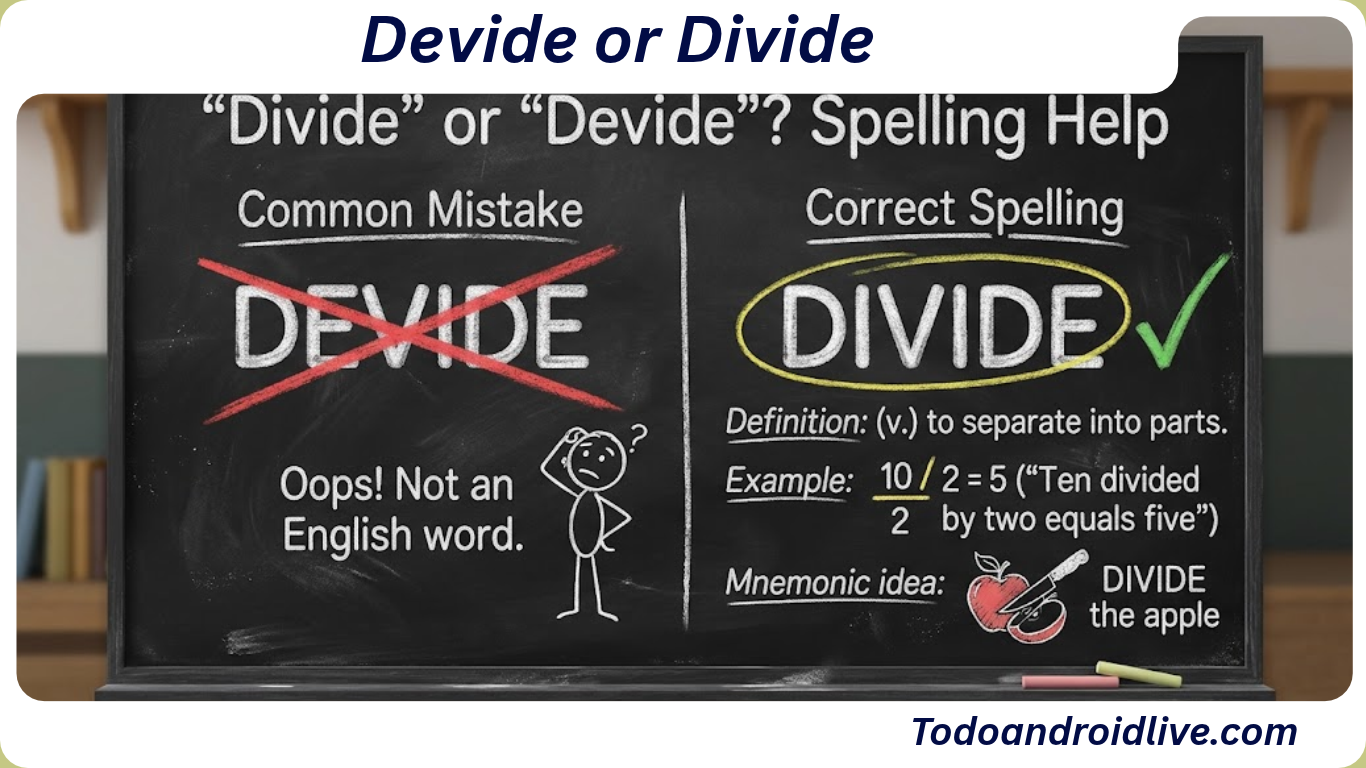
Are you confused about whether to write devide or divide? The correct spelling is divide, while devide is a common spelling mistake.
The word divide means to separate something into parts, share items among people, or perform a mathematical calculation.
In this guide, you’ll learn the meaning, definition, verb forms, synonyms, and sentence examples of divide, along with simple math examples to help you understand its correct usage.
Devide or Divide: Which Spelling Is Correct?
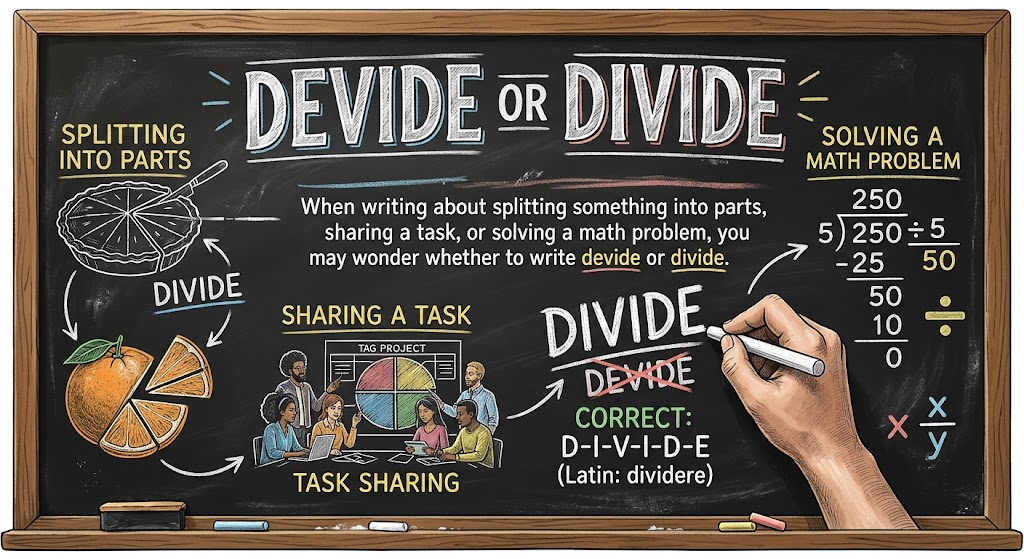
When writing about splitting something into parts, sharing a task, or solving a math problem, you may wonder whether to write devide or divide. The correct spelling is divide. The spelling devide is a common misspelling and should not be used in standard English.
The confusion often happens because the sounds of certain English words can make their spelling difficult to remember. Words such as device, decide, and divide may look or sound similar to learners, but they have different meanings and spellings.
Understanding the correct form is useful in school assignments, emails, business documents, mathematical explanations, and online writing. It also helps you recognize related forms such as divided, dividing, and divides.
This guide explains the meaning and definition of divide, its verb forms, its Latin origin, its noun and adjective forms, and how to use it correctly in sentences. You will also find math examples, spelling tips, and answers to common questions about devide and divide.
Devide or Divide: Quick Answer
Divide is the correct spelling in standard English. Devide is an incorrect spelling of the word.
Use divide when you mean to separate something into smaller parts, distribute something among people, or calculate how many times one number fits into another.
Examples:
- Correct: Please divide the pizza into eight slices.
- Incorrect: Please devide the pizza into eight slices.
- Correct: We need to divide the expenses equally.
- Incorrect: We need to devide the expenses equally.
- Correct: Divide 24 by 6 to get 4.
- Incorrect: Devide 24 by 6 to get 4.
Remember that the correct spelling contains the letters d-i-v-i-d-e. The first vowel after the initial d is i, not e.
What Does Divide Mean?
The word divide has several related meanings. Its exact meaning depends on the sentence and the situation in which it appears.
1. To Separate Something Into Parts
Divide can mean to split one thing into two or more sections.
Also Read: Unattentive or Inattentive: Correct Spelling, Meaning, Examples, and ADHD Differences
Examples:
- Divide the paper into four equal sections.
- A fence divides the garden from the driveway.
- The river divides the two towns.
In these sentences, divide describes a separation between parts, areas, or objects.
2. To Share Something Among People
Divide can also mean to distribute an amount or a responsibility among several people.
Examples:
- We will divide the bill between four friends.
- The manager divided the assignments among the employees.
- They decided to divide the profits equally.
Here, the word focuses on sharing or distributing something.
3. To Perform a Mathematical Calculation
In mathematics, divide means to determine how many equal groups can be made from a number or how much belongs in each group.
For example:
24 ÷ 6 = 4
This means that 24 divided by 6 equals 4.
The same word appears in classroom instructions, calculators, textbooks, and mathematical problems.
4. To Create a Difference or Disagreement
Divide can also describe a disagreement between people or groups.
Examples:
- The proposal divided the community.
- Different opinions divided the committee.
- The issue continues to divide voters.
In these examples, divide refers to disagreement rather than physical separation.
Divide Definition and Part of Speech
The standard definition of divide is to separate something into parts, groups, or sections, or to distribute it among people or things.
Divide is primarily a verb. A verb expresses an action, process, or state.
Examples:
- Please divide the books into three groups.
- The teacher divides the class into teams.
- We divided the money equally.
- They are dividing the work fairly.
The word can describe a physical action, a mathematical operation, or an abstract process.
Is Divide a Verb?
Yes. Divide is a verb in its base form.
It can be used with an object, as in “divide the cake,” or in certain constructions without a directly stated object, as in “the road divides.”
The verb can appear in different tenses:
- Present: I divide the tasks.
- Third-person singular: She divides the tasks.
- Past: She divided the tasks yesterday.
- Present participle: She is dividing the tasks now.
These forms express when an action happens or how it relates to the rest of a sentence.
Is Divided a Verb?
Yes. Divided can function as the simple past tense or the past participle of divide. It can also appear as an adjective.
Examples:
- Verb, past tense: We divided the cake yesterday.
- Verb, past participle: The cake has been divided into six pieces.
- Adjective: The divided opinion made the decision difficult.
Its grammatical role depends on how it is used in the sentence.
Divide Verb Forms: V1, V2, V3, V4, and V5
The verb divide is a regular English verb. Its past tense and past participle are formed by adding -ed.
| Verb Form | Word | Example |
| V1: Base form | Divide | I divide the work. |
| V2: Past tense | Divided | I divided the work. |
| V3: Past participle | Divided | I have divided the work. |
| V4: Present participle | Dividing | I am dividing the work. |
| V5: Third-person singular | Divides | She divides the work. |
These forms are useful for English grammar exercises, writing assignments, and verb-conjugation practice.
Divide in the Present Tense
Use divide with I, you, we, and they in the simple present. Use divides with he, she, and it.
Examples:
- I divide my time between work and study.
- You divide the ingredients into equal portions.
- We divide the responsibilities fairly.
- They divide the class into groups.
- He divides the money equally.
- She divides the report into sections.
The main rule is simple: add -s to divide when the subject is third-person singular in the simple present tense.
Divide in the Past Tense
The past tense of divide is divided.
Examples:
- We divided the project into three stages.
- She divided the apples among the children.
- The teacher divided the students into pairs.
- They divided the land into smaller plots.
Because divide is a regular verb, its past tense follows the standard -ed pattern.
Divide in the Future Tense
Use will divide to describe an action that will happen in the future.
Examples:
- We will divide the costs next week.
- The teacher will divide the students into groups.
- They will divide the work after the meeting.
The base form divide follows will, not divided or divides.
Divide in the Continuous Tense
Use dividing with a suitable form of the verb be.
Examples:
- I am dividing the documents into folders.
- She is dividing the class into teams.
- They were dividing the budget when the meeting ended.
The -ing form shows an action that is ongoing or was ongoing at a particular time.
Past Participle of Divide
The past participle of divide is divided.
It is used with auxiliary verbs such as have, has, had, and be.
Examples:
- I have divided the money into equal amounts.
- She has divided the chapter into sections.
- They had divided the work before the deadline.
- The property was divided among the family members.
Do not confuse the past participle with the present participle. Divided is the past participle, while dividing is the present participle.
Divide Meaning in Math: Devided by 3, 6, and Other Numbers
People sometimes search for phrases such as “24 devided by 3” or “6 devided by 4” when looking for a mathematical answer. In correct English, the word is divided, as in “24 divided by 3.”
Division is one of the four basic arithmetic operations, along with addition, subtraction, and multiplication.
A division problem usually contains three important parts:
- Dividend: The number being divided.
- Divisor: The number you divide by.
- Quotient: The answer to the division problem.
For example, in 24 ÷ 3 = 8, the dividend is 24, the divisor is 3, and the quotient is 8.
Common Division Examples
| Search Phrase | Correct Math Expression | Answer |
| 24 devided by 3 | 24 ÷ 3 | 8 |
| 6 devided by 4 | 6 ÷ 4 | 1.5 |
| 5 devided by 3 | 5 ÷ 3 | 1.666… |
| 24 devided by 6 | 24 ÷ 6 | 4 |
| 2 devided by 3 | 2 ÷ 3 | 0.666… |
| 4 devided by 3 | 4 ÷ 3 | 1.333… |
| 8 devided by 3 | 8 ÷ 3 | 2.666… |
| 36 devided by 3 | 36 ÷ 3 | 12 |
| 3 devided by 2 | 3 ÷ 2 | 1.5 |
| 3 devided by 4 | 3 ÷ 4 | 0.75 |
| 4 devided by 6 | 4 ÷ 6 | 0.666… |
| 3 devided by 5 | 3 ÷ 5 | 0.6 |
| 63 devided by 9 | 63 ÷ 9 | 7 |
| 30 devided by 5 | 30 ÷ 5 | 6 |
| 56 devided by 2 | 56 ÷ 2 | 28 |
| 7 devided by 3 | 7 ÷ 3 | 2.333… |
| 6 devided by 5 | 6 ÷ 5 | 1.2 |
| 9 devided by 11 | 9 ÷ 11 | 0.818181… |
The repeated decimal dots indicate that the decimal continues. Some answers can also be written as fractions.
For example, 5 ÷ 3 is exactly 5/3, or 1⅔. Writing it as 1.67 gives an approximation rounded to two decimal places.
What Is 1 Divided by 0?
Division by zero is undefined in ordinary arithmetic.
For example:
1 ÷ 0 = undefined
There is no number that can serve as the answer because multiplying any number by zero gives zero, not one.
This is different from dividing zero by a nonzero number:
0 ÷ 5 = 0
The distinction is important when solving math problems or using a calculator.
How Do You Divide Numbers?
A simple way to understand division is to think about equal groups.
Suppose you have 24 cookies and want to share them equally among six children. Each child receives four cookies because 24 ÷ 6 = 4.
For larger numbers, you can use long division. This method involves dividing, multiplying, subtracting, and bringing down the next digit until you reach the answer or a remainder.
For decimal answers, you may continue the calculation beyond the decimal point. For some problems, a fraction is a more exact way to express the result.
Divide in a Sentence: Examples and Usage
Learning the correct spelling is only the first step. It is also useful to see how divide works in different types of sentences.
Everyday English Examples
- Please divide the sandwich into two equal parts.
- We should divide the household chores fairly.
- The wall divides the living room from the kitchen.
- They agreed to divide the prize money.
- You can divide the books by subject.
Academic and Professional Examples
- The researcher divided the participants into two groups.
- The report divides the findings into four categories.
- The supervisor will divide the workload among the team members.
- The accountant divided the annual expenses by department.
- The study examines the factors that divide public opinion.
Math Sentence Examples
- Divide 36 by 3 to get 12.
- The student divided 63 by 9 and found the answer.
- If you divide 30 by 5, the quotient is 6.
- Divide the numerator by the denominator when converting a fraction to a decimal.
How to Form a Sentence With Divide
A common sentence pattern is:
Also Read:Braves vs Nationals: 2026 Scores, Stats, Results & Season Breakdown
Subject + divide + object.
Example: We divide the assignments.
You can add more information to explain how, when, or why the action happens.
Example: We divide the assignments equally among the four team members.
Another useful pattern is:
Subject + divide + object + into + parts or groups.
Example: The teacher divided the students into five groups.
When describing mathematical operations, use divide by.
Example: Divide 56 by 2 to get 28.
Divide Synonyms: Other Words for Divide
The best synonym for divide depends on what you want to express. Some words describe physical separation, while others refer to sharing or disagreement.
| Synonym | Meaning | Example |
| Split | Separate into parts | Split the sandwich in half. |
| Separate | Keep things apart | Separate the clean clothes from the dirty ones. |
| Partition | Divide an area or object into sections | The wall partitions the office. |
| Distribute | Give portions to different people | Distribute the papers among the students. |
| Share | Give or use something together | Share the expenses equally. |
| Allocate | Assign resources for a purpose | Allocate the budget to each department. |
| Segment | Divide into distinct sections | Segment the audience by age group. |
| Disperse | Spread people or things over an area | The wind dispersed the leaves. |
| Classify | Arrange into categories | Classify the documents by type. |
| Disunite | Cause people to become less united | The disagreement threatened to disunite the group. |
These words are not interchangeable in every sentence. For example, distribute may fit a situation involving money or materials, while segment is often suitable for dividing data or an audience into categories.
Divide Noun Form: What Is the Noun of Divide?
The most direct noun form of divide is division.
Division refers to the act of separating something, the result of separation, or a mathematical operation.
Examples:
- The division of the land took several months.
- Division is an important part of elementary mathematics.
- The company announced a new division.
- The political division affected the community.
In mathematics, division names the operation used to calculate a quotient.
In other contexts, division can refer to a disagreement, a section of an organization, or the separation of something into parts.
Is Divid a Word?
Divid is not the standard modern English base form of the verb. The correct word is divide.
However, divid- can be discussed as a word root or stem in explanations of word formation. The Latin verb dividere is historically related to English divide.
If you are writing a normal English sentence, use divide rather than divid.
What Is the Abstract Noun of Divide?
Division is the usual noun form associated with divide. It can describe an action or process, such as the division of a task, and an abstract result, such as division between two groups.
Example: The division between the teams became more noticeable after the debate.
The related adjective divisive describes something that tends to create disagreement or separation.
Example: The divisive proposal caused a heated discussion.
Adjective Form of Divide
The adjective most directly related to divide depends on the intended meaning.
Divided
Divided describes something that has been separated or people who disagree.
Examples:
- The divided road has two lanes.
- The committee remained divided on the proposal.
- The class was divided into smaller groups.
Divisible
Divisible means that something can be divided, often without a remainder in mathematics.
Examples:
- Twelve is divisible by three.
- Twenty is divisible by five.
- The amount is divisible into four equal shares.
Divisive
Divisive describes something that causes disagreement or separation between people.
Examples:
- The divisive issue led to a long debate.
- The decision proved divisive among employees.
Although these words share a connection with divide, they have different meanings and grammatical uses.
Divide Etymology: Where Does the Word Come From?
The English word divide comes from Latin dividere, meaning to separate or split. It entered English through French, ultimately developing from the Latin form.
The Latin word is associated with the idea of separating something into parts. That basic meaning remains in modern English.
The historical origin also helps explain related English words, including division and divisive.
Latin for Divide
The Latin verb is dividere. It means to divide or separate.
The Latin form differs from the modern English spelling, but the relationship is clear when you compare the words:
- Latin: dividere
- English verb: divide
- English noun: division
- English adjective: divisible
The spelling devide does not represent the standard English word or its accepted modern form.
How Many Syllables Are in Divide?
Divide has two syllables:
di-vide
The word is commonly pronounced /dɪˈvaɪd/ in American English, with the main stress on the second syllable.
The final e is silent, and the vowel sound in the second syllable is the long i sound, as in the word time.
Breaking the word into syllables can help learners remember its spelling and pronunciation.
Divide vs. Device, Devise, and Divine
Some spelling errors happen because different words look similar. Understanding their meanings can help you avoid confusion.
| Word | Part of Speech | Meaning | Example |
| Divide | Verb | Separate into parts | Divide the cake into slices. |
| Device | Noun | A tool or piece of equipment | She bought a new electronic device. |
| Devise | Verb | Plan or invent something | They devised a new strategy. |
| Divine | Adjective or verb | Related to a deity; or discover through intuition | The dessert tasted divine. |
Divide and device are especially easy to confuse because they contain many of the same letters. However, device ends in -ice, while divide ends in -ide.
Devise is a real English word, but it means to plan or create something. It does not mean to separate something into parts.
Divine has a different meaning as well. It can describe something connected with a god or deity, or it can be used as a verb meaning to discover or guess something through intuition.
The correct choice depends on the meaning you intend to communicate.
Common Spelling Mistakes Related to Divide
Besides devide, writers sometimes produce other incorrect forms when typing quickly or relying on sound.
Divided or Devided
Divided is correct. Devided is a misspelling.
Correct: The students divided the work into three parts.
Incorrect: The students devided the work into three parts.
Divide or Divideed
Divideed is incorrect. The past tense is divided, formed by adding -d to the base form because the word already ends in e.
Correct: They divided the money equally.
Incorrect: They divideed the money equally.
Divide or Divied
Divied is not the standard spelling of the verb’s past tense. Use divided.
Correct: She divided the class into four groups.
Incorrect: She divied the class into four groups.
Divides or Dividies
The correct third-person singular form is divides.
Correct: The road divides the town into two areas.
Incorrect: The road dividies the town into two areas.
Dividing or Devideing
The correct -ing form is dividing.
To form it, remove the final e and add -ing.
Divide → dividing
Correct: He is dividing the materials into separate piles.
Incorrect: He is devideing the materials into separate piles.
Also Read:Cancel or Cancell: Correct Spelling, Meaning, Definition, and Usage (2026)
How to Remember the Correct Spelling of Divide
You do not need to memorize a complicated rule to spell divide correctly. A few simple techniques can help.
1. Remember the First Vowel
The word begins with di-, not de-.
Think of the spelling as d-i-v-i-d-e. If you remember the first i, you can avoid the common error devide.
2. Connect Divide With Division
The words divide and division share a historical root and a similar spelling pattern.
For example:
- Divide the cake.
- Make a division problem.
- Calculate the result.
Thinking of division may help you recall the correct spelling of divide.
3. Practice With Short Sentences
Write a few simple sentences using the word:
- Divide the apples equally.
- Divide 24 by 6.
- We divide the tasks fairly.
- She divided the paper into sections.
Repeated use can make the spelling easier to remember.
4. Check the Word Before Publishing
Use a spellchecker or dictionary when you are unsure about a word. Spellcheck tools can catch many errors, although they may not detect every mistake.
For important schoolwork, business writing, or published content, review the full sentence rather than relying only on automatic correction.
Frequently Asked Questions About Devide or Divide
How do you spell divide correctly?
The correct spelling is divide: D-I-V-I-D-E. Devide is a misspelling. Use divide when describing separation, distribution, or a mathematical operation.
Is devided the past tense of divide?
No. The correct past tense is divided. For example, “We divided the cake into six pieces.” The spelling devided is incorrect.
What is the difference between divide and divided?
Divide is the base form of the verb, while divided is its past tense and past participle. Use divide for the base form and divided for completed past actions or perfect and passive constructions.
What is the difference between divide and division?
Divide is a verb that describes separating something into parts or performing a mathematical operation. Division is a noun that names the action, process, or mathematical operation.
What is the V1, V2, and V3 form of divide?
The V1 form is divide, the V2 form is divided, and the V3 form is also divided. Divide is a regular verb, so its past tense and past participle use the -ed spelling pattern.
What is 24 divided by 3?
Twenty-four divided by three equals eight. The correct mathematical expression is 24 ÷ 3 = 8.
What is 6 divided by 4?
Six divided by four equals 1.5, or 1½. It can also be written as the fraction 6/4, which simplifies to 3/2.
Conclusion
The correct spelling is divide, not devide. Divide is a regular verb that means to separate something into parts, distribute it among people, or perform a mathematical calculation.
Its main verb forms are divide, divided, divided, dividing, and divides. The related noun is division, while adjectives such as divided, divisible, and divisive express different related meanings.
In mathematics, phrases such as “24 devided by 3” should be written as “24 divided by 3,” which equals 8. Remember that division by zero is undefined, while zero divided by a nonzero number equals zero.