

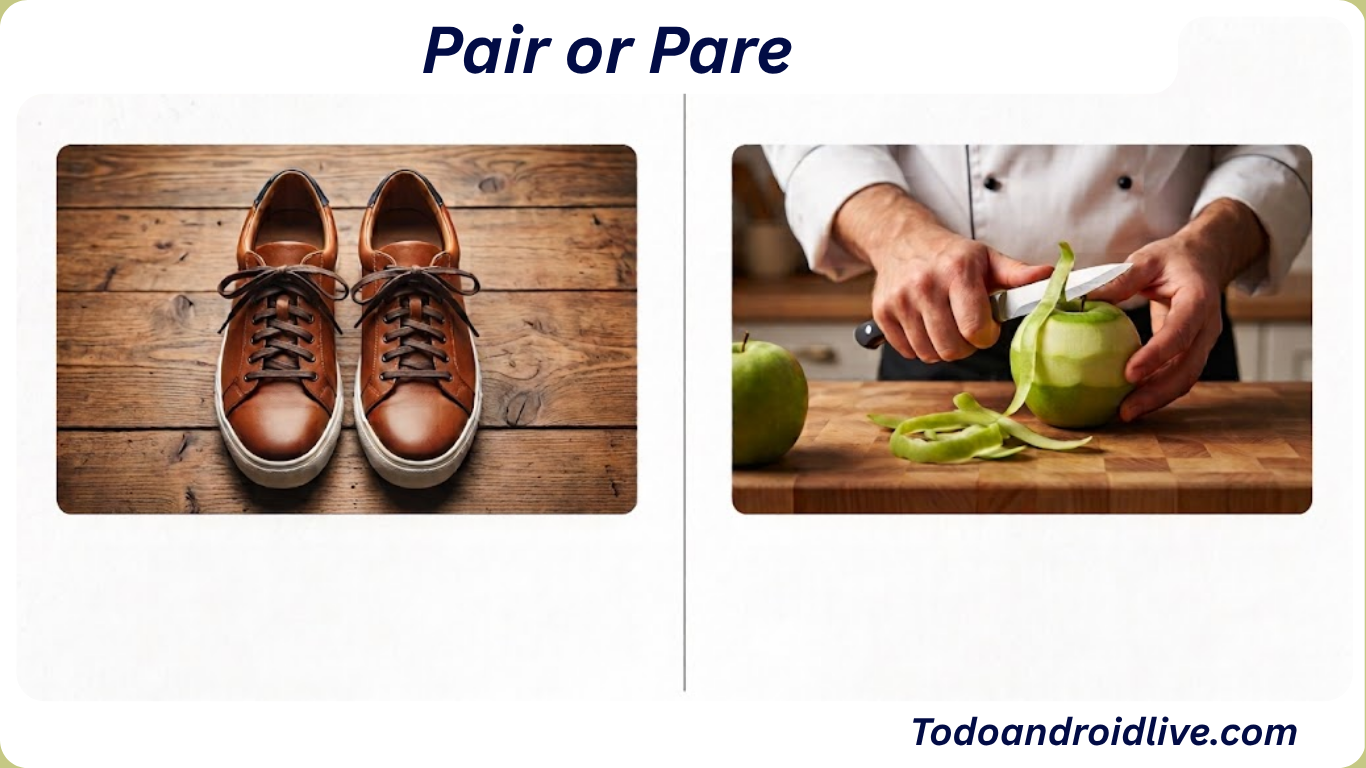
Confusing pair or pare is one of the most common spelling mistakes in written English. Because these two terms sound identical, spell-check software often fails to flag them when they are swapped. However, using the wrong term changes the whole meaning of your sentence.
Whether you are deciding between pair or pare for a business document, financial report, or everyday writing, this complete guide breaks down their definitions, origins, phrasal usages, and practical memory tricks so you can confidently pick the right word every time.
Quick Answer: Pair or Pare?
The primary difference when choosing between pair or pare comes down to function and intent:
- Pair refers to two matching items, a set of two components, or the act of joining two people or objects together.
- Pare is an action verb that means to trim, peel away, shave off, or reduce something down gradually.
+—————————————————————–+
| QUICK MEMORY GUIDE: PAIR OR PARE |
+—————————————————————–+
| PAIR -> “AI” = Assembly & Integration (Putting two together) |
| PARE -> “RE” = Reduce & Eliminate (Cutting away or trimming) |
+—————————————————————–+
Detailed Meaning and Grammar Rules
Understanding “Pair”
The word pair functions as both a noun and a verb. It always involves the concept of two items or individuals working as a unit or forming a matching set.

Pair as a Noun
As a noun, it describes two identical, complementary, or connected items intended to be used together.
- A custom pair of leather boots completed the outfit.
- Every member received a pair of safety goggles.
- They make a wonderful pair on stage.
Special Noun Rules: Plural Forms and Countability
Some single objects are always spoken of in the plural form because they consist of two identical, connected parts (like trousers, scissors, or glasses). In grammar, these are treated as plural unless preceded by the term pair of.
- These scissors are sharp.
- This pair of scissors is sharp.
When referring to multiple sets, the standard plural form is pairs.
- Three pairs of clean socks remained in the drawer.
Pair as a Verb
As a verb, it means to unite, link, align, or group two people or objects together.
- The software allows you to pair your wireless headphones to your laptop.
- Instructors often pair students with different skill levels to encourage collaborative learning.
Understanding “Pare”
The word pare functions exclusively as a verb. It relates directly to cutting, shaving, trimming, or systematically downsizing.
Also Read: Maxed or Maxxed: Complete Spelling, Grammar, and Word Meaning Guide
Pare in Literal Contexts
In physical contexts, it means removing the outer coating, edge, or skin of an object using a sharp edge or hand tool.
- Use a paring knife to pare the tough outer skin of the butternut squash.
- Artisans carefully pare thin strips of leather before stitching the seams together.
Pare in Figurative Contexts
In business, finance, and daily organization, it describes reducing volume, lowering expenses, or simplifying complex systems.
- Management must pare operational costs before the next fiscal quarter.
- Editors work to pare redundant word choices from long manuscript articles.
Etymology: Where Do These Words Come From?
Understanding historical origins provides strong context for why choosing pair or pare involves two very distinct linguistic roots.
LATIN ORIGINS:
– Paria (“Equals” or “Alike”) –> Old French (Paire) –> PAIR
– Parare (“Prepare” or “Trim”) –> Old French (Parer) –> PARE
- Pair: Originates from the Latin term paria, meaning “equal items” or “things that are alike.” It moved into Middle English through Old French as paire. The core concept of balance and dual equality has remained intact for centuries.
- Pare: Traces back to the Latin verb parare, which originally meant “to prepare” or “make ready.” Over centuries, its meaning narrowed to preparing raw ingredients or materials by shaving away skin, rind, or excess material.
Common Phrasal Verbs: Pair or Pare?
Misunderstanding phrasal combinations creates confusion in business reports, editorial copy, and everyday writing. Here is how each word behaves inside common idioms so you know whether to write pair or pare.
Correct vs. Incorrect Formats
Pare Down vs. Pair Down
- Pare down (Correct): Means to reduce, streamline, or strip away unnecessary parts until only the essential elements remain.
- Example: The project manager decided to pare down the timeline.
- Pair down (Incorrect): This is a frequent spelling mistake. Unless you are describing an action involving a matching set moving downward, this usage is grammatically incorrect.
Pare Back vs. Pair Back
- Pare back (Correct): Means to trim down budgets, scale back operations, or shrink commitments.
- Example: The agency had to pare back its quarterly advertising spend.
- Pair back (Incorrect): Non-standard. Always use pare back when discussing cost reductions or scaling down operations.
Pair Up vs. Pare Up
- Pair up (Correct): Means to partner, team up, or group people into sets of two.
- Example: Athletes were instructed to pair up for the drill.
- Pare up (Incorrect): Non-standard and incorrect. The verb pare implies cutting down, which directly conflicts with the concept of teaming up.
American English vs. British English Standards
Unlike words with regional variations (like color/colour or analyze/analyse), deciding between pair or pare involves identical spellings, definitions, and pronunciations across standard international dialects:
- American English (US)
- British English (UK)
- Canadian English
- Australian English
Whether preparing documentation for an audience in London, New York, Toronto, or Sydney, the usage rules stay identical: match your choice strictly to search intent and core meaning.
Sentence Examples Across Different Contexts
Seeing these words in distinct settings helps solidify proper usage across various industries when deciding whether to write pair or pare.
Business and Finance
- Executives decided to pare non-essential overhead to maintain profit margins.
- Analysts recommend that investors pair high-risk growth assets with stable treasury bonds.
- Financial planners advise clients to pare down debt before making major capital investments.
Culinary Arts and Food Preparation
- Chefs use small, sharp blades to pare apples, pears, and citrus peels quickly.
- Pair this dry red wine with aged cheddar cheese for the best flavor balance.
Technology and Consumer Electronics
- The mobile application makes it easy to pair your smart device via Bluetooth connection.
- System engineers continue to pare unused code from the firmware update to lower memory footprint.
Fashion and Apparel
- She selected a stylish pair of sunglasses for the trip.
- Wardrobe consultants suggest clients pare down their closets to versatile core pieces.
Pair or Pare Quick Comparison Matrix
| Feature | Pair | Pare |
| Part of Speech | Noun, Verb | Verb |
| Primary Meaning | A set of two; to join two components together | To cut away, peel, trim, or gradually reduce |
| Core Concept | Combination, dual structure, assembly | Reduction, downsizing, subtraction |
| Physical Application | Two shoes, a set of gloves, pairing a device | Paring an apple, trimming fingernails |
| Business Application | Pairing team members, forming strategic partnerships | Paring costs, paring back operational budgets |
| Common Phrasal Form | Pair up, pair with | Pare down, pare back |
| Key Antonym Idea | Separate, disconnect, divide | Expand, inflate, enlarge, add to |
Top 100 Genuinely Relevant Synonyms
To help expand your vocabulary and improve writing variety, here is a categorized list of up to 100 accurate synonyms and related terms for pair and pare.
Synonyms for “Pair” (As a Noun: A Set of Two)
- Duo
- Couple
- Twosome
- Dyad
- Brace
- Match
- Set of two
- Doublet
- Twin
- Combination
- Partnership
- Team
- Span (used for draft animals)
- Yoke (used for oxen)
- Tandem
Synonyms for “Pair” (As a Verb: Joining Together)
- Match
- Couple
- Connect
- Link
- Join
- Unite
- Team up
- Partner
- Combine
- Align
- Associate
- Bracket
- Bind
- Attach
- Merge
- Tie
- Mipmap (tech pairing contexts)
- Fuse
- Ally
- Network
- Synchronize
- Interface
- Group
- Yoke
- Bridge
Synonyms for “Pare” (Literal Trimming and Peeling)
- Peel
- Trim
- Skin
- Shave
- Whittle
- Clip
- Crop
- Strip
- Bark
- Flay
- Slice
- Shear
- Scrape
- Hull
- Decorticate
- Rind
- Whittling away
- Prune
- Lop
- Snip
Synonyms for “Pare” (Figurative Reduction and Cost Cutting)
- Reduce
- Downsize
- Cut
- Decrease
- Slash
- Lower
- Shrink
- Curtail
- Simplify
- Streamline
- Minimize
- Deduce
- Condense
- Retrench
- Scale down
- Whittle down
- Discount
- Economize
- Subtract
- Diminish
- Moderate
- Contract
- Abate
- Drop
- Compress
- Squeeze
- Chop
- Prune back
- Trim back
- Taper
- Limit
- Restrict
- Erode
- Deplete
- Narrow down
- Shave off
- Cut down
- Mitigate
- Lessen
- Ax
Incorrect vs. Correct Usage Examples
Reviewing real-world corrections is one of the most effective ways to avoid mistakes when choosing pair or pare in your own writing.
Also Read: Emerse or Immerse: Correct Spelling, Meanings, and Usage Guide
- Incorrect: We need to pair down our expenses before the month ends.
- Correct: We need to pare down our expenses before the month ends.
- Incorrect: He bought a brand new pare of running shoes.
- Correct: He bought a brand new pair of running shoes.
- Incorrect: Please pare the Bluetooth keyboard with your tablet interface.
- Correct: Please pair the Bluetooth keyboard with your tablet interface.
- Incorrect: The chef began to pair the peaches before baking the pie.
- Correct: The chef began to pare the peaches before baking the pie.
- Incorrect: The management team decided to pair back overhead liabilities.
- Correct: The management team decided to pare back overhead liabilities.
Frequently Asked Questions
Is it “pair or pare” of shoes?
When asking whether to use pair or pare for footwear, the correct choice is pair of shoes. Because shoes come in a set of two matching items designed to work together, you must always use the word pair.
What does the phrase “pare down” mean?
The expression pare down means to reduce, lessen, or simplify something by removing excess components, unnecessary details, or unwanted expenses step by step.
Can “pair” be used as an action verb?
Yes. When used as an action verb, pair means to connect, combine, or group two people, objects, or concepts together (e.g., Please pair your wireless headphones with the device).
Is “pare” only used when cooking?
No. While pare frequently describes peeling or trimming fruits and vegetables, it is equally common in corporate communications, personal budgeting, and publishing to describe cutting back costs, shortening manuscripts, or streamlining processes.
Why do spellcheck tools struggle with pair or pare?
Because both pair and pare are real, correctly spelled English words, standard spellcheck applications cannot always detect when the wrong term has been used. The tool sees a valid word and moves on, which makes understanding the underlying context and rules essential.
Is “pear” related to pair or pare?
No. While pear is a homophone that sounds identical to both terms, it refers strictly to the sweet, bell-shaped fruit. It has no grammatical or functional connection to joining items or trimming costs.
What is a paring knife?
A paring knife is a small, versatile kitchen knife with a narrow blade designed specifically to pare, peel, trim, and perform detailed, delicate cutting tasks on fruits and vegetables.
Conclusion: Mastering “Pair or Pare”
Choosing between pair or pare comes down to one simple question: Are you bringing two things together, or are you cutting something away?
- Use pair when talking about two matching items, joining two components, or working in a set of two (e.g., a pair of shoes, pair your Bluetooth device, pair up for a project).
- Use pare when describing trimming, peeling, cutting back, or reducing expenses and details (e.g., pare an apple, pare down the budget, pare back operations).
By remembering that pair means two together and pare means trim or reduce, you will always pick the correct word in your business communications, academic writing, and everyday content.