

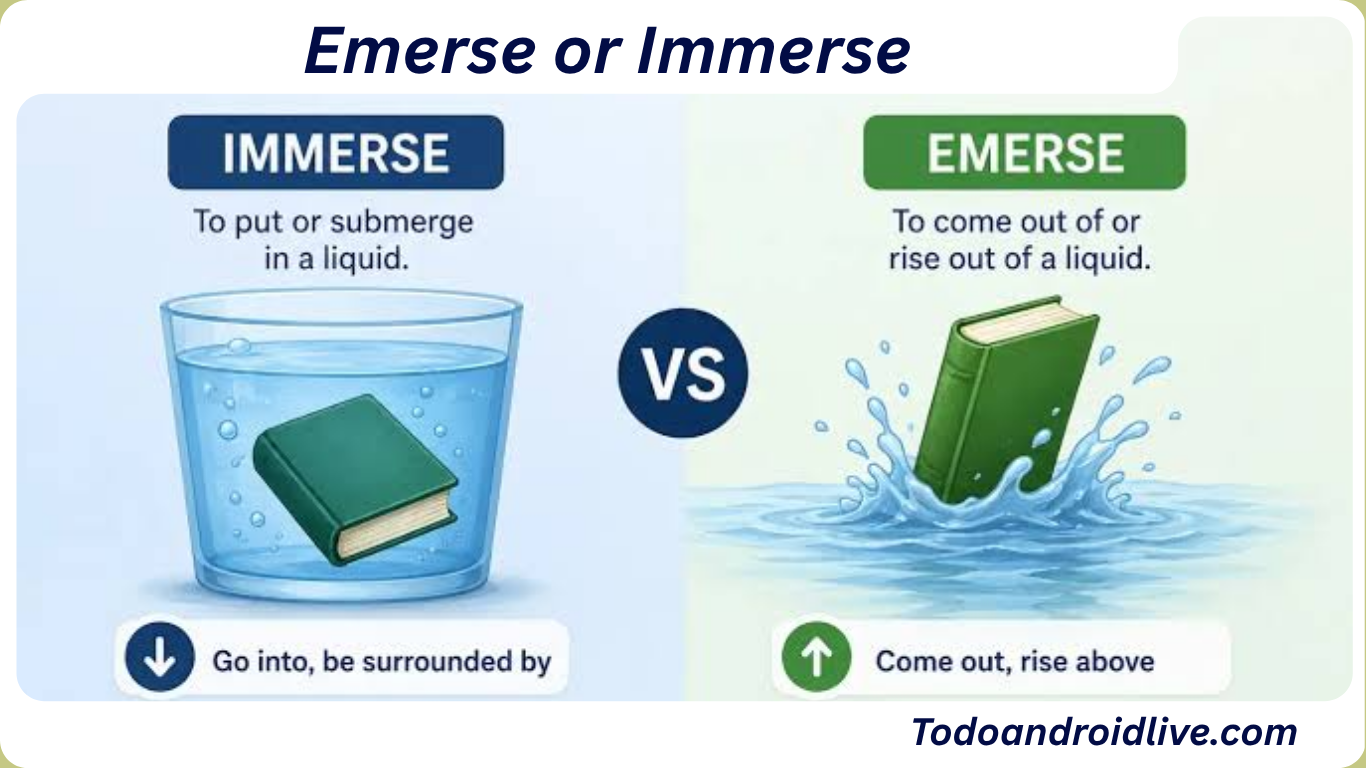
Stopping mid-sentence to wonder whether to write emerse or immerse is a common slip for writers, students, and professionals alike. Because both words share similar sounds and Latin roots, it is easy to assume they are interchangeable variations—much like regional spellings in English. However, picking the wrong form can make an otherwise polished sentence look incorrect.
This guide delivers a fast, definitive answer to clear up the confusion between emerse or immerse, explains why the mistake happens, and breaks down the exact contexts where each term belongs.
The Short Answer: Which Spelling Is Correct?
When deciding between emerse or immerse, the choice is straightforward: immerse is the correct, standard word in modern English.
Whether you are writing an email, an academic paper, or a professional article, immerse is the only accepted spelling when you mean to plunge something into liquid or to involve someone deeply in an activity.
In contrast, emerse is non-standard, outdated, and treated as a spelling mistake in standard English dictionaries. While emerse appears in historical texts or specific botanical concepts, it is not used in general writing.
- Correct: The language school allows students to immerse themselves in daily conversation.
- Incorrect: The language school allows students to emerse themselves in daily conversation.

Why Do People Confuse Emerse and Immerse?
Spelling confusion between these two letter patterns happens frequently. Understanding why this mix-up occurs makes it much easier to avoid.
Phonetic Similarity and Pronunciation Slurring
In spoken English, unstressed vowels at the start of words often blend together into an indistinct schwa sound. When native speakers say immerse quickly, the initial i sound can sound almost identical to an e. Unaware writers spell the word phonetically based on what they hear, leading to the mistake.
Confusion with “Emerge”
Another major source of confusion is the common verb emerge, which means to come out into view, rise out of a substance, or become apparent. Because emerge starts with e-m-e-r, writers assume that its opposite action—going into something—must be spelled emerse.
Related Botanical and Technical Terminology
In botany and aquatic ecology, researchers use the term emersed to describe plants that grow rooted underwater with stems or leaves extending above the surface. Seeing technical terms like emersed plants or emersion leads people to assume that emerse must be a standard verb for general writing.
Word Origins and Etymology
Looking at the Latin roots of these words reveals why they developed distinct forms.
The Origin of Immerse
The word immerse entered the English language in the early 1600s directly from the Latin verb immergere.
- Prefix: in- (meaning in, into, or upon)
- Root: mergere (meaning to dip, plunge, or sink)
Combined, immergere literally means to dip or plunge into a fluid. Over the centuries, English speakers expanded this physical concept into figurative meanings, such as diving completely into a topic, culture, or project.
The Origin of Emerse and Emersion
The rarely used form emerse derives from a different Latin verb, emergere.
- Prefix: ex- or e- (meaning out of or away from)
- Root: mergere (meaning to dip, plunge, or sink)
Emergere means to rise out of water or emerge from darkness. Historically, emerse was occasionally used as a direct opposite to immerse. Over time, however, English dropped emerse as a verb and kept emerge instead.
The noun form emersion survived in specialized fields, such as astronomy (referring to a celestial body coming out of an eclipse) and marine biology (referring to low tide exposing aquatic life).
How to Use “Immerse” Correctly (With Examples)
The verb immerse functions in two main contexts: physical dipping and mental or emotional involvement.
Physical Meaning: Submerging in Liquid
In a physical sense, to immerse means to lower something completely into liquid so that it is covered.
- The chef will immerse the vegetables in ice water to stop the cooking process.
- To clean the equipment properly, fully immerse the detachable parts in soapy water.
- The diver took a deep breath before he immersed himself in the cold lake.
Figurative Meaning: Deep Involvement or Absorption
In a figurative sense, to immerse means to absorb oneself entirely in an activity, subject, surroundings, or interest.
- To master a new skill, you must immerse yourself in consistent daily practice.
- The historical novel immerses readers in eighteenth-century life.
- During her research trip, the scientist chose to immerse herself in local customs.
The Technical Meaning of “Emersed” in Botany and Aquascaping
While emerse is incorrect as a standard general verb, the adjectival form emersed plays a central role in aquatic biology and aquarium keeping.
What Does “Emersed Growth” Mean?
In botany, emersed describes aquatic or semi-aquatic plants that grow with their roots underwater in saturated soil while their foliage, stems, and flowers stand above the water level.
This contrasts directly with submerged plants, which complete their entire lifecycle fully underwater.
Emersed vs Submerged Aquatic Plants
Aquarium hobbyists and aquascapers cultivate many popular aquatic species in two distinct growth forms:
- Emersed Growth: Grown above water in high-humidity environments. Leaves are often thicker, stiffer, and less prone to algae.
- Submerged Growth: Grown entirely under water inside an aquarium. Leaves are usually softer, thinner, and translucent.
| Feature | Emersed Growth | Submerged Growth |
| Environment | Roots in water, foliage in air | Entire plant under water |
| Leaf Structure | Thick, firm, waxy, hardy | Soft, delicate, flexible |
| CO2 Access | High (absorbs from atmospheric) | Limited (absorbs from dissolved) |
| Flower Production | Common and vibrant | Rare |
Popular Plants That Can Grow Emersed
Many common aquarium plants transition easily between emersed and submerged states:
- Anubias species (Anubias nana, Anubias barteri, Anubias coffeefolia)
- Bucephalandra species
- Cryptocoryne species (Cryptocoryne wendtii, Cryptocoryne parva, Cryptocoryne flamingo)
- Echinodorus species (Amazon Sword varieties, Echinodorus ozelot)
- Stem Plants (Rotala rotundifolia, Bacopa monnieri, Bacopa caroliniana, Ludwigia glandulosa, Ammania bonsai, Ammania gracilis)
- Foreground Plants (Eleocharis parvula, Monte Carlo, Staurogyne repens)
When hobbyists move an emersed plant into a submerged aquarium setup, the plant often sheds its air-adapted leaves and grows new submersed leaves. This transition period is known as adapting from emersed to submerged growth.
Immersion vs Emersion: Understanding the Noun Forms
Understanding the difference between the noun forms immersion and emersion clarifies how these root words interact.
Definition of Immersion
Immersion refers to the state of being submerged in liquid or deeply involved in an environment.
- Language Immersion: An educational method where students learn a foreign language by speaking and hearing it constantly in daily activities.
- Immersion Heater: A heating device placed directly inside a liquid container to heat water or other fluids.
- Immersion Blender: A handheld kitchen tool dipped directly into pots or bowls to puree ingredients smoothly (such as a Cuisinart or Vitamix immersion blender).
Definition of Emersion
Emersion refers to the act of emerging or coming out from being covered, submerged, or obscured.
- Astronomical Emersion: The reappearance of a star, planet, or moon after emerging from behind another celestial object during an eclipse or occultation.
- Ecological Emersion: The phase of the tide cycle when water recedes and exposes intertidal organisms to the air.
While immersion is used daily across cooking, education, and technology, emersion remains restricted to scientific and technical disciplines.
Quick Reference: Immersion vs Emersion vs Emerge
To keep these terms clear in your writing, use this comparison table:
| Term | Part | Main Meaning | Example |
| Immerse | Verb | To plunge into liquid or involve | I want to immerse myself in art. |
| Immersion | Noun | The act of dipping or absorbing | She prefers language immersion. |
| Emerge | Verb | To come out or become visible | The sun will emerge behind clouds. |
| Emersion | Noun | The act of coming out into view | Astronomers tracked moon emersion. |
| Emersed | Adjective | Rooted in water, growing above air | Anubias shows strong emersed leaf. |
| Emerse | Non-standard | Obsolete form; avoid in standard composition | Avoid in general prose. |
Common Spelling Mistakes to Avoid
Also Read: Maxed or Maxxed: Complete Spelling, Grammar, and Word Meaning Guide
To ensure your writing remains professional, avoid these common grammatical errors:
1. Substituting Emerse for Immerse
- Incorrect: The program allows participants to emerse themselves in cultural activities.
- Correct: The program allows participants to immerse themselves in cultural activities.
2. Confusing Verb Direction
Remember that immerse moves inward or downward into a medium, while emerge moves outward or upward.
- Incorrect: The whale immersed from the ocean depths.
- Correct: The whale emerged from the ocean depths.
3. Misspelling Verb Forms
Pay attention to double letters and correct endings when conjugating immerse:
- Present Tense: immerse / immerses
- Present Participle: immersing
- Past Tense: immersed
- Noun Form: immersion
Comprehensive List of Synonyms
Depending on whether you mean physical dipping, mental absorption, or emerging outward, choosing the right word improves clarity. Here is a curated list of relevant synonyms categorized by context:
Physical Submersion (Sinking into Fluid)
- Submerge
- Dip
- Plunge
- Dunk
- Douse
- Steep
- Souse
- Duck
- Soak
- Drench
- Saturate
- Submerse
- Bathe
- Inundate
- Flood
- Sink
- Lower
- Wet
- Imbrue
- Swamp
Mental and Emotional Involvement (Deep Absorption)
- Absorb
- Engage
- Engross
- Enthrall
- Captivate
- Occupy
- Fascinate
- Preoccupy
- Involve
- Consume
- Submerge
- Entangle
- Enmesh
- Wrap
- Busy
- Rivet
- Grip
- Hold
- Monopolize
- Deepen
Total Involvement and Concentration
- Focus
- Devote
- Dedicate
- Commit
- Bury
- Lose
- Sink
- Apply
- Concentrate
- Fixate
- Immerse
- Intent
- Steep
- Merge
- Assimilate
- Integrate
- Surround
- Enfold
- Embed
- Envelop
Rising Out, Emerging, and Surfacing (Opposites and Related Terms)
- Emerge
- Rise
- Surface
- Appear
- Materialize
- Arise
- Issue
- Emanate
- Expose
- Uncover
- Disengage
- Withdraw
- Extract
- Detach
- Reappear
- Exit
- Break
- Come
- Out
- Unveil
Practical Action and Contextual Alternatives
- Soaking
- Dipping
- Plunging
- Submerging
- Involving
- Absorbing
- Engaging
- Drenching
- Steeping
- Dunking
- Penetrating
- Pervading
- Permeating
- Infusing
- Impregnating
- Satiating
- Covering
- Drowning
- Overwhelming
- Encompassing
Frequently Asked Questions
Is “emerse” a real word in the dictionary?
In modern English dictionaries like Merriam-Webster or Oxford, emerse is listed as an obsolete form or omitted entirely. Dictionaries redirect readers to immerse for general usage, or to emersed for botanical contexts.
Is “emerse” acceptable in British or Commonwealth English?
No. Standard British English, Australian English, and American English all agree that immerse is the only correct spelling for general usage.
What is an immersion blender?
An immersion blender (also called a hand blender, stick blender, or cordless emersion blender) is an electric kitchen appliance with mixing blades at the end of a shaft. It is submerged directly into liquid, soup, or batter to blend ingredients smoothly without transferring them to a jug.
What is the difference between an emersed plant and a submerged plant?
An emersed plant grows rooted in wet soil or shallow water with its stems and foliage above the water surface. A submerged plant grows completely underwater. Many aquatic species can adapt to grow in either condition.
How do I remember whether to use “i” or “e”?
Use this simple memory trick:
- In starts with I -> Immerse means to go in or deep into something.
- Exit starts with E -> Emerge means to exit or rise out of something.
Conclusion
Choosing the correct word between emerse and immerse comes down to standard usage rules. Always select immerse whenever you describe putting something into liquid or becoming deeply involved in an activity, field of study, or environment. Keep emerse out of standard writing, reserving its past form, emersed, solely for botanical descriptions of plants growing above the water line.