

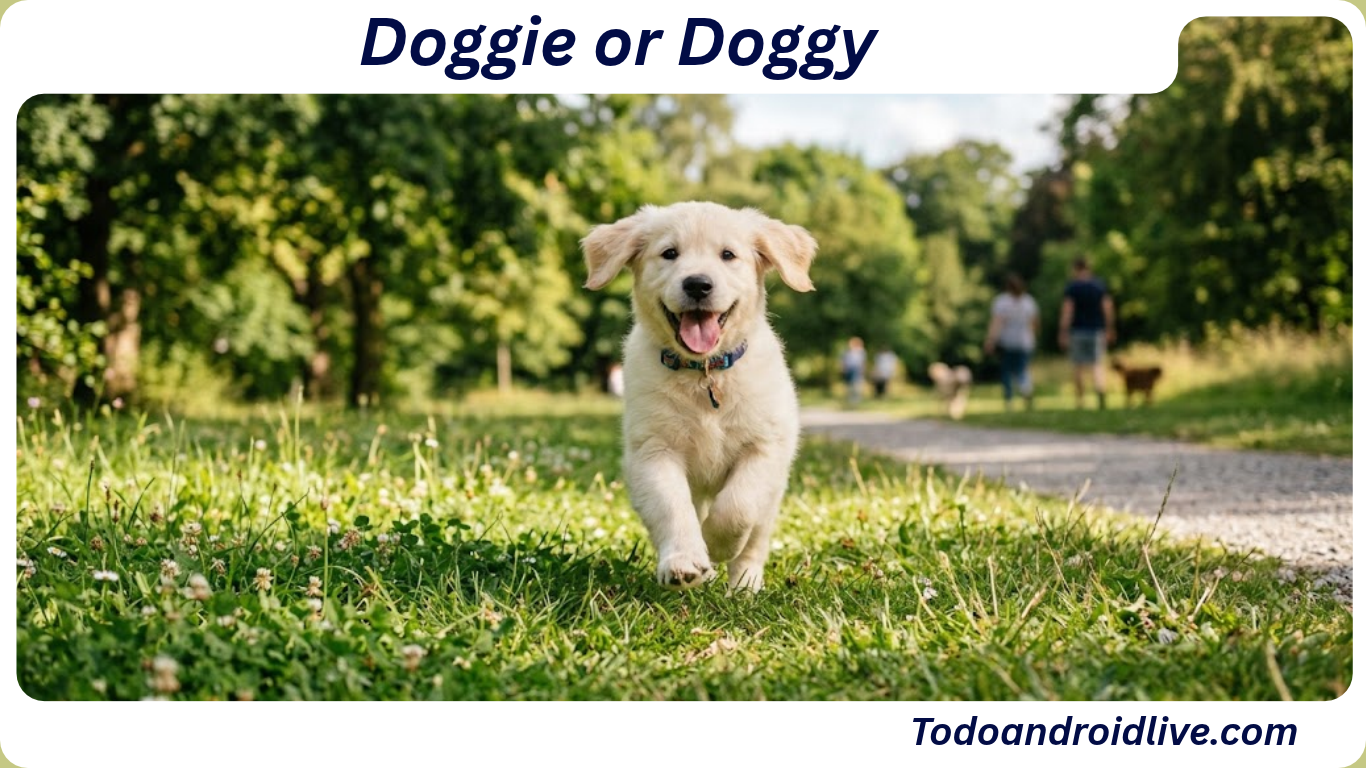
Have you ever wondered whether to write doggie or doggy when talking about a cute dog? Both spellings look natural, sound the same, and appear in everyday English. However, many writers still search for the correct spelling because they are unsure whether one version is more acceptable than the other.
The answer is simple: both doggie and doggy are correct. They are informal, affectionate words used to refer to a dog. Although they have the same basic meaning, their spelling and writing style can create slightly different impressions.
Doggy is generally the more familiar spelling in standard English usage. Doggie is also widely understood and often appears in children’s books, playful conversations, and affectionate descriptions of pets.
People search for phrases such as doggy or doggie, doggie or doggy which is correct, how to spell doggy or doggie, and is it spelled doggy or doggie because both forms are commonly used. Understanding their meanings and usage makes it easier to choose the right version.
In this guide, you will discover the difference between doggy and doggie, their definitions, origins, pronunciation, British and American English usage, and examples. You will also learn about common expressions such as doggy bag and doggy paddle, along with answers to frequently asked questions.
Doggie or Doggy: Quick Answer
Both doggie and doggy are correct English spellings. They refer to a dog in an informal, friendly, or affectionate way. Neither spelling is considered universally incorrect.
The main difference is their appearance and common usage:
- Doggy: A familiar spelling commonly used in general informal English.
- Doggie: An accepted alternative spelling that often creates a cute, playful, or child-friendly impression.
For example:
- The little doggy followed its owner into the garden.
- My daughter wants to adopt a doggie.
- Look at that adorable doggy playing with a ball.
- The doggie is sleeping beside its favorite toy.
All these sentences are correct.
Which Is Correct: Doggy or Doggie?
If you are asking which is correct, the answer is both. However, doggy is a practical choice for general writing because it is commonly used as the main dictionary spelling.
Doggie works equally well when you want a softer or more affectionate tone.
Here is a simple comparison:
| Feature | Doggy | Doggie |
| Correct spelling | Yes | Yes |
| Meaning | Informal word for a dog | Informal word for a dog |
| Pronunciation | Dog-ee | Dog-ee |
| General usage | More common | Alternative spelling |
| Tone | Friendly and casual | Cute and affectionate |
| Children’s writing | Suitable | Suitable |
| Formal writing | Usually avoided | Usually avoided |
Neither version changes the animal being described. Your choice should depend on your audience, writing style, and personal preference.

What Does Doggy Mean?
The word doggy is an informal English term for a dog. People often use it when talking about pets in a friendly, playful, or affectionate manner.
It can refer to a small puppy, an adult dog, or any dog that someone wants to describe in a warm and familiar way.
Doggy Definition
Doggy (noun): An informal or affectionate name for a dog.
Doggy (adjective): Relating to dogs or having qualities associated with dogs.
For example:
- The doggy is waiting outside the house.
- That little doggy loves playing with children.
- We bought a new doggy bed for our pet.
- The room has a doggy smell.
In the first two examples, doggy is a noun. In the last two, it describes something associated with dogs.
Doggy Meaning in English
The doggy meaning in English is usually simple: it is another informal way of referring to a dog.
However, its meaning can depend on the sentence in which it appears.
Also Read: Presence or Presense: Which Spelling Is Correct? (2026)
Common uses include:
- Affectionate reference: Someone may call their pet a doggy to show love or friendliness.
- Child-friendly language: Parents may use the word when teaching young children about animals.
- Casual conversation: Friends and pet owners may use it instead of the ordinary word dog.
- Dog-related descriptions: It can describe products, activities, and services associated with dogs.
For example, a parent might ask, “Would you like to pet the doggy?” when introducing a child to a friendly animal.
What Is a Doggy?
A doggy is simply a dog described using informal or affectionate language. It does not refer to a particular breed, size, or age.
A Labrador, German shepherd, poodle, beagle, or mixed-breed animal can all be called a doggy.
The word describes the speaker’s tone rather than a specific physical characteristic of the animal.
What Does Doggie Mean?
Doggie is an alternative spelling of doggy. It has the same basic meaning and is used to describe a dog in a friendly or affectionate way.
The spelling is especially familiar in children’s language, pet-related conversations, and playful writing.
Doggie Definition
Doggie (noun): An informal or affectionate word for a dog, often used in child-friendly language.
For example:
- The little doggie is sleeping in its bed.
- My brother wants a doggie for his birthday.
- That doggie has beautiful brown eyes.
- The children enjoyed playing with the doggie.
These sentences use doggie as a friendly alternative to dog.
Doggie Meaning in English
The doggie meaning in English is almost identical to doggy. Both words refer to dogs without changing their basic meaning.
People may use doggie when speaking to children, addressing their pets, or describing an animal in a cute way.
For example, someone might say, “Come here, doggie!” when calling a friendly pet.
The word also appears in expressions such as doggie toys, doggie treats, and doggie daycare. These phrases describe products or services intended for dogs.
Is Doggie a Word?
Yes, doggie is a real English word. It is not simply a spelling mistake or an invented expression.
Dictionaries recognize doggie as an alternative spelling of doggy or provide it as a related dictionary entry.
Therefore, you can use doggie in informal writing without worrying that it is grammatically incorrect.
The Origin of Doggy and Doggie
The words doggy and doggie developed from the familiar English word dog. Their endings help create a more affectionate or informal expression.
English speakers often add endings to ordinary words to make them sound friendlier, smaller, or more playful.
How Did Doggy Develop?
Doggy is formed by adding the suffix -y to the word dog.
This is a familiar pattern in English. Similar words include:
- Cat → Kitty
- Pig → Piggy
- Dog → Doggy
These forms often appear in conversations with children or when someone wants to express affection.
The ending does not necessarily mean that an animal is physically small. For example, someone can call a large adult dog a doggy.
Where Did Doggie Come From?
Doggie developed as an alternative spelling of doggy. Both forms have been used in English, particularly in informal speech and writing.
The IE ending also appears in other affectionate English words, such as sweetie and kitty.
Over time, both spellings became established. Doggy is commonly used as the main spelling, while doggie remains an accepted alternative.
Why Are There Two Spellings?
English has many words with different accepted spellings. Some variations develop because writers represent sounds differently or follow familiar spelling patterns.
Doggy and doggie are examples of this development.
Although their endings look different, they have the same pronunciation and basic meaning. The difference is mainly a matter of spelling preference rather than grammar.
British English vs. American English Spelling
One common question is whether doggy or doggie is preferred in British or American English.
Unlike spelling differences such as color and colour, this is not a strict regional spelling issue. Both forms are understood in the United States and the United Kingdom.
However, doggy is generally a familiar choice in both varieties of English.
Doggy in American English
In American English, doggy is a common informal term for a dog. It appears in everyday conversations, children’s language, pet advertisements, and online content.
Examples:
- The doggy is waiting near the front door.
- We bought a comfortable doggy bed.
- My little girl loves her doggy.
- The children saw a friendly doggy at the park.
Doggie is also accepted in American English, particularly in affectionate or playful contexts.
Doggie in American English
American writers may choose doggie when they want their writing to sound especially warm or child-friendly.
Examples:
- My doggie loves going for walks.
- The little doggie needs some water.
- She bought a new toy for her doggie.
There is no American grammar rule that makes this spelling incorrect.
Doggy in British English
British English also uses doggy as an informal word for a dog.
Examples:
- The doggy is running across the garden.
- The children want to play with the doggy.
- Our doggy enjoys long walks.
Doggie can also appear in British writing, particularly when the writer wants an affectionate tone.
British English vs. American English Comparison
| Feature | American English | British English |
| Doggy | Correct | Correct |
| Doggie | Correct | Correct |
| Basic meaning | Informal word for a dog | Informal word for a dog |
| General preference | Doggy is familiar | Doggy is familiar |
| Child-friendly use | Both spellings | Both spellings |
| Formal alternative | Dog | Dog |
The main takeaway is that you do not need to change the spelling when writing for an American or British audience.
Which Spelling Should You Use?
Choosing between doggy and doggie depends on your writing purpose.
Also Read:Incurable or Uncurable: Which Spelling Is Correct?
Although both forms are correct, selecting one spelling and using it consistently makes your writing easier to read.
When to Use Doggy
Choose doggy when you want a familiar, general-purpose informal word.
It works well in:
- Blog posts and informational articles
- Pet-related websites
- Product descriptions
- General online content
- Casual conversations
- Everyday descriptions
Examples:
- The doggy needs regular exercise.
- We bought a new doggy collar.
- Every doggy deserves proper care and attention.
When to Use Doggie
Choose doggie when you want a playful, affectionate, or child-friendly expression.
It works well in:
- Children’s stories
- Pet captions
- Greeting cards
- Casual conversations
- Personal messages
- Playful descriptions
Examples:
- My little doggie loves cuddles.
- Look at that adorable doggie!
- The doggie is sleeping beside its owner.
Should You Use Dog or Doggy in Formal Writing?
Neither doggy nor doggie is usually appropriate for formal documents.
If you are writing a scientific article, veterinary report, academic paper, or professional document, dog is the better choice.
For example:
Informal: The doggy was examined by the veterinarian.
Formal: The dog was examined by the veterinarian.
The second sentence sounds more professional and direct.
Common Mistakes with Doggy or Doggie
Even though both spellings are correct, writers sometimes misunderstand their usage.
Here are some common mistakes and ways to avoid them.
Mistake 1: Thinking Doggie Is Incorrect
Some people believe that doggy is the only acceptable spelling.
This is incorrect. Doggie is also recognized in English.
Correct: The doggie is playing outside.
Correct: The doggy is playing outside.
Both sentences are grammatically acceptable.
Mistake 2: Assuming They Have Different Meanings
Doggy and doggie do not describe two different animals.
For example:
- The doggy is eating its food.
- The doggie is eating its food.
Both sentences communicate the same idea.
Mistake 3: Mixing Both Spellings Without a Reason
Using both spellings in one article is not automatically a grammar mistake. However, switching between them unnecessarily can make your writing inconsistent.
Less consistent: The doggie loves playing. The doggy enjoys sleeping.
More consistent: The doggy loves playing. The doggy enjoys sleeping.
Choose one as your main spelling unless you are specifically discussing the difference.
Mistake 4: Using Doggy in Professional Documents
Doggy is informal, so it may not be suitable for official writing.
Instead of writing, “The doggy received a medical examination,” use “The dog received a medical examination.”
Mistake 5: Spelling the Plural Incorrectly
The plural of both doggy and doggie is doggies.
Correct: The two doggies are playing together.
Incorrect: The two doggys are playing together.
When a noun ends in a consonant followed by Y, the Y usually changes to I before adding ES.
Doggie or Doggy in Everyday Examples
Seeing both spellings in different situations can help you understand how to use them naturally.
Examples in Everyday Conversations
- The doggy followed me into the kitchen.
- My neighbor has a friendly doggie.
- Look at that cute doggy near the gate.
- The little doggie wants to play.
- Our doggy enjoys sleeping on the sofa.
Examples in Emails
- Please bring your doggy to the vet tomorrow.
- Your doggie looks adorable in the photograph.
- I hope your doggy is feeling better now.
Examples in News and Blogs
- A lost doggy was reunited with its owner.
- The local animal shelter welcomed several new doggies.
- The new doggy park will open next month.
Examples on Social Media
- My little doggie makes every day better.
- Weekend adventures with my favorite doggy!
- Nothing beats spending time with this adorable doggie.
- Just another happy day with my furry friend.
Examples in Formal Writing
Informal: The doggy was examined by a specialist.
Formal: The dog was examined by a specialist.
Informal: The doggie requires regular medical care.
Formal: The dog requires regular medical care.
These examples show that doggy and doggie are useful in casual situations, while dog is more appropriate for professional communication.
Doggy vs. Doggie: Google Trends and Search Usage
People search for both doggy and doggie because they want to understand whether the spellings have different meanings or whether one is incorrect.
Both terms are relevant to search queries about spelling, definitions, pronunciation, and everyday usage.
Why Do People Search for Doggy or Doggie?
Common searches include:
Also Read: Tier or Teir: Correct Spelling, Meaning, Examples, and Tier Lists (2026)
- Doggy or doggie
- Doggie or doggy
- Is it doggy or doggie?
- Which is correct doggy or doggie?
- How do you spell doggy or doggie?
- Is doggie a word?
- Is doggy a real word?
- What does doggy mean?
- What does doggie mean?
These searches show that users are often looking for a direct spelling answer rather than a complicated grammar explanation.
Which Spelling Is More Popular?
Doggy is commonly used as the main spelling in general English writing. Doggie also appears frequently in child-focused content, pet-related descriptions, and affectionate expressions.
However, exact search popularity can change by country, platform, and time. Without a specific Google Trends comparison, it would be misleading to claim an exact search-volume difference.
Which Spelling Is Better for SEO?
For general informational content, doggy is a practical primary spelling. However, including doggie naturally is important because readers may search for either version.
A useful article can cover both spellings through:
- Definitions and meanings
- Spelling comparisons
- Pronunciation
- British and American usage
- Sentence examples
- Common expressions
- Frequently asked questions
The goal should be to answer the reader’s question clearly rather than repeat keywords unnecessarily.
Comparison Table: Doggie vs. Doggy
| Feature | Doggie | Doggy |
| Meaning | Informal word for a dog | Informal word for a dog |
| Correctness | Correct | Correct |
| Popularity | Alternative spelling | Common spelling |
| Tone | Cute and affectionate | Casual and friendly |
| Pronunciation | Dog-ee | Dog-ee |
| Number of letters | Six | Five |
| Plural | Doggies | Doggies |
| Children’s writing | Suitable | Suitable |
| General writing | Suitable | Suitable |
| Formal writing | Usually avoided | Usually avoided |
| Best use | Playful descriptions | General informal writing |
The comparison makes one thing clear: both words are correct, and neither has a different basic definition.
FAQs
Is It Doggy or Doggie? Which Spelling Is Correct?
Both spellings are correct. Doggy is a common spelling in general English, while doggie is an accepted alternative. Both refer to a dog in an informal or affectionate way.
How Do You Spell Doggy or Doggie?
Doggy is spelled D-O-G-G-Y, while doggie is spelled D-O-G-G-I-E. Both contain the same pronunciation but have different endings.
Is Doggy a Real Word?
Yes. Doggy is a recognized English word used as an informal name for a dog. It can also describe something associated with dogs.
Is Doggie a Real Word?
Yes. Doggie is a real English word and an accepted alternative spelling of doggy. It is often used in affectionate conversations and children’s language.
What Is the Meaning of Doggie?
Doggie means a dog in informal or affectionate English. People commonly use it when talking about pets, puppies, or dogs in a playful way.
What Does Doggy Mean in English?
Doggy means an informal or affectionate name for a dog. It can also work as an adjective to describe something related to dogs.
Is Doggy More Correct Than Doggie?
No. Doggy is more commonly used as the main spelling, but doggie is also correct. The difference is based on spelling preference rather than grammatical correctness.
Conclusion
The difference between doggie and doggy is mainly about spelling preference and writing style. Both are correct English words that refer to a dog in an informal, friendly, or affectionate way.
Doggy is a familiar choice for general writing and is commonly used as the main dictionary form. Doggie is an accepted alternative that often creates a cute or playful impression, especially in children’s stories and conversations about pets.
Neither spelling changes the basic meaning or pronunciation. Both can describe puppies and adult dogs, and both have the same plural form: doggies.
If you are writing a general article, blog post, or product description, doggy is a practical choice. If you want a more affectionate tone, doggie works just as well.
For formal, academic, or professional writing, use dog instead. Most importantly, understand your audience and maintain consistent spelling throughout your content.