

English spelling can be confusing when two words look almost identical. One common example is tier and teir. People may type the wrong version when discussing membership plans, gaming rankings, business categories, storage shelves, or subscription options. Although the difference is only one letter, choosing the correct spelling matters in professional and everyday writing.
The word tier appears in many different settings. A software company may offer several subscription tiers, a business may classify suppliers into different tiers, and gamers may create a tier list to compare characters, weapons, or teams. Online searches such as tier list maker, top tier, and tier 1 vs tier 2 show how widely the word is used.
The spelling question itself has a simple answer, but understanding the word’s different uses makes it easier to recognize and use correctly.
Tier or Teir: Which Spelling Is Correct?
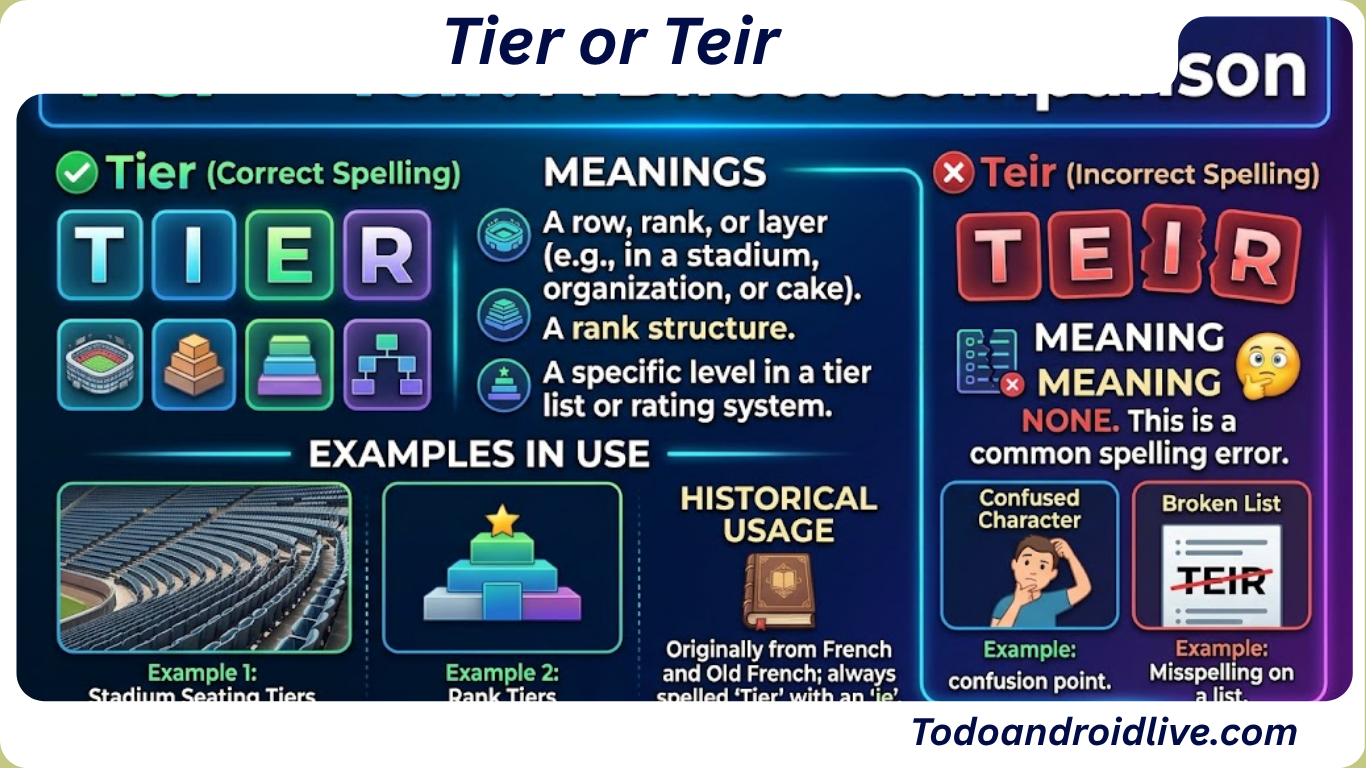
Tier is the standard English spelling. Teir is a misspelling when someone intends to write the word meaning a level, rank, category, or layer.
Use tier when describing a position within a ranking system, a level of service, a group of products, or one row in a layered arrangement. Its plural form is tiers.
Examples of correct usage include:
- The company offers three subscription tiers.
- This character belongs in the highest tier on the ranking list.
- Our supplier is classified as a Tier 1 partner.
- The library needs a five-tier bookshelf.
- Premium-tier customers receive additional features.
Examples of incorrect spelling include:
- The company offers three subscription teirs.
- This character belongs in the highest teir.
- Choose the premium pricing teir.
The correct spelling remains tier in American English, British English, Canadian English, and Australian English. The word does not have a separate accepted spelling for different English-speaking regions.
What Does Tier Mean?
A tier is a level, rank, category, or layer within a larger system. The exact meaning depends on the subject being discussed.
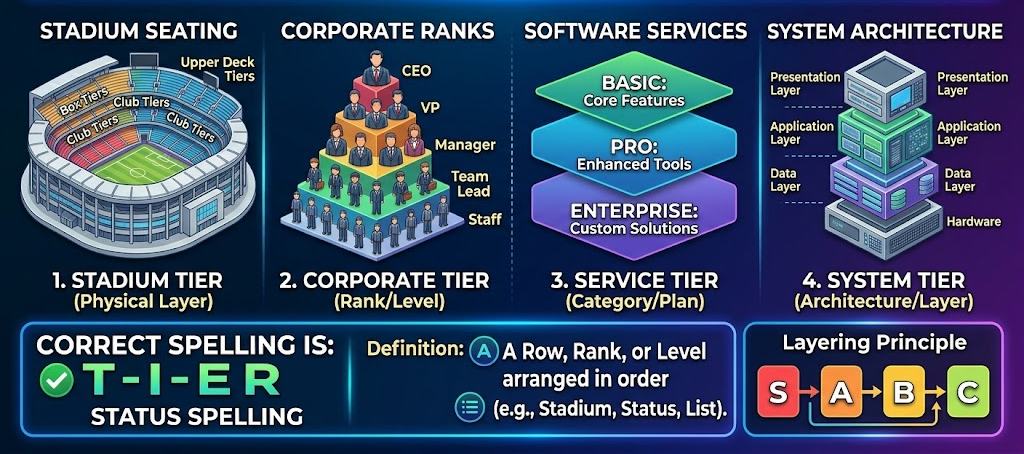
For example, a business might divide its customers into three groups based on spending. A video game might rank characters according to their performance. A building might have several levels of seating, and a subscription service might offer different packages at different prices.
In each case, the word describes one position or category within an organized structure.
Tier as a Level or Rank
When tier means a rank, it identifies the relative position of a person, product, service, or item. The position may be based on quality, performance, importance, or another standard.
Example: The tournament places its strongest teams in the top tier.
Tier as a Layer
When tier refers to a physical arrangement, it describes one level of a structure with multiple levels.
Example: The display stand has three tiers for arranging products.
Tier as a Category
A tier can also identify a group that shares certain features or qualifications.
Example: The company assigns customers to different service tiers based on their membership benefits.
Tier as a Pricing Level
In pricing, a tier is a package or plan with its own price, features, limits, or benefits.
Example: The basic tier includes limited storage, while the premium tier provides additional space.
Tier vs. Tier List: Understanding the Difference
The word tier and the phrase tier list are related, but they do not mean exactly the same thing.
Also Read:Allie or Ally: Meaning, Spelling, Differences, and Examples
A tier is a single level or category. A tier list is an organized ranking that places multiple items into different levels according to selected criteria.
For example, a gaming tier list might place the strongest characters in S tier, other strong characters in A tier, average choices in B tier, and weaker options in lower categories. The exact labels depend on the person creating the list.
A tier list may rank:
- Characters in a video game
- Weapons and equipment
- Sports teams or players
- Movies, books, or television shows
- Products and services
- Strategies, skills, or abilities
A ranking list does not always need tiers. It might simply number items from first to tenth. A tier list groups items into levels, so multiple items can share the same ranking category.
What Does S Tier Mean?
S tier is a label commonly used for the highest category in many gaming and ranking systems. It often represents exceptional performance, strength, usefulness, or overall quality.
However, S tier does not have a universal definition. One creator may use it for the strongest options, while another may reserve it for choices that are especially effective in a particular situation.
For example:
- S tier: Outstanding choices under the creator’s criteria
- A tier: Very strong choices
- B tier: Solid or average choices
- C tier: Situational or less effective choices
- D tier: Weak choices under the same criteria
These labels are examples, not fixed standards. Some lists include SS, S+, F, or other categories.
What Is the Difference Between Top Tier and S Tier?
Top tier is a general expression for something considered among the best in its category. S tier is a specific label used in certain ranking systems.
For example, someone might describe a highly rated laptop as a top-tier device without assigning it an S-tier ranking. In a game, a character placed in S tier would usually be considered one of the strongest options according to that particular list.
The two expressions are related, but they are not interchangeable in every context.
What Is a Tier List Maker?
A tier list maker is a tool that lets users create visual rankings by placing items into categories. These tools are popular with gaming communities, social media creators, sports fans, and people who want to compare products or personal preferences.
A typical tier list maker provides a set of rows labeled with rankings such as S, A, B, C, and D. Users can drag images or item names into the appropriate rows and rearrange them as needed.
Some tools allow users to upload their own images, customize category labels, share a completed list, or download the result.
What Is TierMaker?
TierMaker is the name of a website commonly associated with creating and sharing tier lists. It also appears in searches as tiermaker, tier maker, tierlist maker, and tiermaker tier list.
Although these phrases are closely related, the generic term tier list maker refers to the broader category of tools, while TierMaker refers to a particular service.
People use tier-making tools to create rankings about games, entertainment, sports, food, products, and other subjects. The usefulness of a finished list depends on the criteria used to rank its items.
How to Create a Useful Tier List
Creating a ranking is straightforward, but a useful list needs a clear purpose.
- Choose a subject, such as game characters, sports teams, or products.
- Decide what the ranking measures, such as strength, value, speed, or overall performance.
- Create categories with understandable labels.
- Place each item in the category that best matches your criteria.
- Review the results for consistency.
- Share the list with an explanation of your ranking method.
For example, a gaming tier list based on competitive performance may look different from one based on ease of use. A character can be powerful in expert hands but difficult for beginners to control.
Explaining the criteria helps readers understand why an item appears in a particular tier.
Tier Lists in Gaming: Popular Examples and Search Terms
Gaming is one of the most visible uses of the word tier online. Players frequently look for rankings to help them choose characters, weapons, teams, classes, or strategies.
Search phrases such as anime tier list, Genshin Impact tier list, League of Legends tier list, and Honkai: Star Rail tier list reflect this interest. Each phrase identifies a particular game or gaming category rather than a separate meaning of the word tier.
The rankings themselves can change as games receive updates, balance adjustments, new characters, and additional equipment.
Genshin Impact Tier List
A Genshin Impact tier list ranks characters according to factors such as damage output, team support, flexibility, and performance in particular game modes.
One character may perform exceptionally well in a specific team but be less useful without the right equipment or teammates. Therefore, rankings should be interpreted according to their assumptions rather than treated as universal judgments.
Honkai: Star Rail Tier List
An Honkai: Star Rail tier list compares characters according to their effectiveness in relevant combat situations. Factors may include damage, team compatibility, available equipment, and the requirements of a particular game mode.
Character rankings can change when new content or balance updates alter the strengths of different teams.
League of Legends Tier List
A League of Legends tier list often ranks champions by their performance in a particular role, game mode, skill bracket, or competitive environment.
A champion’s position can depend on the current game patch, player skill, team composition, and changes to game balance. A top-lane tier list, jungle tier list, and ADC tier list may therefore produce different rankings.
Brawl Stars Tier List
A Brawl Stars tier list compares characters according to their performance in different game modes, maps, and team combinations. A character that performs well in one mode may be less effective in another.
This is why a useful ranking should explain whether it covers general performance or a specific mode.
Other Gaming Tier List Searches
Other common gaming-related search phrases include:
- Marvel Rivals tier list
- Zenless Zone Zero tier list
- Wuthering Waves tier list
- Warframe tier list
- Overwatch tier list
- Pokémon Unite tier list
- Clash Royale tier list
- Apex Legends tier list
- Diablo 4 tier list
- Smash Bros. Ultimate tier list
These phrases are examples of how tier is used in gaming searches. They do not all refer to the same ranking system, and their results should not be combined into one universal list.
When looking for a current ranking, check the game’s latest version, the date of publication, the ranking criteria, and the experience level of the person or group producing it.
What Does Tier Mean in Business?
In business, a tier is a category used to organize products, customers, suppliers, services, or business partners. Companies can establish tiers to manage pricing, assign responsibilities, set service levels, and compare performance.
For example, a software provider might offer a basic package for individual users, a professional package for growing teams, and an enterprise package for larger organizations.
The tiers may differ in storage, user limits, support options, security features, and monthly costs.
Tier 1 vs. Tier 2 Suppliers
The terms Tier 1 supplier and Tier 2 supplier are often used in supply chains and manufacturing. They describe a supplier’s position in relation to a particular company or organization.
A Tier 1 supplier typically provides goods or services directly to the manufacturer or primary business. A Tier 2 supplier typically provides components, materials, or services to a Tier 1 supplier.
For example, a vehicle manufacturer may purchase a finished electronic system from a Tier 1 supplier. That supplier may purchase individual components from a Tier 2 supplier.
The labels depend on the relationship being examined. A supplier’s tier does not automatically indicate that it is better or worse than another supplier.
In engineering and other regulated industries, organizations may also define supplier categories using their own requirements. These classifications should be interpreted according to the applicable company’s standards rather than assumed to have one universal meaning.
What Does Tier 1 Mean?
Tier 1 usually means the first or highest-priority level in a particular classification system, but its exact meaning depends on the context.
In a supplier network, Tier 1 often identifies a direct supplier. In a technology or service system, it may identify a designated service level. In a ranking list, it may indicate one of the highest categories.
Always check the system’s definition before interpreting a tier number.
What Does Tier 2 Mean?
Tier 2 generally identifies a second category or level. It may refer to a supplier that serves another supplier, a second level of service, or a classification with specific requirements.
It does not always mean second-best. In a supply chain, for instance, Tier 2 describes a relationship, not necessarily a quality ranking.
Tier Meaning in Pricing, Memberships, and Subscriptions
Many companies use tiered pricing to offer different packages to different customers. Each tier includes a defined combination of features, usage limits, services, or benefits.
Also Read:Classes or Class’s: Meaning, Grammar Rules, and Correct Usage
A subscription service might have three plans:
| Plan | Typical purpose | Possible features |
| Basic tier | Entry-level users | Core features and limited usage |
| Standard tier | Regular users | More features and higher limits |
| Premium tier | Users with greater needs | Expanded access and additional services |
This is an illustrative example. Actual package names, prices, and features vary by provider.
Tiered pricing helps customers select an option that matches their needs. It can also help businesses serve people with different budgets and usage requirements.
What Are Subscription Tiers?
Subscription tiers are different membership or payment plans offered by a service. They may vary by price, access, storage, number of users, support, or included features.
Searches such as HBO Max subscription tiers, game pass tiers, and 24 Hour Fitness membership tiers use the word in this sense.
When comparing subscription tiers, review the complete feature list, billing frequency, restrictions, cancellation terms, and any additional charges. The most expensive tier is not automatically the best choice for every customer.
What Is an AWS Free Tier?
AWS Free Tier is a specific term associated with Amazon Web Services’ free-use offerings. Similar phrases appear in searches for Google Cloud free tier, Oracle Cloud free tier, Claude AI free tier, and other technology services.
In these contexts, tier describes a defined access or usage arrangement. It does not necessarily mean a ranking from best to worst.
Free-use offers may have usage limits, eligibility rules, expiration dates, or charges when usage exceeds included allowances. Users should check the provider’s current terms before relying on a free tier for ongoing work.
Tier Meaning in Gaming, Technology, and Everyday Life
The word tier is flexible because it describes a level within a system rather than one specific type of object.
In technology, it can describe separate parts of an application architecture. In education, it may identify a level of instruction or support. In retail, it can refer to membership benefits. In construction or furniture, it can describe physical layers or shelves.
Tier in Technology
A technology system may use a multi-tier architecture in which different layers perform different tasks. For example, a three-tier application architecture commonly separates the presentation layer, application logic, and data storage.
Here, tiers describe functional divisions, not quality rankings.
Tier in Education
Schools and training providers may use tiers to organize levels of support, instruction, or access to services. The meaning depends on the institution’s framework.
A tiered approach can help organizations match resources to different needs, provided the criteria are clearly defined.
Tier in Furniture and Storage
A three-tier cart has three levels for holding or organizing items. A five-tier bookshelf has five shelf levels, although the precise product design can vary.
Searches for a 3-tier rolling cart, a 4-tier bookshelf, or a 5-tier storage shelf use tier to describe the number of levels in a physical product.
When shopping, check the product’s dimensions, weight capacity, materials, and assembly requirements rather than relying on the tier count alone.
Tier or Teir: Origin and Spelling History
The English word tier has a history connected to French. It entered English through older French usage and developed the meaning of a row, rank, or level.
Over time, English speakers began using tier for both physical arrangements and abstract classifications. The word can now describe rows of seats, levels in a business structure, subscription plans, and categories in a ranking system.
Teir, by contrast, is not the standard spelling of this word. It commonly appears when someone reverses the letters in tier while typing.
Why Is Tier Sometimes Misspelled as Teir?
Several factors can explain this spelling mistake:
- Letter order confusion: The letters i and e appear in an unexpected order for some writers.
- Similar-looking words: Words such as their can influence how people remember letter patterns.
- Typing errors: Fast typing can cause letters to be entered in the wrong order.
- Weak spelling recall: Someone may know the spoken word but be unsure how to write it.
- Search behavior: People sometimes enter a misspelling into a search engine because they are uncertain about the correct form.
These mistakes are understandable, but they do not make teir an accepted spelling.
Does Tier Follow the “I Before E” Rule?
The familiar spelling rule says that i comes before e in certain letter combinations, but English has many exceptions and patterns that the rule does not explain well.
The safest approach is to learn the spelling of tier as a complete word instead of relying on a general rule. Remember that the correct order is t-i-e-r.
Tier, Tiers, Tiered, and Tiering: Word Forms Explained
Knowing the related forms of tier can help you use the word accurately in different sentences.
| Word form | Meaning | Example |
| Tier | One level or category | This is the highest tier. |
| Tiers | More than one level or category | The service offers four tiers. |
| Tiered | Arranged in levels or organized into categories | The company introduced a tiered pricing system. |
| Tiering | The process of arranging or classifying things into levels | The business is tiering its services by usage. |
Is Tier a Noun or a Verb?
Tier is most commonly used as a noun, but it can also be used as a verb.
As a noun, it identifies a level or category.
Example: The customer selected the premium tier.
As a verb, it means to arrange or classify something into tiers.
Example: The company tiers its membership plans according to the benefits included.
The verb form is useful in business and technical writing, although phrases such as organize into tiers or divide into levels may sound more natural in some contexts.
What Is the Plural of Tier?
The plural of tier is tiers. You add s to the singular form without changing the spelling.
Correct examples:
- The building has several seating tiers.
- Customers can choose from three membership tiers.
- The ranking system contains five tiers.
Incorrect examples include teirs and tier’s when the intended meaning is simply more than one tier.
Is Tiered the Same as Ranked?
Not exactly. Tiered means organized into levels or categories, while ranked means ordered or evaluated according to a position or standard.
A tiered system may place several items in the same category. A ranked list often assigns each item an individual position.
For example, five products might be divided into three tiers, while a ranking list could order those five products from first to fifth.
Tier vs. Teir: Common Mistakes to Avoid
Correct spelling becomes easier when you understand how tier functions in real sentences.
1. Reversing the Letters
The most direct mistake is writing teir instead of tier.
Incorrect: The product belongs to the premium teir.
Correct: The product belongs to the premium tier.
2. Confusing Tier With Their
Their is a possessive word used to show that something belongs to people or things. Tier identifies a level or category.
Examples:
- Their subscription includes additional storage.
- Their company offers a premium tier.
Both words are correct in their own contexts, but they cannot replace each other.
3. Using an Apostrophe for the Plural
The plural of tier does not require an apostrophe.
Incorrect: The company offers three tier’s.
Correct: The company offers three tiers.
An apostrophe is needed only when the sentence requires a possessive form, such as the tier’s benefits.
4. Confusing Tiered With Tier List
A tiered system is an arrangement that contains different levels. A tier list is a ranking format that groups items into categories.
For example, a company may have a tiered subscription system, while a gaming community may publish a tier list of characters.
Also Read:Handle or Handel: Which Spelling Is Correct? Meaning and Examples
5. Assuming Every Tier Is a Quality Ranking
A higher tier may indicate a better ranking in one system, but tier does not always mean superior quality.
In supplier networks, a Tier 1 supplier is generally one that supplies a business directly. In furniture, a tier simply refers to a physical level. In subscription pricing, a higher tier may provide more features, but whether those features are worth the cost depends on the customer.
Understanding the context is just as important as spelling the word correctly.
How to Remember the Correct Spelling of Tier
If you frequently confuse tier and teir, a few simple habits can help.
First, memorize the letter sequence t-i-e-r. You can practice by writing the word several times or using it in a sentence.
Second, connect the word with a familiar phrase, such as tier list, pricing tier, or three-tier shelf. Remembering a common phrase can make the spelling easier to recall.
Third, review the sentence before submitting professional writing. Pay particular attention to words that have been typed quickly or copied between documents.
Finally, use a spell-checking tool as a second check rather than relying on it completely. Proofreading remains useful because software may not identify every typing mistake.
Frequently Asked Questions About Tier or Teir
Is tier or teir correct in English?
Tier is the correct spelling when referring to a level, rank, category, or layer. Teir is a misspelling of this word in standard English.
What does tier mean in simple words?
A tier is one level within a larger system. It can refer to a shelf, a pricing plan, a business category, or a position in a ranking.
What does tier list mean in gaming?
A tier list is a ranking that groups characters, weapons, teams, or other game elements into categories according to selected criteria. The rankings may change with updates and gameplay conditions.
What does top tier mean?
Top tier describes something considered among the best in a particular group or category. It is a general expression and does not always refer to a formal ranking system.
Is TierMaker the same as a tier list maker?
TierMaker is a specific service associated with creating tier lists. A tier list maker is the general term for a tool that allows users to build and organize rankings.
Does tier have the same spelling in the US and UK?
Yes. Tier is the standard spelling in both American and British English. There is no accepted US-versus-UK spelling difference for this word.
Can tier be used as a verb?
Yes. Tier can mean to arrange or classify things into levels. For example, a company may tier its services according to customer needs.
Conclusion
Tier is the correct spelling, while teir is a common typing or spelling mistake. The word describes a level, rank, layer, or category and appears in many areas of everyday life, including business, technology, subscriptions, furniture, and gaming.
Understanding related expressions such as tier list, top tier, tiered pricing, and Tier 1 supplier makes the word easier to use in context. Remember that a tier may represent a physical layer, a service category, or a ranking level, depending on the subject.
For clear and professional writing, use tier when referring to a level or category, use tiers for the plural, and use tiered when describing something arranged into levels.