

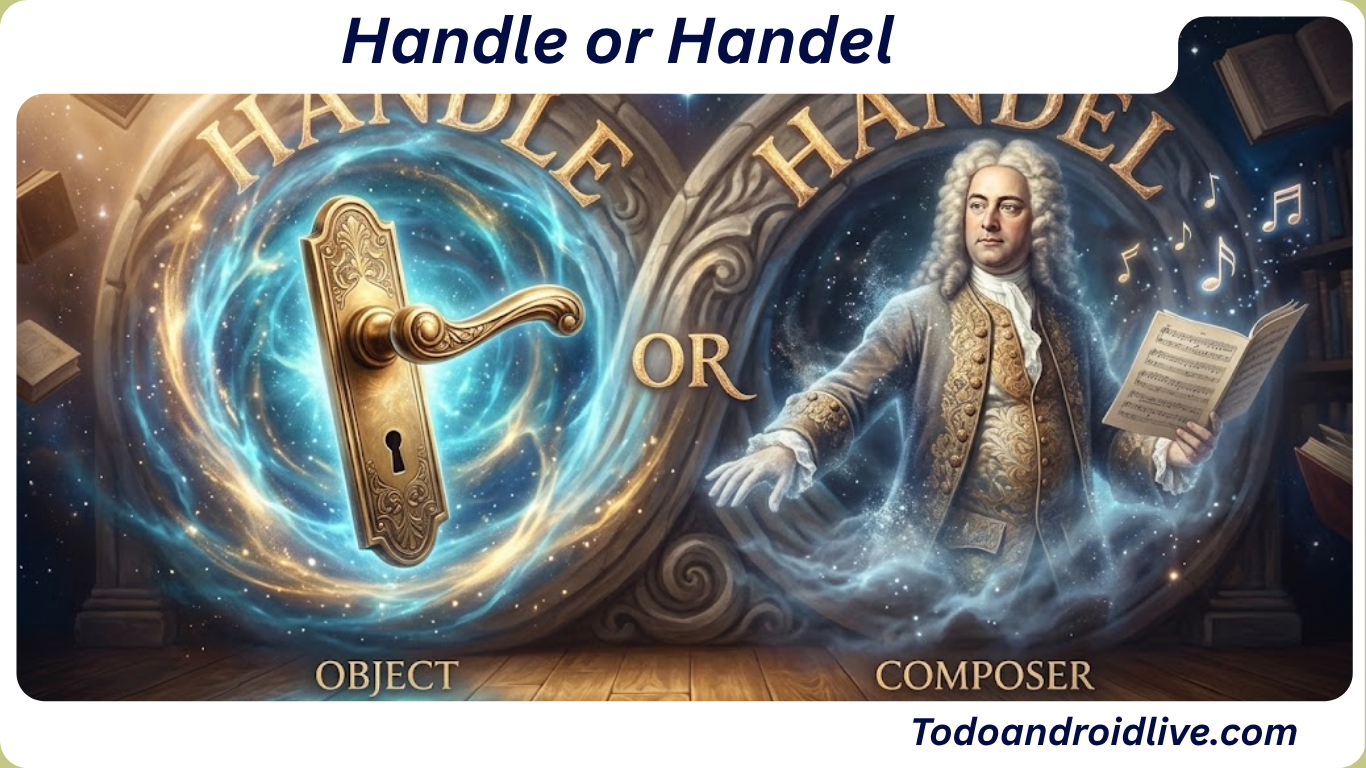
Handle or Handel is a common spelling question because both words look and sound similar. However, they have different meanings. Handle is the correct English word when talking about managing a task, dealing with a problem, or referring to a part of an object that you hold. Handel is a proper name, best known as the surname of composer George Frideric Handel.
Understanding the difference between handle and Handel can help you avoid spelling mistakes in everyday conversations, professional writing, and online searches. This guide explains their meanings, correct usage, pronunciation, grammatical forms, and common mistakes.
Handle or Handel: Which Is Correct?
The correct spelling depends on what you want to say. Handle is the standard English word for managing, touching, or dealing with something. Handel is a proper name, not an alternative spelling of the common English word.
Here are some examples:
- Correct: I can handle this situation.
- Incorrect: I can handel this situation.
- Correct: The front door handle is broken.
- Correct: George Frideric Handel composed Messiah.
If you are writing about a task, responsibility, object, or problem, use handle. If you are referring to the famous composer, use Handel.
The spelling difference is important because changing one letter can change the meaning of a sentence.

What Does Handle Mean?
The word handle has several meanings, depending on how it is used. It can function as both a noun and a verb.
Handle as a Verb
As a verb, handle means to manage, control, touch, operate, or deal with something.
For example, a person can handle a difficult conversation, a manager can handle customer complaints, and a worker can handle fragile equipment carefully.
Examples:
- She can handle difficult situations calmly.
- Please handle the package with care.
- Our team will handle your request.
- He knows how to handle pressure.
- Can you handle the extra work?
In these sentences, handle describes an action. It shows that someone is dealing with a task, object, responsibility, or situation.
Handle as a Noun
As a noun, a handle is a part of an object designed to be held, pulled, pushed, or turned.
Examples include door handles, cup handles, suitcase handles, and kitchen cabinet handles.
Examples:
- The front door handle needs repair.
- This suitcase has a strong handle.
- She picked up the cup by its handle.
- The kitchen cabinet handles are loose.
Handle can also refer to a username or identifying name used on social media.
Also Read: Devide or Divide: Correct Spelling, Meaning, Verb Forms, and Math Examples
For example, someone might ask, “What is your Instagram handle?” In this case, handle means the username associated with an account.
What Does Handle Mean in Everyday English?
In everyday conversation, handle often means being able to manage something.
When someone says, “I can handle it,” they usually mean they can take care of a task or deal with a situation.
For example:
“I can handle the meeting while you finish the report.”
This means the speaker is willing and able to take responsibility for the meeting.
The expression can communicate confidence, readiness, or a willingness to help.
What Does Handel Mean?
Handel is a proper name, best known as the surname of George Frideric Handel, a famous composer of the Baroque period.
It is not the standard spelling of the English word meaning to manage or deal with something.
Examples:
- George Frideric Handel was born in Germany.
- Handel composed the oratorio Messiah.
- Many orchestras perform Handel’s music.
The meaning of Handel depends on the context. In a discussion about classical music, it will often refer to the composer. In a sentence about managing a task, the intended word is usually handle.
Is Handel a Real Word?
Yes. Handel is a real surname and a proper name. However, it is not a standard alternative to handle in ordinary English writing.
For example:
Incorrect: I will Handel the problem tomorrow.
Correct: I will handle the problem tomorrow.
Correct: I listened to a recording of Handel’s music.
The first sentence needs the verb handle, while the second uses Handel as a person’s name.
Handle Definition and Meaning
A handle can refer to a physical grip or the action of managing, touching, or dealing with something.
The verb handle has several related meanings:
- To touch or hold something with your hands.
- To manage a task or responsibility.
- To deal with a difficult situation.
- To operate or control equipment.
- To respond to requests, complaints, or information.
The noun handle can refer to:
- A part of an object used for holding, lifting, pulling, or turning.
- A username used to identify an online account.
- An identifying name or informal label in certain contexts.
For example, a door handle allows someone to open or close a door. A social media handle identifies an account. The verb handle describes the action of dealing with a situation.
Although these meanings differ, they all relate to interaction, access, or control.
How Do You Spell Handle?
The correct spelling is H-A-N-D-L-E.
The word contains six letters. A common mistake is writing handel instead of handle.
To remember the spelling, connect handle with the word hand. A handle is often something you hold with your hand, such as a door handle, cup handle, or suitcase handle.
You can also practice the word in a sentence:
“I can handle this task.”
Writing and reading the word in context can help reinforce its correct spelling.
How Do You Spell Handled?
Handled is the correct past-tense and past-participle form of handle.
Examples:
- She handled the complaint professionally.
- He handled the equipment carefully.
- They handled the situation well.
The correct spelling is handled, not handel or handelled.
Handle, Handles, Handled, and Handling
These words are different grammatical forms of handle.
| Word | Grammatical form | Example |
| Handle | Base verb or singular noun | I can handle the task. |
| Handles | Third-person singular verb or plural noun | She handles customer requests. |
| Handled | Past tense or past participle | We handled the issue. |
| Handling | Present participle or gerund | He is handling the order. |
Each form is correct when used in the appropriate context.
Is It Handling or Handeling?
Handling is correct. Handeling is a common spelling mistake.
When adding -ing to handle, remove the final E before adding the ending.
The spelling pattern is:
Handle → Handling
Similar examples include:
- Make → Making
- Take → Taking
- Write → Writing
Remembering this pattern can help you avoid mistakes when using handle in different tenses.
Handle or Handel Pronunciation
Handle is generally pronounced HAN-dul in American English. Its pronunciation can be represented in the International Phonetic Alphabet as /ˈhændəl/.
The first syllable receives the main stress.
Handel, the composer’s surname, is also commonly pronounced HAN-dul in English. Pronunciation can vary depending on the language and speaker.
Because the words sound similar, it may be difficult to identify the correct spelling from pronunciation alone.
Consider these examples:
- “Please handle the package carefully.”
- “I enjoy listening to Handel.”
The first sentence uses the common English verb. The second refers to the composer.
The meaning and context help determine which spelling is correct.
Handle vs. Handel: Main Differences
The main difference between handle and Handel is their meaning and grammatical use.
| Feature | Handle | Handel |
| Type of word | Common noun and verb | Proper name |
| Used for managing a task | Yes | No |
| Used for a physical grip | Yes | No |
| Associated with classical music | Not specifically | Yes, when referring to the composer |
| Example | I can handle the work. | Handel composed Messiah. |
| Capitalization | Usually lowercase | Capitalized as a surname |
Handle is the correct choice when discussing tasks, objects, or responsibilities. Handel is correct when referring to a person with that name, particularly the composer.
Common Mistakes With Handle or Handel
Writers sometimes confuse handle and Handel because the words look similar. The following examples show how to use them correctly.
Mistake 1: Using Handel as a Verb
Incorrect: I will handel the project.
Correct: I will handle the project.
The sentence describes managing a project, so handle is the correct word.
Mistake 2: Assuming Handel Is British English
Incorrect: British English uses handel, while American English uses handle.
Correct: Both British and American English use handle.
There is no standard spelling difference between the two varieties of English for this word.
Mistake 3: Misspelling the Composer’s Name
Incorrect: George Frideric Handle composed Messiah.
Correct: George Frideric Handel composed Messiah.
When referring to the composer, use Handel.
Mistake 4: Writing Handelled Instead of Handled
Incorrect: She handelled the situation well.
Correct: She handled the situation well.
The past-tense form of handle is handled.
Mistake 5: Writing Handeling Instead of Handling
Incorrect: He is handeling the complaint.
Also Read: Unattentive or Inattentive: Correct Spelling, Meaning, Examples, and ADHD Differences
Correct: He is handling the complaint.
Remove the final E before adding -ing.
Mistake 6: Confusing Handles and Handels
Handles is the normal plural form of the noun handle.
For example:
“The cabinet handles need replacing.”
Handels may appear as a plural surname in a particular context, but it is not the standard plural form of handle.
How to Use Handle in Sentences
Examples can help you understand how handle works in different situations.
Handle in Professional Writing
In a workplace, handle often describes managing responsibilities, communication, or tasks.
Examples:
- Our department handles customer inquiries.
- She handled the negotiations professionally.
- The support team will handle your request.
- I can handle the report before the deadline.
- The manager knows how to handle difficult conversations.
These examples show that handle is useful in both formal and everyday writing.
Handle in Everyday Conversation
Handle is also common in informal speech.
Examples:
- I can handle it.
- Can you handle this bag for a moment?
- He handles pressure well.
- She cannot handle spicy food.
- We need to handle this problem together.
The meaning changes according to the situation, but the spelling remains the same.
Handle in Technology and Social Media
In technology, handle can refer to a username or a reference used to access a resource.
A social media handle is the username associated with an account. It helps people find, mention, or tag that account.
Examples:
- What is your Instagram handle?
- I changed my social media handle last week.
- Please share your business handle.
- The software uses a handle to access a resource.
These uses are different from the physical handle on a door or bag, but they are established meanings of the same word.
Handle in Household and Product Descriptions
The noun handle appears in descriptions of many household objects and products.
Examples include:
- Front door handle
- Sliding door handle
- Kitchen cabinet handle
- Wooden tool handle
- Suitcase handle
- Shower handle
- Faucet handle
Example sentence:
“The sliding door handle is difficult to turn.”
In this sentence, handle refers to the part used to open or close the door.
What Does “Handle It” Mean?
The phrase “handle it” generally means to take care of a task, manage a situation, or deal with a problem.
Examples:
- Don’t worry about the appointment. I’ll handle it.
- Can you handle it if the customer requests a refund?
- She can handle it on her own.
In the first example, the speaker promises to take responsibility for the appointment. In the second, the speaker asks whether someone can manage a possible situation.
The expression often communicates confidence or a willingness to take responsibility.
What Does “I Think I Can Handle It” Mean?
“I think I can handle it” means that someone believes they are capable of managing a task or situation.
For example, a coworker might use this phrase after being offered an additional responsibility.
The expression shows confidence without making an absolute promise. The speaker believes the task is manageable but may not be completely certain.
George Frideric Handel: The Composer Behind the Name
George Frideric Handel was an influential composer of the Baroque period. He is particularly known for his oratorios, operas, and orchestral compositions.
His surname is spelled Handel, not Handle.
This distinction is useful when researching classical music or checking the spelling of the composer’s name.
Who Was George Frideric Handel?
George Frideric Handel was born on February 23, 1685, in Halle, in what is now Germany. He later developed a successful musical career in England and became a British citizen in 1727.
Handel composed music for theaters, public performances, royal occasions, and concert audiences.
He died on April 14, 1759, in London, England.
What Is Handel Famous For?
Handel is best known for the oratorio Messiah, which includes the celebrated Hallelujah Chorus.
Other important works include Water Music and Music for the Royal Fireworks. He also composed numerous operas and other oratorios.
His music remains an important part of the classical repertoire and is performed by orchestras, choirs, and ensembles around the world.
Is Handel a Baroque Composer?
Yes. George Frideric Handel is widely recognized as one of the leading composers of the Baroque period.
Baroque music often features elaborate melodies, rich harmonies, and detailed musical structures. Handel’s compositions demonstrate many of these characteristics.
His works also reflect the musical traditions of European courts, theaters, and concert settings during his lifetime.
Is Handel the Same as Georg Friedrich Händel?
Yes. Georg Friedrich Händel is the German form of the composer’s name, while George Frideric Handel is the commonly used English form.
You may encounter different spellings when searching for his biography or music. These variations refer to the composer rather than the English word handle.
Other Words for Handle
The best synonym for handle depends on the meaning in the sentence.
Also Read: Congrats or Congratulations: Meaning, Correct Spelling, and How to Use Each Word
When handle means managing a task, possible alternatives include manage, address, oversee, tackle, and deal with.
When handle means touching or using an object, alternatives may include hold, grasp, grip, or operate.
When handle refers to a physical part, grip or knob may be suitable in some contexts. However, these words are not always interchangeable because objects have different designs.
Examples:
- Handle a problem: manage a problem.
- Handle a complaint: address a complaint.
- Handle a fragile object: hold it carefully.
- Handle a machine: operate a machine.
- Door handle: grip or knob, depending on the design.
Choose a synonym that preserves the intended meaning instead of replacing handle automatically.
Frequently Asked Questions About Handle or Handel
Which spelling is correct: handle or handel?
Handle is correct when referring to managing something, touching an object, or a physical grip. Handel is a proper name, most notably the surname of composer George Frideric Handel.
What is the meaning of handle?
Handle means to manage, control, touch, operate, or deal with something. As a noun, it usually refers to a part of an object designed to be held or a username used to identify an online account.
Is Handel ever correct in English?
Yes. Handel is correct when used as a proper name. For example, “Handel composed Messiah.” It is not the standard spelling of the English verb meaning to manage something.
How do you spell handle and handled?
Handle is spelled H-A-N-D-L-E. Handled is spelled H-A-N-D-L-E-D. Both are correct forms used in different grammatical contexts.
What is the plural of handle?
The plural noun is handles. For example, “The kitchen cabinet handles need replacing.” Handles can also be the third-person singular form of the verb, as in “She handles the accounts.”
Is handling or handeling correct?
Handling is correct. Remove the final E from handle before adding -ing. Handeling is a misspelling when the intended word is the English verb form.
Are handle and Handel pronounced the same way?
They are commonly pronounced similarly in English, although pronunciation can vary. Context helps distinguish the common English word from the composer’s surname.
Conclusion
The difference between handle and Handel depends on the meaning of the sentence.
Handle is the standard English word used for managing a situation, dealing with a task, touching an object, or referring to a physical grip. Its related forms include handles, handled, and handling.
Handel is a proper name best known through George Frideric Handel, the influential Baroque composer who wrote Messiah and many other celebrated works.
When writing in American English, use handle for the common noun and verb, and capitalize Handel when referring to the composer or another person with that surname. Understanding this distinction will help you choose the correct spelling and communicate your meaning clearly.