

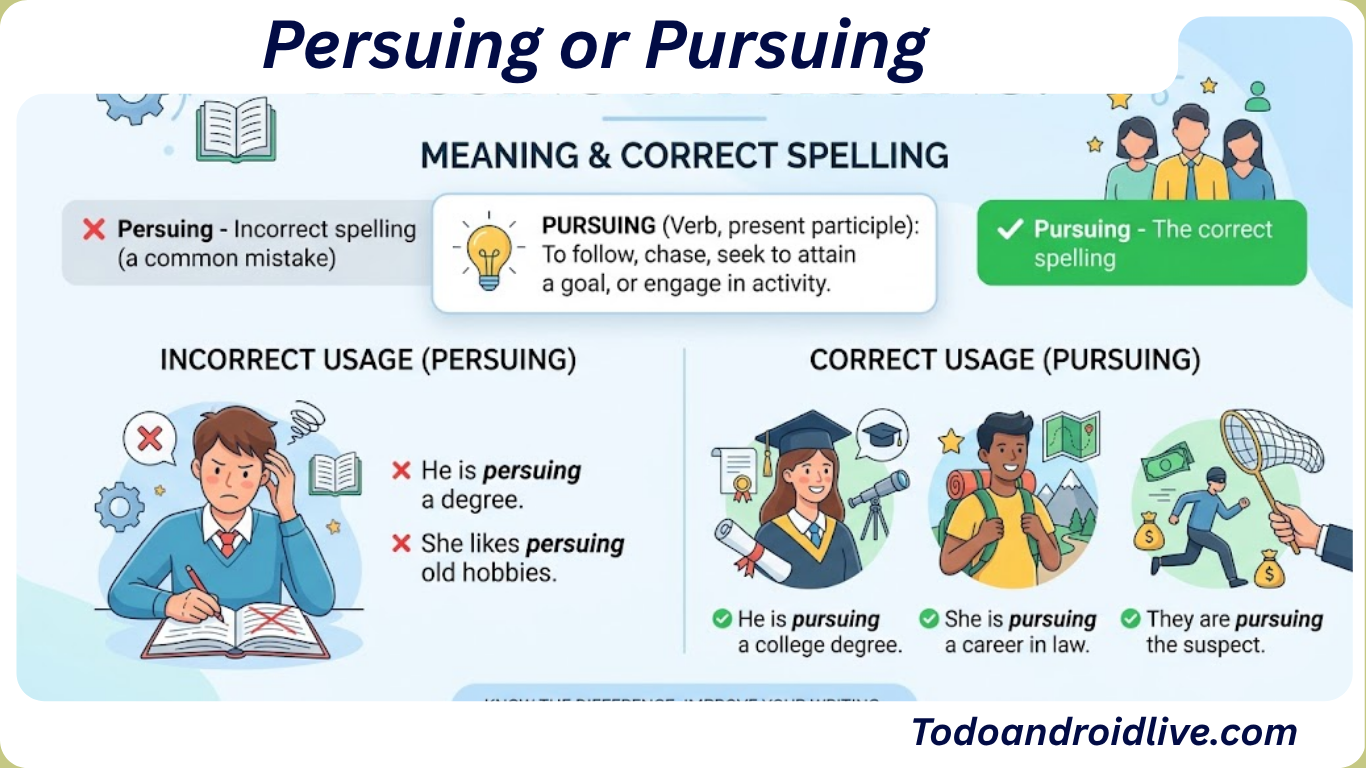
English spelling can be confusing when a word sounds different from the way it is written. One common example is the confusion between persuing and pursuing. People often type “persuing” when they want to describe following a goal, working toward a degree, or trying to achieve something important.
If you have searched for “persuing or pursuing,” “how to spell persuing,” or “persuing meaning,” the answer is straightforward: pursuing is the correct spelling. Persuing is a misspelling of the word pursuing and is not accepted as a standard English spelling.
Understanding the difference between persuing vs pursuing can help you write more confidently in school assignments, job applications, professional emails, and online content. It also helps you understand related words, such as pursue, pursued, pursues, and pursuit.
This guide explains the correct spelling, definition, pronunciation, word history, grammar rules, common mistakes, and practical examples. It also clears up confusion between pursue and peruse, pursue and pursuit, and other similar-looking words.
Is It Persuing or Pursuing?
The correct spelling is pursuing, with the letters “pur” at the beginning.
- Correct: pursuing
- Incorrect: persuing
If you are asking, “Is it persue or pursue?” the correct base word is pursue. Similarly, if you are wondering whether to spell persuing or pursuing, always choose pursuing.

The same spelling applies in American English and British English. There is no regional spelling difference between the two forms.
| Word | Correct or incorrect? | Explanation |
| Pursuing | Correct | The present participle of pursue |
| Persuing | Incorrect | A common misspelling of pursuing |
| Pursue | Correct | The base form of the verb |
| Persue | Incorrect | A misspelling of pursue |
| Pursued | Correct | The past tense and past participle |
| Persued | Incorrect | A misspelling of pursued |
| Pursues | Correct | The third-person singular form |
| Pursuit | Correct | The noun describing an effort or activity |
| Pursueing | Incorrect | An incorrect attempt to form the -ing word |
The important distinction is that pursue is the verb, pursuing is its -ing form, and pursuit is a related noun.
What Does Pursuing Mean?
The pursuing meaning depends on the situation, but it generally describes following, seeking, continuing, or working toward something.
The pursuing definition can be understood in three main ways.
Also Read: Happend or Happened: Correct Spelling, Meaning, and Examples (2026)
1. Working Toward a Goal
Pursuing often means making an effort to achieve something you want.
Examples:
- Maya is pursuing her dream of becoming a doctor.
- He is pursuing a career in software development.
- They are pursuing better opportunities for their family.
- I am pursuing my goal of learning English.
In these sentences, pursuing describes an ongoing effort rather than a completed achievement.
2. Following or Chasing Someone
Pursuing can also mean following someone or something, particularly when trying to catch, find, or reach it.
Examples:
- The police were pursuing a suspect.
- The dog was pursuing a ball across the garden.
- The detective continued pursuing the missing person case.
The phrase “pursuing someone” can have different meanings depending on context. It might refer to a police chase, trying to contact someone, or showing romantic interest in a person.
3. Continuing an Activity or Plan
The word can also describe continuing an action, investigation, opportunity, or course of action.
Examples:
- The company is pursuing a new business strategy.
- The researchers are pursuing further studies.
- She is pursuing legal action against the organization.
- The team is pursuing several possible solutions.
These examples show why the meaning of pursuing is broader than simply chasing someone.
Persuing Meaning: Why Do People Search for This Word?
The search term “persuing meaning” is usually entered by people who have seen the misspelling or are unsure how to write the word.
If someone asks for the meaning of persuing, the intended word is generally pursuing. The misspelled form does not have a separate standard English definition.
The same applies to searches such as:
- What does persue mean?
- What is the meaning of persue?
- What does persued mean?
- What is the persuing definition?
- How do you spell persuing?
- What is the correct spelling of persue?
- Is there a word persue?
For all these questions, the intended word is usually pursue or one of its grammatical forms.
However, context matters. For example, “peruse” is a different, correctly spelled English word. It should not be confused with pursue.
How Do You Spell Pursuing or Persuing?
If you are asking, “How do you spell pursuing or persuing?” remember the spelling of the base word first.
The correct spelling is:
P-U-R-S-U-I-N-G
The incorrect spelling is:
P-E-R-S-U-I-N-G
The difference is the second letter. Pursuing begins with “pur,” not “per.”
An Easy Way to Remember the Spelling
Learn the word in two stages:
- Write the base word: pursue.
- Add -ing: pursuing.
This gives you the correct spelling without changing the order of the original letters.
A useful memory trick is to connect pursue with purpose. Both begin with “pur,” which can remind you to avoid writing persue or persuing.
You can also practice these forms together:
- Pursue a goal.
- Pursuing a goal.
- Pursued a goal.
- Pursues a goal.
Learning the entire word family is often more useful than memorizing only one spelling.
Why Is Persuing Incorrect?
The spelling persuing is incorrect because the standard verb is pursue, not persue. Adding -ing to the wrong base word does not make it correct.
Several factors can cause this mistake.
Pronunciation Confusion
Some English speakers may not clearly distinguish the vowel sounds in unstressed or quickly spoken words. As a result, a person might hear the beginning of pursue and remember it as “per.”
However, spelling must follow the established form of the word rather than an individual’s interpretation of its sound.
Typing Errors
People frequently type words quickly on phones, tablets, and computers. A single incorrect letter can turn pursuing into persuing.
Spell-checking tools may catch this mistake, but not every writing application detects every error in every context.
Confusion With Other Words
English contains many words that begin with similar letter combinations. Words such as person, persist, and persuade may influence how someone remembers the spelling of pursue.
The best solution is to learn the base form and its related forms together.
Incorrect Spelling Repeated Online
Seeing a misspelling in comments, posts, or informal messages does not make it correct. Repeated exposure can make an error look familiar, even when it remains nonstandard.
For formal writing, use pursue, pursuing, pursued, pursues, and pursuit according to their grammatical roles.
Pursue or Persue: Which Is Correct?
The correct word is pursue. The form persue is a spelling mistake.
Pursue is a verb, which means it describes an action. It can refer to following something, trying to achieve a goal, or continuing an activity.
Examples:
- I want to pursue a master’s degree.
- She decided to pursue her passion for music.
- The organization will pursue new funding opportunities.
Incorrect examples:
- I want to persue a master’s degree.
- She decided to persue her passion for music.
- The organization will persue new funding opportunities.
When someone searches for “persue vs pursue,” “pursue or persue which is correct,” or “correct spelling for persue,” the answer is the same: pursue is correct.
Is Pursue a Word?
Yes. Pursue is a standard English verb found in established dictionaries.
It can be used with an object, as in “pursue a goal,” or in other constructions, such as “pursue a career in medicine.”
Is Persue a Word?
Persue is not the standard spelling of this verb. It should not be used in place of pursue in formal or edited English.
Pursuing Definition and Grammar Rules
To understand the definition of pursuing, it helps to learn how the verb pursue changes according to tense and sentence structure.
| Word form | Grammatical role | Example |
| Pursue | Base form | I pursue my interests. |
| Pursues | Present tense for he, she, or it | She pursues new opportunities. |
| Pursuing | -ing form | He is pursuing a degree. |
| Pursued | Past tense | They pursued the project last year. |
| Pursued | Past participle | She has pursued several options. |
| Pursuit | Noun | Education is a lifelong pursuit. |
How to Form Pursuing
The base verb pursue ends in the letter e. To form its present participle, remove the final e and add -ing.
Pursue → pursuing
This is why “pursueing” is incorrect. The final e is dropped before the suffix is added.
The same pattern appears in many English verbs:
- Make → making
- Write → writing
- Hope → hoping
- Pursue → pursuing
This rule provides a practical way to answer questions about the spelling of pursuing.
How to Use Pursuing in a Sentence
Pursuing is commonly used after forms of the verb be, including am, is, are, was, and were.
Examples:
- I am pursuing a degree in engineering.
- She is pursuing a new opportunity.
- We are pursuing a solution to the problem.
- They were pursuing a different strategy.
It can also appear before a noun when describing a person or activity, as in “students pursuing higher education.”
Pursuing a Degree: Meaning and Examples
The phrase “pursuing a degree” means working toward earning a college or university qualification.
It does not necessarily mean that the person has already graduated. Instead, it usually indicates that the person is studying or making progress toward the qualification.
Examples:
- She is pursuing a bachelor’s degree in biology.
- He is pursuing a master’s degree in business administration.
- I am pursuing a degree in computer science.
- They are pursuing doctoral degrees at different universities.
A common error is writing “persuing a degree.” The correct phrase is always “pursuing a degree.”
You can also say:
- Studying for a degree
- Working toward a degree
- Earning a degree, when referring to the process or achievement
- Completing a degree, when emphasizing finishing the program
These expressions are related, but they are not always identical. Someone pursuing a degree may still have several semesters left before graduation.
Pursuing a Career: Meaning and Examples
Pursuing a career means taking steps toward entering, developing, or advancing in a chosen profession.
The expression can refer to education, training, job applications, professional development, or long-term career goals.
Examples:
- She is pursuing a career in nursing.
- He plans to pursue a career in information technology.
- They are pursuing careers in environmental science.
- I want to pursue a career that allows me to help others.
The phrase “persuing a career” is a misspelling. Use “pursuing a career” in resumes, cover letters, university applications, and professional profiles.
Depending on your intended meaning, you might also write “building a career,” “developing professionally,” or “working toward a professional goal.”
Pursuing Someone: What Does It Mean?
The phrase “pursuing someone” has several meanings. Understanding the surrounding sentence is important because the phrase can describe very different situations.
In Law Enforcement
It can mean following a person in an attempt to catch them.
Example: The officers were pursuing someone suspected of theft.
In Romantic Relationships
It can mean making an effort to develop a romantic relationship with another person.
Example: He is pursuing someone he met at university.
Also Read:Cancel or Cancelled: Correct Spelling, Meaning, Differences, and Examples (2026)
In this context, pursuing someone should still involve respecting the other person’s wishes and boundaries. If the person declines contact or asks for space, continuing unwanted attention is not appropriate.
In Communication or Business
The phrase can also describe trying to reach a person about a professional opportunity, payment, or agreement.
Example: The recruiter is pursuing several candidates for the position.
In every case, pursuing is the correct spelling, not persuing.
Pursuing vs Persuing: Examples of Correct Usage
The following examples show how to use the correct word in different situations.
| Incorrect sentence | Correct sentence |
| She is persuing a medical degree. | She is pursuing a medical degree. |
| He wants to persue his dreams. | He wants to pursue his dreams. |
| They are persuing new customers. | They are pursuing new customers. |
| I persued the opportunity last year. | I pursued the opportunity last year. |
| She persues a career in teaching. | She pursues a career in teaching. |
| We are pursueing a solution. | We are pursuing a solution. |
| The police were persuing the suspect. | The police were pursuing the suspect. |
| Education is a lifelong persuit. | Education is a lifelong pursuit. |
Notice that the correct form changes depending on the sentence. Pursuing is not the right choice in every situation; sometimes pursue, pursued, pursues, or pursuit is needed.
Pursue vs Pursuit: What Is the Difference?
Pursue and pursuit are related, but they perform different grammatical functions.
Pursue is a verb. It describes an action.
Pursuit is a noun. It names the action, effort, or activity.
| Word | Part of speech | Example |
| Pursue | Verb | I pursue my goals. |
| Pursuing | Verb form | I am pursuing my goals. |
| Pursued | Verb form | I pursued my goals last year. |
| Pursuit | Noun | My pursuit of knowledge continues. |
Consider these examples:
- Correct: She wants to pursue a career in law.
- Correct: Her pursuit of a legal career requires years of study.
- Incorrect: She wants to pursuit a career in law.
- Incorrect: Her pursue of a legal career requires years of study.
If you search for “pursue and pursuit difference,” “pursue vs pursuit meaning,” or “pursuit or pursue,” remember that the choice depends on whether the sentence needs a verb or a noun.
Pursue vs Peruse: Are They the Same?
No. Pursue and peruse are two different words with different meanings.
Pursue means to follow, seek, or work toward something.
Peruse means to read, examine, or look through something. In common modern usage, it often means reading or examining material carefully, although it has also been used to mean looking through something.
Examples:
- She plans to pursue a degree in literature.
- She will peruse the course catalog before choosing a degree.
The first sentence describes working toward a qualification. The second describes examining a document.
This distinction matters because searches such as “peruse or pursue,” “peruse vs pursue,” and “browse vs peruse” may come from readers who confuse similar-looking words.
Related examples include:
- Pursue an opportunity.
- Peruse a report.
- Pursue a suspect.
- Peruse a menu.
Do not replace one word with the other simply because the spellings look similar.
Pursue vs Seek, Follow, and Ensue
Several English words are related to pursue, but each has a slightly different meaning.
Pursue vs Seek
Seek means to look for or try to find something. Pursue often emphasizes continued effort toward a goal or the act of following something.
- She is seeking advice.
- She is pursuing a career in medicine.
The first sentence emphasizes looking for advice. The second describes working toward a professional goal.
Pursue vs Follow
Follow can mean to move behind someone, obey instructions, or understand a sequence. Pursue often suggests an active effort to reach, catch, or achieve something.
- Follow the instructions carefully.
- Pursue your long-term goals.
The words sometimes overlap, but they are not interchangeable in every sentence.
Pursue vs Ensue
Ensue means to happen afterward, often as a result of something else.
- The discussion continued, and an argument ensued.
- The team decided to pursue another solution.
An argument can ensue after a disagreement, but a team pursues a solution. These verbs express different ideas.
Pursue vs Persuade
Persuade means to convince someone to believe something or take a particular action.
- She wants to pursue a career in education.
- She wants to persuade her parents to support her decision.
Pursue describes following a goal, while persuade describes influencing another person’s decision.
Different Forms of the Word Pursue
Learning the different forms of pursue can prevent spelling and grammar mistakes.
Pursue
The base form is used with subjects such as I, you, we, and they, and after modal verbs such as can, will, and should.
Examples:
- I pursue meaningful work.
- They pursue new opportunities.
- You should pursue your interests.
Pursues
Pursues is used with a third-person singular subject in the simple present tense.
Examples:
- She pursues excellence.
- He pursues a career in finance.
- The company pursues new markets.
Pursuing
Pursuing commonly describes an action in progress or modifies a noun.
Examples:
- We are pursuing an agreement.
- Students pursuing higher education may need financial support.
Pursued
Pursued is the simple past form and past participle.
Examples:
- She pursued the opportunity last year.
- He has pursued this goal for several years.
Pursuit
Pursuit is the noun form.
Examples:
- The pursuit of happiness is a familiar expression.
- His pursuit of knowledge continued throughout his life.
These are the standard forms to use instead of misspellings such as persue, persuing, persued, and pursueing.
Etymology of the Word Pursue
The word pursue has a long history in English. It entered English through Anglo-French and Old French forms related to the verb poursuivre, which carried the idea of following or continuing after something.
Over time, the word developed its modern meanings, including chasing a person, following a course of action, seeking an objective, and working toward a goal.
Today, pursue is used in many settings, including education, law, business, sports, and personal development.
For example, a police officer may pursue a suspect, a student may pursue a degree, and a researcher may pursue a scientific question.
Although the word’s uses have expanded, its standard spelling remains pursue. The -ing form is pursuing, not persuing.
Common Search and Spelling Questions About Pursuing
People may use several different search phrases when looking for the same spelling answer.
- “Spell persuing” usually means the person wants the correct spelling of pursuing.
- “Persuing def” usually asks for the definition of pursuing.
- “Persued meaning” usually refers to pursued, the past tense of pursue.
- “Persueing definition” usually refers to pursuing, but the correct form is pursuing.
- “Pursing meaning” may refer to the separate word pursing.
- “Puruse definition” is generally a misspelling of pursue, though the intended word should be checked in context.
- “Another word for persuing” usually asks for synonyms of pursuing.
These searches do not all refer to exactly the same grammatical form. The most helpful approach is to identify the intended word before choosing a definition.
Another Word for Pursuing
If you are looking for another word for pursuing, the best alternative depends on the context. No single synonym works in every sentence.
| Alternative | When it fits | Example |
| Chasing | Following someone or something | The police were chasing the suspect. |
| Seeking | Looking for something | She is seeking a better opportunity. |
| Following | Going after or continuing a path | He is following a new career path. |
| Working toward | Making progress toward a goal | They are working toward a degree. |
| Continuing | Carrying on with an activity | The team is continuing its investigation. |
| Endeavoring | Making a serious effort | She is endeavoring to improve her skills. |
| Advancing | Making progress | He is advancing his professional goals. |
| Striving for | Making a determined effort to achieve something | They are striving for excellence. |
For example, “pursuing a degree” can often be replaced with “working toward a degree.” However, “pursuing a suspect” may be better expressed as “chasing a suspect” or “following a suspect,” depending on the situation.
Choose a synonym based on the intended meaning rather than replacing pursuing automatically.
Tips to Avoid Pursuing Spelling Mistakes
You can reduce spelling errors by learning a few simple habits.
Also Read:Christine Harrell
1. Memorize the base form. Learn pursue before trying to spell pursuing, pursued, or pursues.
2. Remember the vowel order. The beginning is “pur,” not “per.”
3. Apply the -ing rule. Remove the final e from pursue and add -ing to make pursuing.
4. Check the grammatical role. Use pursuit when a noun is required and pursue when a verb is required.
5. Read the whole sentence. A spell-checker may not explain whether you need pursue, pursued, pursuing, or pursuit.
6. Use examples for practice. Write sentences about education, work, hobbies, and personal goals.
7. Proofread important documents. Review resumes, applications, school assignments, and business emails before submitting them.
These habits help you use the correct spelling naturally without having to stop and reconsider the word every time.
Frequently Asked Questions About Persuing or Pursuing
What is the correct spelling of persuing?
The correct spelling is pursuing. Persuing is a common misspelling and should not be used in standard English.
What does pursuing mean in simple English?
Pursuing means following something, trying to achieve a goal, or continuing an activity. For example, pursuing a degree means working toward earning a qualification.
Is persuing a real English word?
Persuing is not the standard spelling of an accepted English word with the intended meaning. In most cases, the writer means pursuing.
How do you spell pursuing a degree?
The correct phrase is “pursuing a degree.” It describes studying or working toward a qualification.
What is the difference between pursuing and being pursued?
Pursuing describes the person or thing doing the following or chasing. Being pursued describes the person or thing that someone is following or chasing.
For example, “The officers are pursuing the suspect” means the officers are chasing the suspect. “The suspect is being pursued” describes the same situation from the suspect’s perspective.
Is pursuing a verb or an adjective?
Pursuing is an -ing form of the verb pursue. It can appear in progressive verb phrases, such as “She is pursuing a degree,” or in participial phrases, such as “students pursuing degrees.”
What is the noun form of pursue?
The noun form is pursuit. For example, “the pursuit of knowledge” refers to the effort to gain knowledge.
What is the difference between pursued and pursuing?
Pursued is the simple past form and past participle of pursue. Pursuing is the -ing form, often used for an action in progress.
Examples: “She pursued the opportunity last year” and “She is pursuing the opportunity now.”
Is pursuing the same in American and British English?
Yes. Both American and British English use pursuing. Neither standard uses persuing as the correct spelling.
What does pursuing someone romantically mean?
It means making an effort to develop a romantic relationship with someone. The expression can describe showing interest, initiating conversations, or asking for a date. Such efforts should always respect the other person’s wishes and boundaries.
Conclusion
The difference between persuing or pursuing comes down to correct English spelling. Pursuing is the standard form, while persuing is a misspelling. The base verb is pursue, its past tense is pursued, its third-person singular form is pursues, and its related noun is pursuit.
Understanding these forms makes it easier to write accurately about education, careers, personal ambitions, investigations, and other ongoing activities. It also helps you distinguish pursue from similar-looking words such as peruse, persuade, and ensue.
Whenever you need to describe following a goal, chasing something, or working toward an achievement, use the correct form of pursue. Remember the simple spelling rule: pursue becomes pursuing when the final e is removed and -ing is added. This small habit can help you avoid a common mistake and communicate more clearly in everyday, academic, and professional writing.