

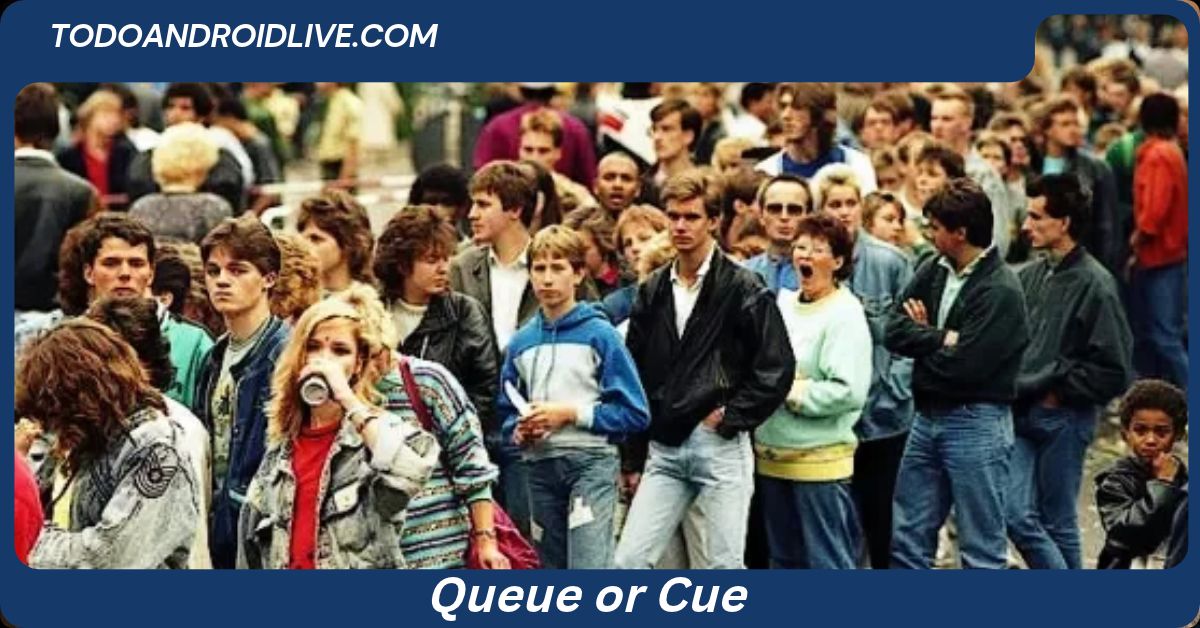
Queue and cue sound exactly alike, but they mean different things.
Queue is a line of people or things waiting for their turn. Cue is a signal that tells someone when to do something.
If you are waiting in a line, the word is queue. If something is a hint, a prompt, or a sign to begin, the word is cue.
Here are four quick examples:
- The queue at the post office stretched out the door.
- The lights dimmed, and that was the cue for the band to start.
- Please queue up at the side entrance.
- Her smile was my cue to ask the question.
Both words are correct English. They are just used in different situations. That is why the question “is it queue or cue?” comes up so often.
Why People Mix Up Queue and Cue
English has many words that sound the same but are spelled differently. These words are called homophones. Queue and cue are a good example. Both are pronounced “kyoo,” and the single letter Q is pronounced the same way too.
Spellcheck does not help much here. Both words are real, so your computer does not mark either one as wrong. It cannot tell which one you meant.
There is a second problem. The word queue looks strange. It has five letters, but only one sound. Many people see it and think it must be a typo, so they shorten it to “cue” or even “que.” Neither is correct when you mean a line.
What Does Queue Mean?
Queue is a noun and a verb. It always has something to do with order and waiting.
Queue as a Noun
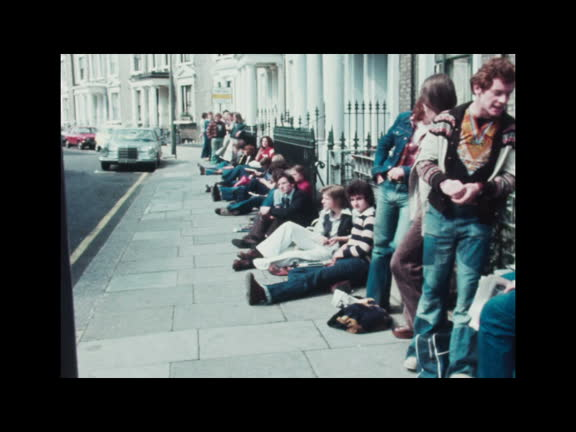
A queue is a line of people, vehicles, or things that are waiting one after another. The first one in line is usually the first one served.
- A queue of cars waited at the toll booth.
- There was a short queue at the food truck.
- Your support ticket is now in the queue.
Queue as a Verb
To queue means to stand or wait in a line. You will often see it with the word “up.”
- Fans began to queue at dawn for concert tickets.
- Shoppers queued up outside the store before the sale.
Queue in Technology
In the United States, the word queue appears most often in technology and customer service. A queue in computing is a list of tasks or messages that wait their turn to be handled.
- A print queue holds documents waiting to be printed.
- A call queue holds callers waiting for an agent.
- A streaming queue holds the videos or songs that will play next.
- A job queue holds tasks that a computer will run in order.
Many programmers also use the phrase “first in, first out,” which describes how a queue normally works.
Queue vs. Line in American English
People in the United States usually say “line” in everyday talk. We say “wait in line,” not “wait in a queue.” People in the United Kingdom, Australia, and India say “queue” much more often in daily life. Both are fine. If your readers are American, “line” will sound the most natural in casual writing, while “queue” fits well in technical or formal writing.
What Does Cue Mean?
Cue is also a noun and a verb. It is about signals, prompts, and timing.
Cue as a Noun
A cue is a sign that tells you when to act or what to do next.
- The teacher’s nod was the cue for the class to stand.
- A green light is a cue to go.
- The smell of coffee was her cue to get out of bed.
Cue as a Verb
To cue someone means to give them a signal.
- The director will cue the actors when the camera is rolling.
- Please cue the next slide.
Cue in the Theater and in Media
The word cue is most closely linked to the stage. In a play, a cue is the line or action that tells an actor, a lighting operator, or a sound technician when to begin. Radio, TV, film, and live events use cues too. A producer might give a light cue, a sound cue, or an audio cue to start a piece of music at the right moment.
Cue in Everyday Language
Outside the theater, cue has a wide meaning. You will see it in many common phrases:
- On cue: happening at exactly the right moment, often by chance.
- Take a cue from someone: copy their example or follow their lead.
- Cue cards: cards that remind a speaker what to say.
- Cue ball: the white ball in pool or billiards.
- Cue stick: the stick used to hit the ball in pool.
Where Do the Words Come From?
Looking at the history of these words helps explain why they look so different.
The Origin of Queue
Queue comes from a French word that means “tail.” That French word goes back to the Latin word for tail. The English language used the word for a tail in older writing, including in the study of heraldry. Later, the meaning grew. A line of people looks a bit like a long tail, so the word was used for a waiting line. This line meaning became common in English in the 1800s, not earlier.
The Origin of Cue
The history of cue is less certain. Dictionaries say the exact origin is unclear. One popular idea is that early theater scripts used the letter Q as a short note for the start of a speech. Another idea is that it came from a Latin word meaning “when.” Neither idea is proven, so it is best to say that experts are not sure.
The pool cue is a different story. The stick is named after the same French word for “tail,” because of its long, thin shape. So the cue stick and the queue line may share a family tree, while the “signal” cue has its own mystery.
Queue vs. Cue: Side-by-Side Comparison
| Feature | Queue | Cue |
| Main meaning | A line of people or things waiting | A signal, hint, or prompt |
| Part of speech | Noun and verb | Noun and verb |
| Pronunciation | kyoo | kyoo |
| Number of letters | 5 | 3 |
| Typical topics | Waiting, order, turns, computers | Timing, signals, performance, behavior |
| Common phrases | In the queue, queue up, print queue | On cue, take a cue, cue cards |
| Verb forms | Queued, queuing or queueing | Cued, cueing or cuing |
Is “Que” a Word? Que vs. Queue vs. Cue
Many people also type “que,” so it is worth clearing up.
Que is not an English word. It does appear in other languages. In Spanish and French, “que” means “what” or “that.” You may know it from the song title “Que Sera, Sera.” It is also sometimes used as the short form for Quebec, written QUE.
If you mean a line of people, do not write que. If you mean a signal, do not write que. Use queue for lines and cue for signals.
So when you ask “que vs. queue” or “que vs. cue,” the answer is the same. Que is a word in another language, while queue and cue are the English words you want.
How to Spell Queue and Its Forms
Queue is hard to spell, so here are the details.
The spelling is Q-U-E-U-E. It has the letter Q, followed by four letters: u, e, u, e. Only the first part, “Q,” makes the sound. The rest are silent.
Spelling Queued, Queuing, and Queueing
- Queued is the past tense: “The customers queued for an hour.”
- Queuing is the usual spelling for the “-ing” form in American English: “We are queuing for the ride.”
- Queueing is also accepted. It is the version with five vowels in a row. Some technical writers use it, especially in computing and math.
Both queuing and queueing are acceptable. Pick one and use it the same way throughout your writing.
Spelling Cue and Its Forms
- Cue is the base word.
- Cued is the past tense: “She cued the lights.”
- Cueing and cuing are both used. Cueing keeps the “e” and is easier to read for many people.
Is Queue an American or British Spelling?
Queue is spelled the same way in the United States, the United Kingdom, Canada, and Australia. There is no separate American spelling. The only difference is how often people use the word. In daily talk, Americans choose “line” more than Britons choose “line.”
Common Phrases: Which One Is Right?
Most mistakes happen inside set phrases. Here are the ones people search for most.
On Cue or On Queue?
The correct phrase is on cue. It means something happens at just the right moment, as if it were planned. Example: “The rain started right on cue, just as we opened the picnic basket.”
“On queue” is a common mistake. It would literally mean “on a line,” which does not make sense here.
Right on Cue or Right on Queue?
Again, the answer is right on cue. Use cue every time you mean perfect timing.
In the Queue or In the Cue?
When you mean waiting in a line, use in the queue. For example: “Your order is in the queue.” “In the cue” is not correct for a line. People who write “waiting in the cue” or “waiting in a cue” have mixed up the words.
In Cue or In the Cue?
These are not standard phrases in English. If you are talking about a signal, you would write “on cue,” “take a cue,” or “the cue was clear.” If you are talking about a line, you would write “in the queue.” Neither “in cue” nor “in the cue” fits.
That’s Your Cue or That’s Your Queue?
Use that’s your cue. It means “that is your signal to act.” Example: “When the music gets louder, that’s your cue to walk out.” The same goes for “that’s my cue,” “this is my cue,” and “take a cue.”
Cue as in Line, or Cue in Line?
Cue never means a line. This is one of the most common errors. The phrases “cue in line,” “line cue,” and “a cue at the store” should all use queue. The correct sentences are “queue in a line” or just “wait in line.”
Visual, Audio, Sound, and Social Cue
These terms are used in teaching, psychology, design, and daily life. The word is always cue.
Visual Cue or Visual Queue?
The correct term is visual cue. A visual cue is something you see that gives you information or a signal. A red stop sign, an arrow on the floor, and a blinking light are all visual cues. A graphic designer may use color or size as a visual cue to guide your eyes.
Audio Cue and Sound Cue
An audio cue or sound cue is something you hear that gives a signal. A phone ringtone, a car horn, and a bell at the end of a class are all examples. In video games and apps, a short sound often tells you that you earned a point or that something went wrong.
Social Cue or Social Queue?
The correct term is social cue. Social cues are the small signals people give each other during a conversation. They include tone of voice, eye contact, facial expressions, and body language. If someone checks their watch while you are talking, that can be a social cue that they need to leave.
Some people find social cues hard to read. Learning to notice them can help with communication at work and at home.
Cue the Music or Queue the Music?
This is another top search, and it is where things get interesting. Both words can be right, but they mean different things.
Cue the Music
Cue the music means to give the signal for the music to start. It comes from film, TV, and theater. Example: “The scene ends, and the director says, ‘Cue the music!'”
Queue the Music or Queue a Song
To queue music means to add songs to a waiting list so they play later. Example: “I will queue three more songs after this one.” Streaming apps use the word queue for the list of songs coming up next.
Cue Up a Song
To cue up a song means to get it ready at the exact starting point so it plays right away at the push of a button. Disc jockeys use this phrase a lot.
Cue It Up or Queue It Up?
Both can be right. Use cue it up when you are preparing something to start at the right time. Use queue it up when you are adding it to a line of things that will happen in order.
- Cue up the video: get it ready at the right spot.
- Queue up the videos: place several videos in order.
You will also see “cued up” and “queued up.” They follow the same rule. Cued up means ready to start. Queued up means waiting in order.
Cue Cards or Queue Cards?
The correct term is cue cards. Cue cards are cards that hold short notes or lines to help a speaker remember what to say. News readers, actors, and students giving speeches often use them. They are cues because they prompt the speaker. They are not a queue.
Cue or Queue Plurals: Cues vs. Queues
The plural of cue is cues, and the plural of queue is queues.
- The actors learned all their cues.
- Several queues formed at the airport gates.
People sometimes write “ques” as the plural, but that is wrong in English. Use cues or queues.
Cueing vs. Queuing
These two forms sound the same too, so they confuse people.
- Cueing means giving a signal. Example: “The stage manager is cueing the lights.”
- Queuing means waiting in line. Example: “The tourists are queuing for the museum.”
Remember that cueing is tied to signals and queuing is tied to lines.
Easy Ways to Remember the Difference
You do not have to guess. Here are simple tricks that work.
The Tail Trick
Queue is a long word, and a queue is a long line. The word even comes from the old word for tail. If your sentence is about a long line of people, use the long word.
The Short Signal Trick
A cue is a quick, short sign. The word is short too, with only three letters.
The Swap Test
Try swapping in the word “line” or “signal.”
- If “line” makes sense, write queue.
- If “signal” makes sense, write cue.
Test it: “We waited in the (line/signal).” Line works, so the word is queue. Now try this one: “That was my (line/signal) to leave.” Signal works, so the word is cue.
The Phrase Check
Learn the most common cue phrases, such as on cue, take a cue, cue cards, cue ball, and visual cue. If your phrase is on that list, you are safe. For most other cases involving waiting, use queue.
Common Mistakes and How to Fix Them
Mistake 1: Using Cue for a Line
Wrong: We stood in a long cue outside the stadium.
Right: We stood in a long queue outside the stadium.
Mistake 2: Using Queue for a Signal
Wrong: The bell was my queue to start.
Right: The bell was my cue to start.
Mistake 3: Writing Que
Wrong: There is a que at the bank.
Right: There is a queue at the bank.
Mistake 4: Writing On Queue
Wrong: The delivery truck arrived on queue.
Right: The delivery truck arrived on cue.
Mistake 5: Mixing Up Cue Up and Queue Up
Wrong: Cue up behind the red line. (This is a request to wait in line.)
Right: Queue up behind the red line.
Also correct: Cue up the next slide. (This means to get it ready to show.)
Queue or Cue in Real-Life Writing
Seeing the words in context makes the rule easier to remember.
At Work
- Your request is in the queue and will be reviewed soon.
- The manager’s frown was a cue to end the meeting.
In School
- Students formed a queue outside the library.
- The teacher used a bell as a cue for silence.
Online and in Apps
- Add the song to your queue.
- The loading icon is a visual cue that the page is working.
In Customer Service
- You are number four in the queue.
- A customer’s raised voice can be a cue to slow down and listen.
In Daily Conversation
- I hate waiting in the queue at the pharmacy.
- When she yawned, that was my cue to say good night.
Frequently Asked Questions
Is it queue or cue for a line of people?
It is queue. A queue is a line of people waiting for something. Cue is never used for a line.
How do you spell the word queue?
Queue is spelled Q-U-E-U-E. Think of it as the letter Q followed by four silent letters.
Is queue a real word?
Yes. Queue is a real English word found in all major dictionaries. It means a line of people or things waiting, and it can also be used as a verb.
What is the difference between que and queue?
Que is not an English word. It means “what” or “that” in Spanish and French. Queue is the correct English spelling for a waiting line.
Is it “cue the music” or “queue the music”?
Both are correct, but they mean different things. Cue the music means to signal the start of the music. Queue the music means to line up songs to play later.
What does “cue up” mean?
To cue up something means to get it ready at the right starting point. For example, you can cue up a song, a video, or a slide.
What does “queue up” mean?
To queue up means to get into a line or to place items in an order to be handled one after another. It can describe people or tasks.
What does “take a cue” mean?
Taking a cue means following someone’s lead or example. For instance, “She took a cue from her coach and stayed calm.”
Is “take a queue” correct?
No. The correct phrase is take a cue.
What is the meaning of “in the queue”?
In the queue means waiting in line for your turn. In software or customer service, it means your request is waiting to be handled.
Can cue ever mean a line?
No. Cue only means a signal, a prompt, or a stick used in pool. It does not mean a waiting line.
Is queuing or queueing correct?
Both are accepted. Queuing is more common in everyday American writing. Queueing is sometimes used in technical fields. Choose one and stay consistent.
Is it cueing or cuing?
Both spellings are used. Cueing is a little more common in many style guides, but both are acceptable.
Is queue British or American?
The spelling is the same in both. British speakers use the word in daily talk more often than Americans, who typically say “line.”
What is a social cue?
A social cue is a small signal people give in conversation, such as a smile, a tone of voice, or crossed arms. These signals help people understand feelings and intentions.
Why is queue spelled with so many letters?
The spelling comes from French. English kept the original French spelling when it borrowed the word, even though the sound is short.
What does “define q u e u e” mean?
People who type the word with spaces are usually checking the spelling. The word Q-U-E-U-E means a line of people or things waiting in order.
Conclusion
Queue or cue? The answer depends on the meaning you want.
Use queue when you are talking about a line, a wait, or a list of things in order. Use cue when you are talking about a signal, a hint, or a prompt to act. Remember that “on cue,” “visual cue,” “social cue,” “audio cue,” “cue cards,” and “take a cue” all use the shorter word. Phrases like “in the queue,” “print queue,” and “queue up” all use the longer one.
Some phrases, such as cue up and queue up, or cue the music and queue the music, can both be correct. In those cases, ask yourself whether you mean to signal something or to line it up.
Que is not an English word, so leave it out of your writing. When in doubt, try the swap test with “line” and “signal.” That simple check will help you choose the right word every time.