

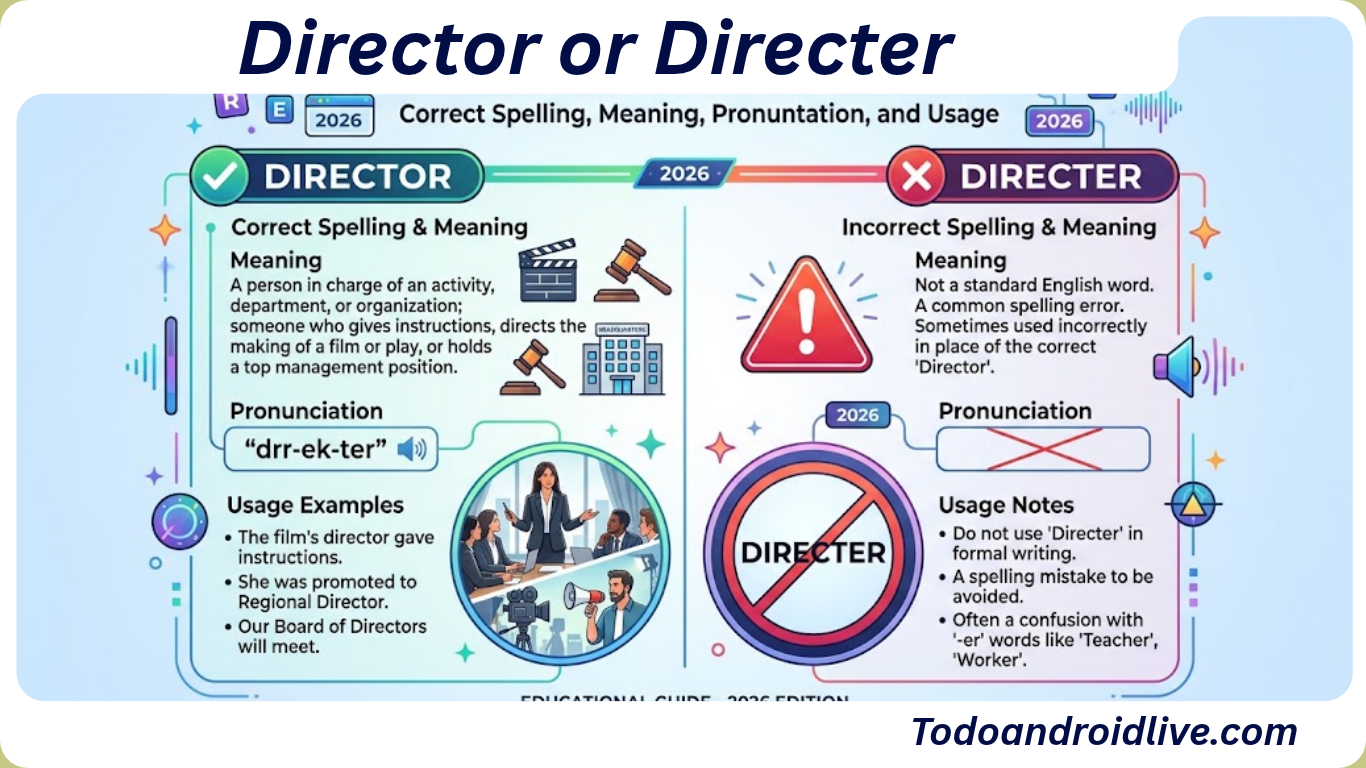
Have you ever wondered whether to write director or directer? This spelling question can arise when writing a business email, preparing a résumé, completing a school assignment, or talking about a movie. Both spellings may look reasonable at first, but only one is the standard choice in modern English.
The correct spelling is director. Directer is a common misspelling when referring to a person who directs, manages, or leads something.
Knowing how to spell director correctly is important because this word appears in many professional settings. A director may lead a company department, supervise a team, guide actors during a film, or oversee a school’s programs. The word also appears in job descriptions, business reports, movie credits, and formal documents.
However, correct spelling is only part of learning this word. People also search for director pronunciation, director syllables, the origin of the word director, director synonyms in English, and the difference between director, directors, and director’s.
This guide covers these questions in simple English. You will learn how to spell and pronounce director, understand its grammatical forms, avoid common typos, and choose suitable synonyms for different situations.
Director or Directer: What Is the Correct Spelling?
Director is the correct spelling in standard English. Directer is not the accepted spelling for the noun used to describe a person who directs or leads an activity.
If you are searching for the correct spelling of director, remember that the word ends in -or, not -er.
Correct: The director approved the new project.
Incorrect: The directer approved the new project.
Here are more examples:
- The company hired a new director.
- The movie director received praise for the film.
- Our school director announced the new schedule.
- The board of directors met to discuss the annual report.
In each example, director or directors is the correct form.
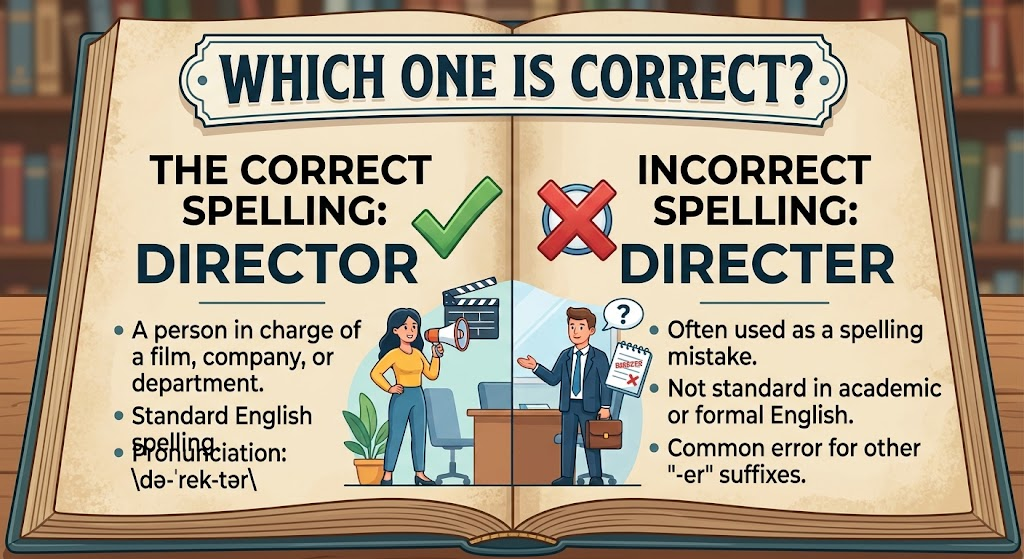
How to Spell Director Correctly
If you want to know how do you spell director, the answer is:
D-I-R-E-C-T-O-R
Director contains eight letters. It begins with D, includes the sequence R-E-C-T in the middle, and ends with O-R.
A helpful spelling reminder is to connect director with familiar words such as actor and editor. These words also end in -or, which may help you remember the correct letter pattern.
The word directer may seem logical because many English nouns end in -er. For example, a person who teaches is a teacher, and a person who drives is a driver. However, English spelling has different patterns, and the correct noun related to direct is director.
How Do You Spell Directors?
The plural of director is directors.
Also Read: Houston Rockets vs Oklahoma City Thunder Timeline
To form the plural, add s to director without changing the original spelling.
- One director attended the meeting.
- Three directors attended the meeting.
- The directors reviewed the company’s plans.
The correct spelling of directors is D-I-R-E-C-T-O-R-S. Avoid writing directers when referring to multiple people who direct or manage something.
What Does Director Mean in English?
Director is a noun that describes a person who guides, manages, supervises, or takes responsibility for an activity, organization, or production.
The exact director definition depends on the situation. In a company, a director may help establish business goals or oversee a department. In the entertainment industry, a film director guides the creative work involved in making a movie.
Here are some common uses of director in English.
Director in Business
A business director may oversee operations, make strategic decisions, manage departments, or serve on a company’s board. Responsibilities vary depending on the organization and the position.
Example: The operations director introduced a new system to improve the team’s performance.
Film Director
A film director guides the artistic and dramatic parts of a movie. The director may work with actors, cinematographers, editors, and other members of the production team.
Example: The film director asked the actors to perform the scene again.
School or Program Director
A school or program director may supervise staff, manage educational activities, and help an institution meet its goals.
Example: The program director organized a workshop for new students.
Board of Directors
A board of directors is a group responsible for overseeing an organization’s activities and major decisions. The phrase is commonly used in business, nonprofit organizations, and other institutions.
Example: The board of directors approved the proposed budget.
These examples show that director is a flexible word. Its meaning changes according to the person’s responsibilities, but its standard spelling does not change.
Director Pronunciation: How to Pronounce Director in English
The pronunciation of director differs slightly across English accents. In most common pronunciations, the word has three syllables, with the strongest stress on the middle syllable.
A simple pronunciation guide is dih-REK-ter.
This is an approximation rather than an exact phonetic transcription. The first vowel and the final r may sound different depending on the speaker’s accent.
If you are learning how to pronounce director, begin by saying the word slowly. Then repeat it at a natural speaking speed.
Example: The director will attend the meeting tomorrow.
Practicing the word in a sentence helps you understand how it sounds in everyday conversation.
Director American Pronunciation
The director pronunciation in American English commonly resembles /dəˈrɛktɚ/ or /dɪˈrɛktɚ/. The exact transcription varies by speaker and dictionary.
American English generally pronounces the final r. This is one of the most noticeable differences between many American and British pronunciations.
When practicing the director pronunciation American English speakers use, focus on three parts:
- The opening syllable, which is usually short and unstressed.
- The middle syllable, REK, which receives the main stress.
- The final syllable, which normally includes a clearly pronounced r.
Example: The director explained the plan to the team.
The goal is not to imitate every American accent. Instead, learn a clear, natural pronunciation that people can understand easily.
Director British Pronunciation
The director pronunciation British speakers use can sound slightly different from the American version.
A common British pronunciation is approximately /dɪˈrɛktə/. In many non-rhotic British accents, the final r is not pronounced when the word ends before a pause or consonant.
The stress still falls on the middle syllable.
Example: The director spoke to the audience after the performance.
There is no single British accent. Pronunciation can vary across England, Scotland, Wales, and Northern Ireland, so individual speakers may say the word differently.
Director Pronunciation in Australian English
The director pronunciation Australia speakers use is generally similar to other English varieties in its syllable structure and stress pattern.
Australian English commonly does not pronounce the final r when it occurs at the end of a word before a pause. Vowel sounds may also differ from those heard in American English.
The important point is that Australian speakers still spell the word director.
Director Pronunciation in English: A Simple Practice Method
If you want to improve your pronunciation director skills, use this short exercise:
- Read the word director slowly.
- Divide it into three syllables: di-rec-tor.
- Give the middle syllable the strongest stress.
- Repeat the word several times without exaggerating the sounds.
- Use it in a sentence about work, school, or entertainment.
You can also listen to a reputable English dictionary’s audio recording to compare American and British pronunciations.
When searching for director pronunciation Google results, look for dictionary audio and IPA transcriptions rather than relying only on informal spellings.
Director Syllables and Phonetic Transcription
One useful way to understand pronunciation is to study director syllables and phonetics.
Director usually has three syllables:
di-rec-tor
The main stress falls on the second syllable. In a simple learner-friendly spelling, this is shown as dih-REK-ter.
A phonetic transcription uses special symbols to represent speech sounds. Common IPA representations include /dəˈrɛktɚ/ in American English and /dɪˈrɛktə/ in some British English pronunciations.
These symbols help explain pronunciation more accurately than ordinary spelling can. Different dictionaries may use slightly different transcriptions because they follow different pronunciation systems or represent different accents.
Is Director Pronounced With a J Sound?
No. Standard English pronunciation begins director with the /d/ sound, as in day or door. The middle consonant sequence includes a /k/ sound.
Some learners may confuse the sound pattern when they first encounter the word. Practicing the opening /d/ and middle /k/ separately can help make the pronunciation clearer.
How to Pronounce Directors
Directors is pronounced like director with an additional plural ending. In standard English, the final s is generally pronounced /z/ because it follows a voiced sound.
Example: The directors discussed the proposal.
When learning how to pronounce directors, maintain the same main stress as in director. The plural ending does not move the stress to another syllable.
Why Is Director Spelled With -or Instead of -er?
Many English nouns describing people end in -er. Examples include teacher, writer, driver, and manager. Other nouns end in -or, including actor, editor, and director.
There is no universal rule that makes every noun formed from a verb use the same ending. English spelling reflects historical development, established word forms, and patterns inherited from other languages.
The verb direct means to guide, lead, instruct, or control the course of an activity. The standard noun for a person who performs this role is director.
Writing directer applies a familiar spelling pattern to a word that does not use that ending in standard English.
Etymology of Director
The origin of the word director can be traced to Latin. It is connected with dirigere, meaning to guide, direct, or set straight, and the Latin noun director, referring to someone who directs.
The word developed in English through historical language influences, including French and Latin. Its established English spelling is director.
This history helps explain why director should be learned as a complete word rather than created by simply adding -er to direct.
For everyday writing, you do not need to memorize the full history. Remembering the established spelling is enough to avoid the most common mistake.
Director Spelling in American and British English
A common question is whether director changes spelling between American and British English.
The answer is no. Both varieties use director as the standard spelling.
| Word or form | American English | British English |
| Director | Correct | Correct |
| Directer | Incorrect for the intended noun | Incorrect for the intended noun |
| Directors | Correct | Correct |
| Director’s | Correct | Correct |
| Directors’ | Correct | Correct |
Some English words have regional spelling differences. For example, American English commonly uses color, while British English commonly uses colour. Director does not follow this pattern.
The main regional differences involve pronunciation rather than spelling.
Whether you are writing for a US company, a British university, or an international audience, director is the appropriate form.
Director, Directors, Director’s, and Directors’: Understanding the Difference
These forms are related, but each serves a different grammatical purpose. Learning the distinction can help you avoid errors in professional and academic writing.
Director: Singular Form
Use director when referring to one person.
Also Read:Persuing or Pursuing: Meaning, Difference, Correct Spelling, and Examples
Example: The director signed the document.
Directors: Plural Form
Use directors when referring to two or more people.
Example: The directors attended the conference.
Director’s: Singular Possessive
Use director’s when something belongs to or is associated with one director.
Example: The director’s office is on the second floor.
Directors’: Plural Possessive
Use directors’ when something belongs to or is associated with multiple directors.
Example: The directors’ meeting lasted two hours.
How to Spell Board of Directors
The correct phrase is board of directors.
It refers to a group of people who oversee an organization or business. The word directors is plural because the board normally includes multiple members.
Example: The board of directors reviewed the company’s annual report.
Do not write board of directers. Also, do not add an apostrophe to directors unless you need to express possession.
Common Typos and Misspellings of Director
People may make spelling errors because they type quickly, misunderstand English word patterns, or confuse similar-looking words.
The most common mistake in this comparison is directer. Other possible typing errors include directior, direcotr, and diretor.
These errors should be corrected to director when the intended meaning is the standard English noun.
Why Do People Spell Director Incorrectly?
Several reasons explain why these mistakes occur.
First, the -er ending is common in English. A learner may assume that directer follows the same pattern as teacher or driver.
Second, typing too quickly can cause letters to appear in the wrong order. A writer may accidentally type direcotr instead of director.
Third, autocorrect does not always identify every mistake, especially when an incorrect form appears in a name, unusual text, or specialized context.
How to Avoid Director Spelling Mistakes
Use these simple methods:
- Memorize the letter sequence D-I-R-E-C-T-O-R.
- Check that the final two letters are O-R.
- Use a trusted dictionary if you are uncertain.
- Proofread job titles and formal documents before submitting them.
- Check the plural and possessive forms separately.
- Read the sentence again to ensure that the chosen word matches the intended meaning.
These habits are useful for students, professionals, English learners, and anyone who wants to improve written communication.
How to Use Director in a Sentence
Understanding the meaning of director becomes easier when you see how the word works in different situations.
Business Examples
- The director presented the new business plan.
- The marketing director introduced the advertising campaign.
- The operations director reviewed the team’s performance.
- The board of directors approved the proposal.
- The director’s decision affected the project schedule.
Film and Entertainment Examples
- The director created a memorable ending for the movie.
- The film director worked closely with the actors.
- She wants to become a theater director.
- The directors discussed their creative ideas.
- The director explained the scene before filming began.
School and General Examples
- The school director welcomed the visiting teachers.
- The program director organized a student event.
- Our director asked everyone to arrive on time.
- The director announced changes to the schedule.
Notice that director remains unchanged when the type of organization changes. The surrounding words explain what kind of director the sentence describes.
Director Synonyms in English: What Is Another Word for Director?
People often search for another word for director when they want to improve their vocabulary, avoid repetition, or describe a particular leadership role more precisely.
However, a director synonym should match the meaning of the original sentence. Some alternatives describe leadership, while others refer to management or creative work.
Here are useful director synonyms and their meanings.
| Synonym | Meaning | Example |
| Leader | A person who guides a group | The leader explained the team’s goals. |
| Manager | A person who supervises work or operations | The manager organized the daily schedule. |
| Head | A person in charge of a group or department | The head of marketing approved the campaign. |
| Executive | A person with senior business responsibilities | The executive reviewed the company’s strategy. |
| Supervisor | A person who oversees other people’s work | The supervisor checked the completed tasks. |
| Administrator | A person who manages organizational activities | The administrator updated the records. |
| Chief | A person in a leading position | The chief announced the new policy. |
| Coordinator | A person who organizes activities and people | The coordinator arranged the event. |
| Filmmaker | A person involved in making films | The filmmaker discussed the new documentary. |
| Producer | A person who organizes or oversees a film or other production | The producer arranged the production schedule. |
These words are not always interchangeable. A manager may handle daily tasks, while a director may be responsible for wider strategic decisions. A producer and a film director also have different responsibilities, even though they work together.
Another Word for Movie Director
If you need a movie director synonym, the best alternative depends on the context.
Filmmaker is a broad term for someone involved in creating films. Film director is the clearest title when you mean the person who guides the film’s creative and dramatic presentation.
Example: The filmmaker received recognition for the movie.
The word filmmaker does not always identify the director specifically, so use it only when the wider meaning fits.
Director Synonyms and Antonyms
There is no single perfect antonym for director because the word describes a role rather than a quality with a direct opposite.
Depending on the sentence, possible contrasts may include follower, subordinate, or team member. These terms describe different positions in a group, but they are not exact opposites in every situation.
For example, a director may also be a team member within a larger organization. Context determines which word makes sense.
Director and Manager: What Is the Difference?
Director and manager are both job titles associated with leadership, but their responsibilities can differ.
A director often oversees a broad area of work, helps set long-term goals, or makes decisions affecting an entire department or organization. A manager often focuses on daily operations, schedules, staff assignments, and the completion of specific tasks.
For example, a sales director might establish annual sales goals, while a sales manager organizes the team’s weekly activities.
These distinctions are not universal. In some organizations, directors manage day-to-day work, and in others, managers hold substantial decision-making authority. Always consider the job description instead of assuming that the title alone explains every responsibility.
Related Words: Direct, Directing, Directorial, and Directorate
Director belongs to a family of related English words. Learning these forms can improve vocabulary and help you select the correct word for each sentence.
Direct
Direct can be a verb or an adjective. As a verb, it means to guide or manage something.
Example: She will direct the actors during the rehearsal.
Directing
Directing is the -ing form of direct. It refers to the activity of guiding, supervising, or leading a process.
Example: Directing a movie requires communication and planning.
Directorial
Directorial is an adjective related to a director or the work of directing.
Example: The film received praise for its directorial style.
Directorate
Directorate is a noun that may refer to a group of directors or an administrative department, depending on the organization.
Example: The directorate introduced updated procedures.
Also Read:Happend or Happened: Correct Spelling, Meaning, and Examples (2026)
These words have related meanings, but they cannot replace one another in every sentence. Use director for the person and select the related form according to the grammatical meaning you need.
Frequently Asked Questions About Director
How do you spell director correctly?
The correct spelling is director: D-I-R-E-C-T-O-R. The word ends in -or, not -er.
Is directer ever correct in standard English?
Directer is not the standard spelling for a person who directs or manages something. Use director in ordinary modern English writing.
How many syllables does director have?
Director usually has three syllables: di-rec-tor. The main stress falls on the middle syllable.
How do you pronounce director in American English?
A common American pronunciation is /dəˈrɛktɚ/. The final r is generally pronounced, although vowel sounds vary among speakers.
How do you pronounce director in British English?
A common British pronunciation is approximately /dɪˈrɛktə/. In many British accents, the final r is not pronounced before a pause or consonant.
What is the plural of director?
The plural is directors. Add s to the end of director without changing the rest of the spelling.
What is the difference between director’s and directors’?
Director’s is the singular possessive form, while directors’ is the plural possessive form. Directors without an apostrophe is the ordinary plural.
Conclusion
Director is the correct standard spelling, while directer is a misspelling when used to refer to someone who directs, manages, or leads an activity. The word appears in business, education, entertainment, and many other areas of everyday life.
To remember the correct spelling, focus on the final -or ending and the eight-letter sequence D-I-R-E-C-T-O-R. Learn the plural directors and the possessive forms director’s and directors’ so you can use each one correctly.
Pronunciation varies between American, British, and Australian English, but the word generally has three syllables with stress on the middle syllable. Understanding its meaning, related words, and synonyms can also help you communicate more precisely.
Whether you are preparing a professional email, writing about a movie, completing an assignment, or describing a leadership role, choosing director will help keep your writing clear, correct, and professional.