

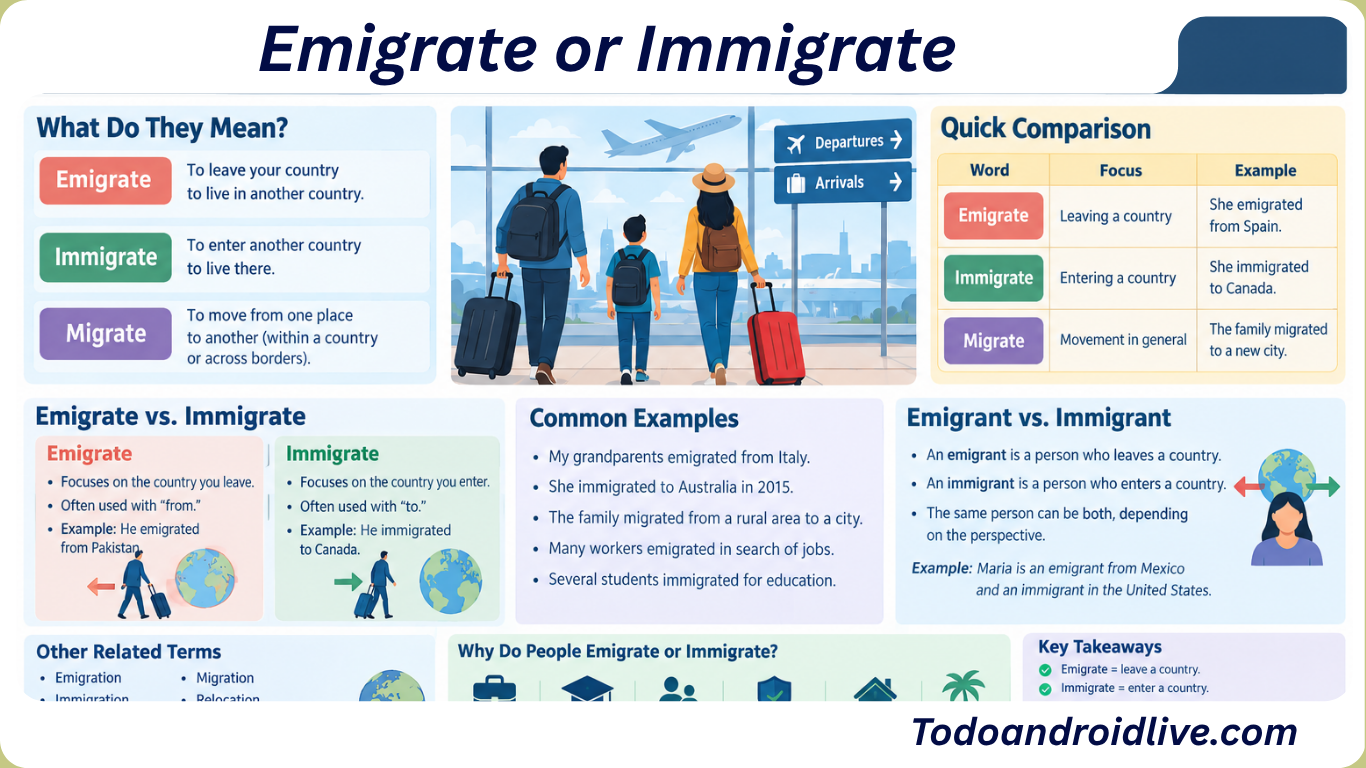
Choosing between emigrate or immigrate can be confusing because both words describe moving from one country to another. However, they have different meanings. One focuses on leaving a country, while the other focuses on entering a new country to live there.
For example, a person moving from India to the United States emigrates from India and immigrates to the United States. Both words describe the same journey, but each presents it from a different perspective.
Understanding the difference between emigrate and immigrate helps you use the correct word in everyday conversations, school assignments, professional writing, news reports, and discussions about international migration.
This guide explains the meaning of both words, compares them with migrate, provides practical examples, and answers common questions about emigration, immigration, emigrants, and immigrants.
Emigrate or Immigrate: What Is the Difference?
The main difference between emigrate and immigrate is the direction from which you view an international move.
- Emigrate means to leave your country to live in another country.
- Immigrate means to enter another country to establish residence there.
- Migrate means to move from one place to another, either within a country or across national borders.
Consider a family moving from Brazil to Canada. From Brazil’s perspective, the family emigrates from Brazil. From Canada’s perspective, the family immigrates to Canada. The overall movement can also be described as migration.

A simple way to remember the distinction is to associate emigrate with exiting and immigrate with entering.
| Word | Definition | Example |
| Emigrate | Leave a country to live elsewhere | She emigrated from Spain. |
| Immigrate | Enter another country to live there | She immigrated to Canada. |
| Migrate | Move from one place to another | The family migrated overseas. |
The words are related, but they are not interchangeable in every sentence. Choosing the right one depends on what you want to emphasize.
What Does Emigrate Mean?
The emigrate meaning refers to leaving one’s country to establish a life in another country. The word emphasizes departure from the original country.
For example, if a teacher leaves Pakistan to settle in Australia, the teacher emigrates from Pakistan. The sentence focuses on the country the teacher has left.
Emigrate Definition in Simple English
To emigrate means to move away from your home country to live somewhere else, usually for an extended period.
People may emigrate for employment, education, family reunification, safety, retirement, or other personal reasons. The word describes the movement rather than the reason for it.
Emigration generally involves relocation rather than a short vacation. However, the exact definition used in official statistics can depend on the country and its residence rules.
What Does It Mean to Emigrate From a Country?
The expression emigrate from identifies the country a person leaves.
Examples include:
Also Read: Engrained or Ingrained: Standard Spelling, Definitions, and Complete Usage Guide
- My grandparents emigrated from Italy many years ago.
- She plans to emigrate from Pakistan after accepting a job abroad.
- Several families emigrated from the region during the economic crisis.
- He decided to emigrate from the United Kingdom to pursue new opportunities.
These examples use emigrate correctly because they emphasize departure.
Emigrate in a Sentence
Here are additional emigrate examples:
- My cousin hopes to emigrate next year.
- Many workers emigrated from the country in search of better employment.
- The family decided to emigrate from Greece.
- She is considering whether to emigrate after graduation.
- Thousands of people emigrated during that period.
The word can be used in different tenses. Emigrates describes an action in the present, emigrated describes a past action, and emigrating describes an ongoing or developing action.
For example, “He is emigrating from Brazil” describes a move that is in progress or being discussed as an ongoing process.
What Does Immigrate Mean?
Immigrate means to enter a country other than one’s country of origin or previous residence to live there. It emphasizes the destination rather than the departure point.
Suppose a student moves from Nigeria to the United States to establish a home. From the American perspective, the student immigrates to the United States.
Immigrate Definition in Simple English
To immigrate means to move into another country to live there, often for a substantial period.
People immigrate for reasons such as work, education, family connections, safety, and long-term settlement. The word does not automatically indicate whether someone has citizenship, permanent residence, or a temporary immigration status.
Immigration and citizenship are separate concepts. A person may immigrate to a country without becoming a citizen immediately or ever becoming one.
What Does It Mean to Immigrate to a Country?
The expression immigrate to identifies the destination country.
Examples include:
- Her family immigrated to Canada in 2016.
- He immigrated to the United States to join his relatives.
- Several researchers immigrated to Germany for professional opportunities.
- They hope to immigrate to New Zealand in the future.
In each example, the destination is the focus.
Immigrate in a Sentence
The following examples show how to use immigrate in different contexts:
- My great-grandparents immigrated to the United States decades ago.
- She wants to immigrate to Australia after completing her education.
- The scientist immigrated to France for a research position.
- Many families immigrated to the country to reunite with relatives.
- He had immigrated to Canada before his children were born.
These sentences show how immigrate works in everyday and formal English.
Emigrate vs. Immigrate vs. Migrate
The difference between emigrate, immigrate, and migrate becomes clearer when you understand how broadly each word can be used.
Emigrate and immigrate usually describe international relocation. Migrate is a broader term that can describe movement within a country, between countries, or in certain animal and biological contexts.
What Does Migrate Mean?
Migrate means to move from one place to another. Depending on the context, the movement may be temporary, seasonal, or long-term.
For example:
- A family migrated from a rural area to a large city.
- Birds migrate to warmer regions during certain seasons.
- Workers migrated to cities to find employment.
- Some people migrate internationally to pursue education.
Unlike emigrate and immigrate, migrate does not automatically tell the reader whether a person is leaving a country or entering another one.
Migrate vs. Emigrate
Migrate is broader than emigrate.
A person moving from one state to another within the United States has migrated but has not normally emigrated. A person leaving the United States to establish a home in another country may be described as emigrating.
Examples:
- The family migrated from Texas to California.
- The family emigrated from the United States to Portugal.
The first sentence describes domestic movement. The second emphasizes departure from a country.
Migrate vs. Immigrate
Migrate describes movement generally, while immigrate specifically emphasizes entering a country to live there.
For example, “The family migrated to Canada” describes movement to Canada. “The family immigrated to Canada” more specifically emphasizes entering Canada as a place of residence.
Both sentences can be correct, but immigrate is more precise when the topic concerns international settlement.
Immigration vs. Emigration vs. Migration
These nouns describe related concepts:
| Term | Meaning | Example |
| Emigration | Leaving a country to live elsewhere | Emigration from Spain increased during the period. |
| Immigration | Entering a country to live there | Immigration to Canada changed over time. |
| Migration | Movement from one place to another | Migration can occur within or between countries. |
The difference between immigration and emigration is mainly perspective. Immigration focuses on arrivals, while emigration focuses on departures.
Emigrant vs. Immigrant: What Is the Difference?
An emigrant is a person who leaves a country to live in another country. An immigrant is a person who enters a country to live there.
Imagine that Maria moves from Mexico to the United States. She is an emigrant from Mexico’s perspective and an immigrant from the United States’ perspective.
The words describe the same person in different contexts.
Emigrant and Immigrant Examples
- The emigrants left Ireland to establish homes abroad.
- The immigrants arrived in Canada to reunite with their families.
- The country recorded the number of people who emigrated during the year.
- The city welcomed immigrants who had recently settled there.
Immigrant vs. Migrant
An immigrant is a person entering a country to live there. A migrant is a broader term for someone moving from one place to another.
For example, a person who moves from Florida to New York may be called a domestic migrant. Someone who moves from Mexico to the United States to live there may be called an immigrant in the destination-country context.
The term migrant does not automatically indicate citizenship, legal status, or the reason for moving.
What Does Émigré Mean?
An émigré is a person who has left their home country, often because of political circumstances or opposition to a government. The word appears frequently in historical and literary writing.
Although émigré is related to emigrant, it can suggest a more specific political or historical context. It should not automatically replace emigrant in ordinary writing.
Emigration vs. Immigration: Definitions and Examples
Emigration and immigration are nouns formed from emigrate and immigrate. They describe the departure and arrival sides of international movement.
What Is Emigration?
Emigration is the process of leaving a country to live somewhere else.
For example, when a person leaves South Korea to establish a home in Canada, the move can be described as emigration from South Korea.
Emigration statistics can help researchers study population changes, employment patterns, family relocation, and international movement.
What Is Immigration?
Immigration is the process of entering another country to live there.
The same person moving from South Korea to Canada is part of Canada’s immigration process when viewed from the destination country’s perspective.
Immigration statistics may help explain population growth, labor supply, family reunification, and settlement patterns.
Emigration and Immigration in One Sentence
Both terms can appear together when a sentence discusses departure and arrival.
Examples:
- Her emigration from Brazil and immigration to Canada occurred in the same year.
- Researchers examined emigration from rural regions and immigration into major cities abroad.
- The report compared immigration and emigration patterns over a decade.
When both countries matter, using both terms can make your meaning more precise.
Emigrate or Immigrate: Grammar, Word Forms, and Usage
Understanding the different forms of these words helps you use them correctly in sentences.
| Word form | Emigrate | Immigrate |
| Base form | Emigrate | Immigrate |
| Third-person singular | Emigrates | Immigrates |
| Simple past | Emigrated | Immigrated |
| Present participle | Emigrating | Immigrating |
| Noun | Emigration | Immigration |
| Person noun | Emigrant | Immigrant |
Emigrated vs. Immigrated
Emigrated and immigrated are past-tense forms of their respective verbs.
Alos Read: Charlotte Hornets vs Celtics Match Player Stats, Game Recap, and Full Box Score
Use emigrated when the sentence emphasizes leaving a country. Use immigrated when it emphasizes entering a country.
Examples:
- She emigrated from Japan in 2019.
- She immigrated to Canada in 2019.
- The family had emigrated before the new rules took effect.
- The family had immigrated before their youngest child started school.
The two forms can appear in the same account because they describe different perspectives on the move.
Emigrating vs. Immigrating
Emigrating and immigrating describe actions in progress or actions considered in relation to another event.
Examples:
- The family is emigrating from Venezuela.
- The family is immigrating to Spain.
- He considered emigrating after receiving a job offer.
- She is preparing the documents needed to immigrate.
Choose the form that fits the sentence’s tense and meaning.
How to Use From and To
The prepositions from and to can help readers understand direction.
Emigrate commonly appears with from when the writer identifies the departure country. Immigrate commonly appears with to when the writer identifies the destination.
For example:
- He emigrated from Egypt.
- He immigrated to Canada.
- He emigrated from Egypt to Canada.
The third sentence is also correct because it includes both the departure and destination. Emigrate can be used with to when the sentence describes a move away from one country toward another. The key is the perspective, not a rigid rule that emigrate can never be followed by to.
Common Mistakes With Emigrate or Immigrate
Writers often confuse these words because they describe connected parts of the same event.
Treating the Words as Interchangeable
The words are related but have different emphases.
If the sentence focuses on leaving France, “She emigrated from France” is clear. If it focuses on entering the United States, “She immigrated to the United States” is clearer.
Confusing Immigration With Citizenship
Immigrating does not automatically make someone a citizen. Citizenship and permanent residence have separate legal definitions and requirements.
Using Emigrate for a Short Holiday
A person who visits another country for two weeks has traveled abroad. The word emigrate is usually inappropriate unless the context describes relocation to live elsewhere.
Confusing Emigrant With Immigrant
An emigrant is viewed from the country being left. An immigrant is viewed from the destination country. The same person can be both.
Using Migration Without Enough Context
Migration is a broad term. If you are writing about international arrivals or departures, immigration or emigration may communicate your meaning more precisely.
Why Do People Emigrate or Immigrate?
People move between countries for many reasons. The reason for the move does not change the basic distinction between emigrate and immigrate.
Common reasons include:
- Employment: finding a job or pursuing career development.
- Education: attending a university or completing research.
- Family: joining relatives or reuniting with a spouse.
- Safety: escaping conflict, persecution, or other serious threats.
- Lifestyle: choosing a different environment or community.
- Retirement: settling closer to family or in a preferred location.
For example, a nurse who leaves India to work in Australia emigrates from India and immigrates to Australia if the move involves establishing residence there.
How Emigration and Immigration Affect Population Statistics
Emigration and immigration are important in population research because they describe movements that can change the number of people living in a country.
What Is Net Migration?
Net migration is generally calculated by subtracting the number of emigrants from the number of immigrants during a defined period, provided the figures use comparable definitions.
For example, if a country records 100,000 immigrants and 70,000 emigrants in one year, its net migration is positive 30,000.
This figure does not represent total population growth because births, deaths, and other adjustments also affect population change.
Gross Migration vs. Net Migration
Gross migration describes the total volume of inward and outward movement, while net migration represents the difference between those movements.
Statistics should be interpreted carefully because governments may use different definitions of residence, migration duration, and the people counted. Figures from different sources are not always directly comparable.
Emigrate and Immigrate: Origins and Pronunciation
Both words have Latin roots associated with movement away from or into a place.
Emigrate comes from Latin emigrare, meaning to move away. Immigrate comes from Latin immigrare, meaning to move into.
Their shared history explains their similar spelling and meaning.
How to Pronounce Emigrate and Immigrate
In American English, the usual pronunciations are:
- Emigrate: EM-uh-grayt.
- Immigrate: IM-uh-grayt.
- Emigration: em-uh-GRAY-shun.
- Immigration: im-uh-GRAY-shun.
- Emigrant: EM-uh-grunt.
- Immigrant: IM-uh-grunt.
The first syllable differs, but remembering the direction of movement is the most reliable way to choose the correct word.
Is There a British and American English Difference?
No. Emigrate and immigrate have the same standard spellings in American and British English.
The difference is semantic, not regional. Writers should select the word that accurately describes departure or arrival regardless of the variety of English they use.
Synonyms and Related Words for Emigrate and Immigrate
Emigrate and immigrate have specific meanings, so many suggested synonyms are actually explanatory phrases rather than exact replacements. The best choice depends on the context.
Related Expressions for Emigrate
- Leave one’s country
- Move abroad
- Relocate overseas
- Depart one’s homeland
- Move to another country
- Resettle abroad
- Relocate internationally
- Leave one’s home country
- Settle abroad
- Move overseas
- Seek residence abroad
- Establish a home abroad
- Move away to live elsewhere
- Relocate to another nation
- Leave to establish a new home
Related Expressions for Immigrate
- Enter a country to live
- Move into another country
- Settle in a new country
- Establish residence abroad
- Relocate to a destination country
- Take up residence in another country
- Move to a foreign country
- Begin living in a new country
- Resettle in another country
- Establish a home overseas
- Join family in another country
- Move to a country of residence
- Settle in a destination country
- Relocate to a foreign destination
- Enter another country for long-term residence
Also Read:Calvary or Golgotha: Meaning, Origin, and Historical Differences
These phrases explain the main ideas but are not all exact synonyms. For instance, move abroad can describe a temporary move, while emigrate usually suggests leaving a country to live elsewhere.
Other related terms include relocation, resettlement, international migration, internal migration, return migration, and cross-border movement. Each has its own meaning and should be used only when it fits the subject.
Frequently Asked Questions About Emigrate or Immigrate
What does emigrate mean in simple words?
Emigrate means to leave your country to live in another country. It focuses on the departure side of the move.
What does immigrate mean in simple words?
Immigrate means to enter another country to live there. It focuses on the destination.
Can a person be both an emigrant and an immigrant?
Yes. Someone who leaves one country to live in another is an emigrant from the first country’s perspective and an immigrant from the destination country’s perspective.
What is the difference between emigration and immigration?
Emigration is the process of leaving a country to live elsewhere. Immigration is the process of entering another country to live there.
Is migrate the same as immigrate?
No. Migrate is a broad term for movement between places. Immigrate specifically refers to entering a country to live there.
What is the opposite of emigrate?
Immigrate is the closest directional counterpart to emigrate. However, they describe different perspectives on international relocation rather than strict opposites in every context.
Does immigrating mean becoming a citizen?
No. Immigration and citizenship are separate concepts. A person can immigrate to a country without becoming a citizen.
Can I say “emigrate to Canada”?
Yes. The sentence is grammatically correct when describing a move away from another country toward Canada. “Immigrate to Canada” places more direct emphasis on Canada as the destination.
What is the difference between an emigrant and an immigrant?
An emigrant is someone who leaves a country to live elsewhere. An immigrant is someone who enters a country to live there.
How can I remember emigrate vs. immigrate?
Connect emigrate with exiting and immigrate with entering. Then check whether your sentence focuses on the country being left or the country being entered.
Conclusion
The difference between emigrate or immigrate becomes simple once you identify the direction of the move. Emigrate means leaving a country to live elsewhere, immigrate means entering another country to establish residence, and migrate describes movement more broadly.
A person who moves from one country to another can be both an emigrant and an immigrant, depending on the perspective. Likewise, emigration and immigration describe two sides of the same international move.
When writing, consider whether your sentence emphasizes departure, arrival, or movement in general. This approach helps you choose the right word and communicate your meaning clearly in everyday English, academic writing, and discussions about international migration.