
When someone shares exciting news, such as getting a new job, graduating from college, getting married, or welcoming a baby, we often want to express our happiness. Two common ways to do this are “congrats” and “congratulations.” Both communicate positive feelings, but they differ in tone, length, and suitability for different situations.
If you have ever wondered whether to write “congrats or congratulations” in a message, email, greeting card, or social media post, the answer is simple: both are correct English expressions. The best choice depends on whom you are addressing and how formal your message needs to be.
“Congratulations” is the complete expression and is suitable for almost every situation. “Congrats” is its shorter, more casual form, making it especially popular in text messages, online conversations, and friendly exchanges.
However, knowing which word is correct is only the beginning. You may also want to understand how to spell congratulations, whether congratulation is correct in the singular, how to respond when someone congratulates you, and which phrases sound natural for specific occasions.
This guide explains the meaning, spelling, grammar, and practical use of both expressions. It also covers common spelling mistakes, professional examples, celebration messages, and useful alternatives so you can choose your words confidently.
Congrats or Congratulations: What Is the Correct Answer?
Both “congrats” and “congratulations” are correct. Neither expression is a spelling mistake, and both can be used to recognize another person’s success or happy news.
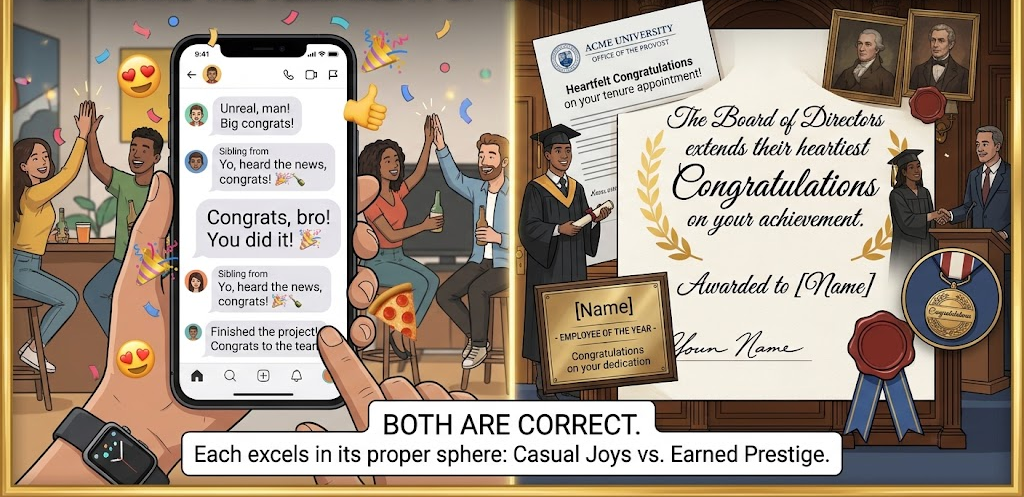
The difference is mainly formality.
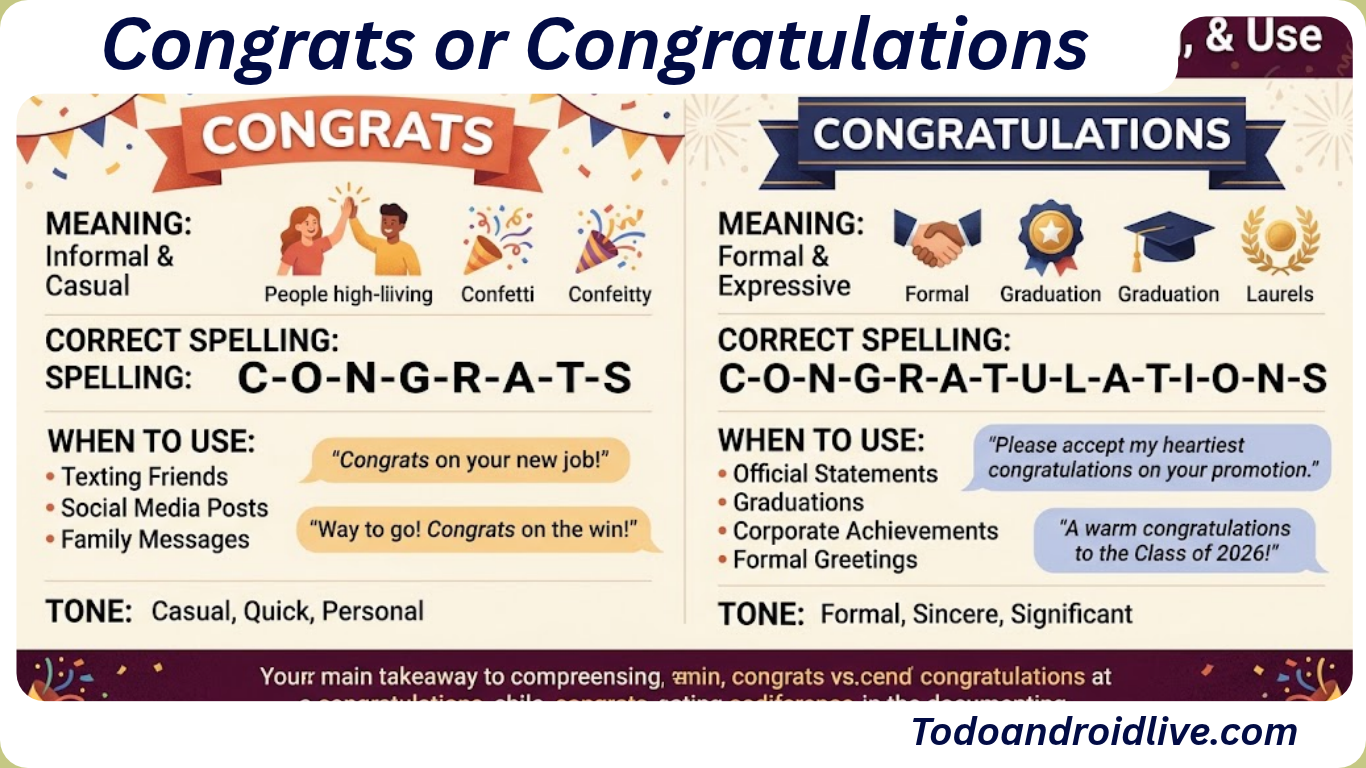
- Congratulations: The complete expression, appropriate for formal, professional, academic, and personal communication.
- Congrats: An informal shortened form that works well in friendly conversations, quick messages, and social media posts.
Consider these examples:
- Professional: Congratulations on your promotion. Your hard work has paid off.
- Casual: Congrats on the new job!
- Academic: Congratulations on earning your degree.
- Friendly: Congrats! You did it!
All four sentences are correct. The first three use the full expression or a formal setting, while the last example demonstrates a relaxed, conversational tone.
If you are unsure which option to choose, use “congratulations.” It is suitable for nearly any audience, although a very casual conversation may feel more natural with “congrats.”
What Does Congrats Mean?
The word “congrats” means expressing happiness, approval, or good wishes because someone has achieved something or experienced a positive event.
It is a shortened version of “congratulations.” People use it to recognize achievements without writing or saying the complete word.
For example:
- Congrats on passing your driving test!
- Congrats on your engagement!
- Congrats to the entire team for winning the championship.
- Congrats on your new home!
In each sentence, the speaker is recognizing something positive.
Also Read: Braves vs Nationals: 2026 Scores, Stats, Results & Season Breakdown
Is Congrats a Real Word or Just Slang?
“Congrats” is a recognized informal English expression, not simply a misspelling or an invented internet term. It is widely understood in everyday communication.
However, its informal character matters. A message such as “Congrats on the successful launch” may work perfectly well in a team chat. The same wording might sound too casual in a formal award letter or a public announcement from an organization.
The word is therefore correct, but its suitability depends on context.
What Does Congratulations Mean?
“Congratulations” expresses pleasure or approval in response to another person’s success, achievement, or good fortune.
It can be used for major milestones, such as completing a degree, getting married, receiving an award, or starting a new position. It can also recognize smaller achievements, such as completing a difficult project.
Examples include:
- Congratulations on completing your training.
- Congratulations to both of you on your engagement.
- Congratulations on your outstanding performance.
- Congratulations to everyone who contributed to this achievement.
The expression is appropriate in formal and informal settings, although it generally sounds more polished than “congrats.”
How to Spell Congratulations Correctly
The correct spelling is “congratulations.”
Many people search for the spelling because the word is long and contains several syllables. Its repeated consonant sounds can make it difficult to spell from memory, particularly when typing quickly.
The standard spelling is:
C-O-N-G-R-A-T-U-L-A-T-I-O-N-S
The word contains 15 letters.
A useful way to remember it is to connect it with the verb “congratulate.”
- Congratulate: The verb used when expressing good wishes.
- Congratulation: A singular noun, generally used in specific grammatical contexts.
- Congratulations: The standard expression used to praise someone or celebrate good news.
- Congratulating: The -ing form of the verb.
- Congratulatory: An adjective describing something that expresses congratulations.
- Congrats: The informal shortened expression.
For example, you can write, “I want to congratulate you on your achievement,” or “Congratulations on your achievement.”
Both sentences express the same general idea, but their grammatical structures are different.
How Many Letters Are in Congratulations?
“Congratulations” has 15 letters. Counting them can help when you are checking the spelling or completing a word puzzle.
The letters are:
C – O – N – G – R – A – T – U – L – A – T – I – O – N – S
The word begins with “congr” and ends with “tions.” Remembering these parts can make the spelling easier.
Is Congratulation or Congratulations Correct?
Both forms exist, but they are not equally common in everyday expressions.
“Congratulations” is the usual choice when directly praising someone. For example:
- Correct and natural: Congratulations on your graduation.
- Unnatural in this context: Congratulation on your graduation.
The singular noun “congratulation” can appear when discussing the act or expression of congratulating someone, particularly in grammatical explanations or less common constructions. However, it is not the normal standalone greeting used to celebrate someone’s success.
When writing a greeting, choose “congratulations” rather than “congratulation.”
Why Do People Say Congrats Instead of Congratulations?
People often shorten words because shorter expressions are convenient and sound natural in conversation. “Congrats” communicates the same basic message as “congratulations” while requiring less time to say or type.
It is particularly common in situations where communication is quick and informal.
Text Messages and Online Conversations
A short message such as “Congrats!” is easy to send when a friend shares good news. It feels immediate and friendly without requiring a long response.
For example:
“Just found out I got accepted into college!”
“Congrats! That’s amazing news.”
Social Media Posts
Social media encourages brief reactions to announcements, photos, achievements, and milestones. People often write “Congrats,” add an emoji, or share a congratulatory image.
Examples include:
- Congrats, grad! 🎓
- Congrats on the big news! 🎉
- Congrats to you both! ❤️
Workplace Chats
In an informal workplace conversation, “Congrats on your promotion!” may sound warm and natural. However, an official company announcement or formal letter will often benefit from the full expression.
The important point is that people use “congrats” because it is convenient and conversational, not because they necessarily cannot spell “congratulations.”
Congrats vs. Congratulations in Professional Writing
Choosing the right expression can help your message sound appropriate for the situation. In professional writing, the full word is usually the safer choice because it communicates respect and avoids an overly casual tone.
Formal Emails
Use “congratulations” when writing to a client, supervisor, senior colleague, business partner, or someone you do not know well.
Example:
Subject: Congratulations on Your Promotion
Congratulations on your promotion to department manager. Your dedication and leadership have made a positive contribution to the team. I wish you continued success in your new role.
This wording is respectful and appropriate for professional communication.
Informal Workplace Messages
“Congrats” is suitable for a friendly message to a coworker with whom you regularly communicate.
Example:
“Congrats on the promotion! Well deserved.”
The shorter version keeps the message friendly without changing its meaning.
Academic and Official Announcements
For graduation ceremonies, scholarship awards, professional certifications, and formal recognition, “congratulations” is generally preferable.
For example:
“Congratulations to the graduating class on completing this important milestone.”
A casual message to a classmate could simply say, “Congrats on graduating!”
Which Word Should You Use in a Resume or Cover Letter?
Neither expression is normally necessary in the main body of a resume unless you are discussing recognition or achievements. In a cover letter or professional correspondence, use the full word if you need to congratulate a recipient.
The goal is to match your language to the purpose of the document rather than choosing a word solely because it is shorter.
Congrats or Congratulations in American, British, and Australian English
There is no spelling difference between American, British, and Australian English for “congrats” or “congratulations.”
All three varieties use the same spellings.
For example:
- American English: Congratulations on your new job!
- British English: Congratulations on your new job!
- Australian English: Congratulations on your new job!
The same is true of “congrats.”
Differences may occur in personal preferences, workplace culture, or publication style. Some people prefer a full expression in professional communication, while others use “congrats” freely in everyday messages.
These are differences in tone and usage, not regional spelling rules.
If you are writing for an American audience, both expressions are familiar. Use “congratulations” when you want a polished, professional message and “congrats” when a relaxed tone fits your relationship with the recipient.
Common Misspellings of Congratulations
Because “congratulations” is a relatively long word, people sometimes misspell it when typing quickly or trying to remember the letter sequence.
Examples of incorrect spellings include:
- Congradulations
- Congratualtions
- Congratulitions
- Congratualations
- Congratiolations
- Congratluations
- Congradulation
- Congratultions
- Congrulations
- Congratulatons
The correct spelling remains “congratulations.”
Similarly, “congrats” is the accepted short form. Spellings such as “congratz” are informal stylizations rather than the standard spelling expected in professional English.
Why Is Congratulations Difficult to Spell?
The word contains a sequence of letters that may not be obvious from its pronunciation. When people hear it, they may remember the sound but confuse the order of letters.
A practical spelling strategy is to break the word into smaller parts:
“congrat” + “ulations”
Then check the complete word: congratulations.
Another helpful method is to type the word into a spell checker or consult a reliable dictionary if you are unsure. Autocorrect can catch many typing errors, but it is still important to review the final message.
Is Congratualtions a Correct Spelling?
No. “Congratualtions” is a misspelling. The correct spelling is “congratulations.”
The same rule applies to “congradulations,” “congratulitions,” and other incorrect variations.
If you are creating a professional document, greeting card, or public announcement, check the spelling before publishing it.
Is Congratz Correct?
“Congratz” sometimes appears in playful online conversations, gaming communities, or humorous posts. However, it is not the standard spelling of either “congrats” or “congratulations.”
For school assignments, workplace emails, business writing, and other standard English communication, use “congrats” or “congratulations.”
How to Use Congrats in a Sentence
The word “congrats” can stand alone as a reaction or appear in a longer sentence. It usually introduces or accompanies a message of praise.
Here are some natural examples:
- Congrats on passing your final exams.
- Congrats on your new position.
- Congrats to everyone who completed the challenge.
- Congrats on buying your first house.
- Congrats to both of you on your engagement.
- Congrats, grad! Your hard work has paid off.
- Congrats on reaching this important milestone.
- Congrats on your retirement and all the years of hard work behind you.
You can also use it in a short social media caption:
“Congrats to my best friend on earning her degree!”
These examples show how the informal expression works across personal achievements, education, relationships, and professional milestones.
For a more formal version, replace “Congrats” with “Congratulations” without changing the main message.
How to Write Congratulations Messages for Different Occasions
A good congratulatory message should fit the occasion and your relationship with the person. A message to a close friend can be relaxed, while a message to a manager or business contact should usually sound more professional.
Congrats Grad: Graduation Messages
Also Read:Cancel or Cancell: Correct Spelling, Meaning, Definition, and Usage (2026)
Graduation is an important milestone that recognizes years of study, effort, and personal growth.
Examples include:
- Congrats, grad! Your hard work has finally paid off.
- Congratulations on earning your degree. I wish you success in the next chapter.
- Congrats on graduating! Your future is full of possibilities.
- Congratulations on this wonderful academic achievement.
Use “congrats grad” for a short caption, a graduation card, or a message to a friend. Choose the full expression for a formal announcement or a message to someone you do not know well.
Congrats on Baby: Messages for New Parents
Welcoming a baby is a meaningful occasion for families. A warm message can celebrate the new arrival while expressing happiness for the parents.
Examples include:
- Congratulations on your beautiful new baby!
- Congrats on your little one! Wishing your family lots of happiness.
- Congratulations to both of you on the arrival of your baby.
- Congrats on baby number two! Wishing your family love and joy.
A thoughtful baby congrats message should feel personal and positive. If you do not know the family’s circumstances well, keep the message simple and respectful.
Wedding Congrats Message
A wedding message celebrates a couple’s marriage and the beginning of their life together.
Examples include:
- Congratulations on your wedding! Wishing you a lifetime of love and happiness.
- Congrats to both of you on your special day.
- Congratulations to the happy couple on this wonderful milestone.
- Wishing you both a beautiful future together. Congratulations!
“Congrats on your wedding” is suitable for a friendly text or social media comment. “Congratulations on your marriage” may sound more formal on a card or in a professional message.
Congrats on Your Engagement
An engagement announcement is an opportunity to celebrate a couple’s decision to marry.
Examples include:
- Congrats on your engagement! I’m so happy for you both.
- Congratulations to you two on this exciting news.
- Congrats to both of you! Wishing you a wonderful journey toward your wedding.
- Congratulations on finding someone to share your future with.
Keep your message sincere. A simple expression of happiness is often more meaningful than a long, generic greeting.
Congrats on Your Promotion
A promotion recognizes professional progress, responsibility, and achievement.
Examples include:
- Congratulations on your promotion. You have earned this opportunity.
- Congrats on the new role! Wishing you success in your next chapter.
- Congratulations on becoming team leader.
- Congratulations on your promotion to director. I wish you continued success.
For a manager, client, or senior colleague, the full expression is usually the best option.
Congrats on Your New Home
Buying or moving into a new home is another common reason to congratulate someone.
Examples include:
- Congrats on your new home! May it be filled with happy memories.
- Congratulations on finding your perfect place.
- Congrats on becoming a homeowner!
- Wishing you many wonderful years in your new home. Congratulations!
These messages work well in greeting cards, text messages, and social media comments.
Congrats on Retirement
Retirement marks the end of one professional chapter and the beginning of another. Your message can recognize the person’s contribution while wishing them well.
Examples include:
- Congratulations on your retirement! Wishing you a happy and relaxing next chapter.
- Congrats on reaching this important milestone.
- Congratulations on a wonderful career and a well-earned retirement.
- Wishing you many enjoyable adventures ahead. Congrats on retiring!
For a retirement announcement at work, the full word usually gives the message a more polished tone.
Congrats Images, GIFs, Memes, and Emojis
Congratulatory messages do not always need to be written as plain text. Images, animated GIFs, memes, and emojis can make a celebration feel more personal, especially online.
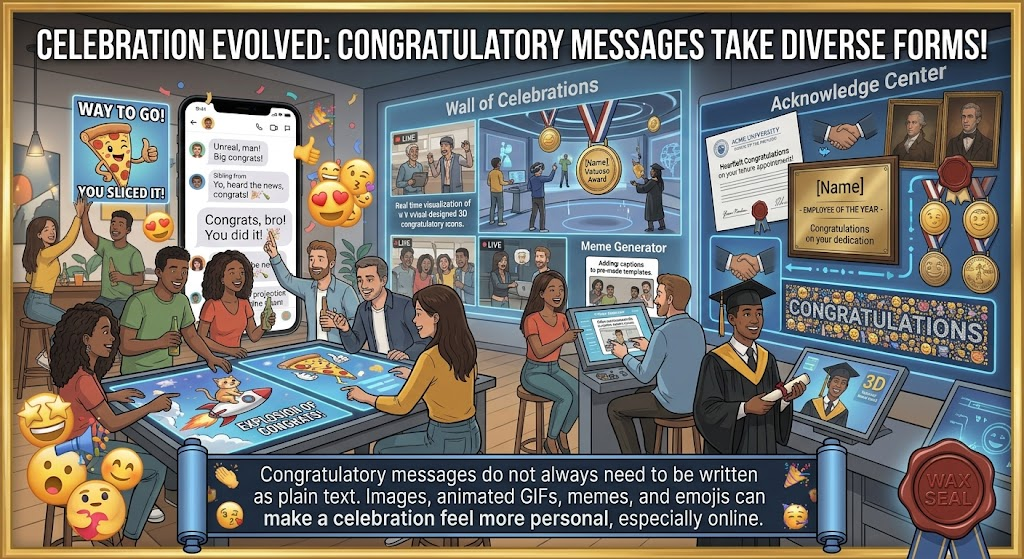
The format you choose should match the recipient and the occasion.
Congrats GIF
A congrats GIF is a short animated image used to celebrate an achievement or share excitement. People often send GIFs after a friend gets a job, graduates, announces an engagement, or wins a competition.
A celebratory animation can make a casual message more expressive. For professional communication, however, a simple written message is usually a safer choice unless the workplace culture is relaxed.
Congrats Meme
A congrats meme adds humor to a congratulatory message. It may use a funny reaction, a familiar internet character, or an exaggerated celebration.
Memes are best suited to friends and people who understand the joke. Avoid using humor that might embarrass the recipient or make light of an important achievement.
Searches such as “congrats happy for you meme” often reflect a playful or sarcastic style. Before sending one, consider whether the recipient will understand the intended humor.
Congrats Images and Flowers
Congrats images can be shared through messaging apps, social networks, or digital greeting cards. Some include balloons, confetti, flowers, or short congratulatory phrases.
Flowers can also be a thoughtful gift for a graduation, promotion, engagement, or new home. If you send congrats flowers, consider the recipient’s preferences and the occasion rather than assuming every person likes the same arrangement.
A short message attached to an image or bouquet can make the gesture more personal.
Congrats Emoji
Emojis help communicate emotion in short messages. Common choices include:
- 🎉 for celebration
- 🎊 for a festive occasion
- 🥳 for excitement
- 🎓 for graduation
- 💐 for flowers and congratulations
- ❤️ for warmth and affection
For example, “Congrats on your promotion! 🎉” is natural in a casual message.
In a formal business letter, it is usually better to leave emojis out unless you know they are appropriate for the recipient and organization.
How Do You Say Congratulations in Spanish and French?
The English expression “congratulations” has equivalents in other languages. The best translation depends on the language and the context.
Congrats in Spanish
A common Spanish translation is “¡Felicidades!” It can be used to congratulate someone on a birthday, graduation, achievement, or other happy event.
For example:
“¡Felicidades por tu graduación!”
This means “Congratulations on your graduation!”
“Enhorabuena” is also used to congratulate someone, particularly in Spain. Regional usage varies, so the most natural expression depends on the audience.
Congrats in French
A common French expression is “Félicitations !”
For example:
“Félicitations pour votre promotion !”
This means “Congratulations on your promotion!”
The English short form “congrats” should not automatically be translated word for word. It is better to use the expression that sounds natural in the target language.
How to Respond to Congratulations
When someone congratulates you, your response should acknowledge their kindness. You do not need a complicated sentence; a sincere reply is usually enough.
Casual Responses
- Thanks!
- Thank you!
- Thanks so much!
- Thanks, I really appreciate it.
- Thanks for your congrats!
These responses work well in text messages, comments, and friendly conversations.
Formal Responses
- Thank you for your kind words.
- I appreciate your congratulations.
- Thank you for your support and encouragement.
- Thank you for recognizing this achievement.
These expressions are useful for professional emails, formal events, and messages from colleagues or clients.
What Does “Congrats to You Too” Mean?
“Congrats to you too” is appropriate when the other person has achieved something worth celebrating as well.
For example, if two classmates both graduate, one might say, “Congratulations!” and the other could reply, “Thanks, and congrats to you too!”
The phrase is not a universal response to every congratulatory message. If the other person has not shared a similar achievement, a simple “Thank you” is more natural.
Congratulations On or Congratulations For: Which Is Correct?
Both “on” and “for” can appear in sentences involving congratulations, but they do not always serve the same purpose.
“Congratulations on” is the standard choice when naming an achievement, event, or milestone.
Examples:
- Congratulations on your graduation.
- Congratulations on the promotion.
- Congratulations on winning the competition.
- Congratulations on your new home.
“Congratulate someone for” can be natural when describing the reason for praising a person, as in “I congratulated her for completing the project.” In many cases, “congratulate someone on” is also natural and often preferred when referring to an achievement.
For direct congratulatory messages, use “Congratulations on” as your default.
Avoid constructions such as “Congratulations on for your promotion,” because they combine two prepositions unnecessarily.
Other Ways to Say Congratulations
Sometimes you may want a message that sounds more personal than the standard expression. The best alternative depends on what the recipient has accomplished.
For a friend:
- Well done!
- You did it!
- That’s fantastic news!
- I’m so happy for you.
- What a wonderful achievement!
For a professional contact:
- Well deserved.
- Best wishes for continued success.
- Your achievement is impressive.
- I wish you every success in your new role.
- Please accept my sincere congratulations.
Also Read:Houston Rockets vs Oklahoma City Thunder Timeline
For a major personal milestone:
- Wishing you all the best.
- Here’s to your next chapter!
- I’m delighted for you.
- Wishing you a future filled with happiness.
These alternatives can make your message more specific and meaningful. Instead of relying on the same phrase every time, mention the achievement and explain why you are happy for the person.
Frequently Asked Questions About Congrats or Congratulations
1. Is “congrats” grammatically correct?
Yes. “Congrats” is an accepted informal shortening of “congratulations.” It is appropriate in casual messages, friendly conversations, and many social media posts. Use the complete expression when a formal tone is important.
2. What is the correct spelling of congratulations?
The correct spelling is “congratulations,” with 15 letters. Common errors include “congradulations,” “congratualtions,” and “congratulitions.” Use a spell checker or dictionary if you are unsure.
3. Is congratulation correct in the singular?
“Congratulation” exists as a singular noun, but “congratulations” is the standard expression for praising someone directly. Write “Congratulations on your success,” rather than “Congratulation on your success.”
4. Is congrats short for congratulations?
Yes. “Congrats” is a shortened form of “congratulations.” It carries the same general meaning but usually sounds more casual.
5. Is there a difference between British and American spelling?
No. Both British and American English use “congrats” and “congratulations.” Differences in usage reflect tone and personal or organizational preferences, not different spellings.
6. Can I say “many congratulations”?
Yes. “Many congratulations” is a natural expression, particularly in British English, and it is also understood elsewhere. For example, “Many congratulations on your graduation!”
7. How do you respond when someone says congratulations?
You can say “Thank you,” “Thanks so much,” or “I really appreciate it.” In a formal setting, “Thank you for your kind words” is also appropriate.
Conclusion
Choosing between “congrats” and “congratulations” is mainly a matter of tone, not correctness. Both expressions communicate happiness for another person’s success, but they fit different situations.
“Congratulations” is the complete expression and works well in professional emails, academic announcements, formal cards, and personal messages. “Congrats” is shorter and more relaxed, making it a natural choice for friends, text messages, and social media.
Remember that the correct spelling is “congratulations,” not “congradulations” or “congratualtions.” When writing a congratulatory message, consider your audience, the occasion, and the impression you want to create.
Whether you are celebrating a graduation, a new baby, a wedding, a promotion, or a new home, the most important part is expressing genuine happiness. Choose the wording that fits the moment, and your message will sound natural, thoughtful, and appropriate.