

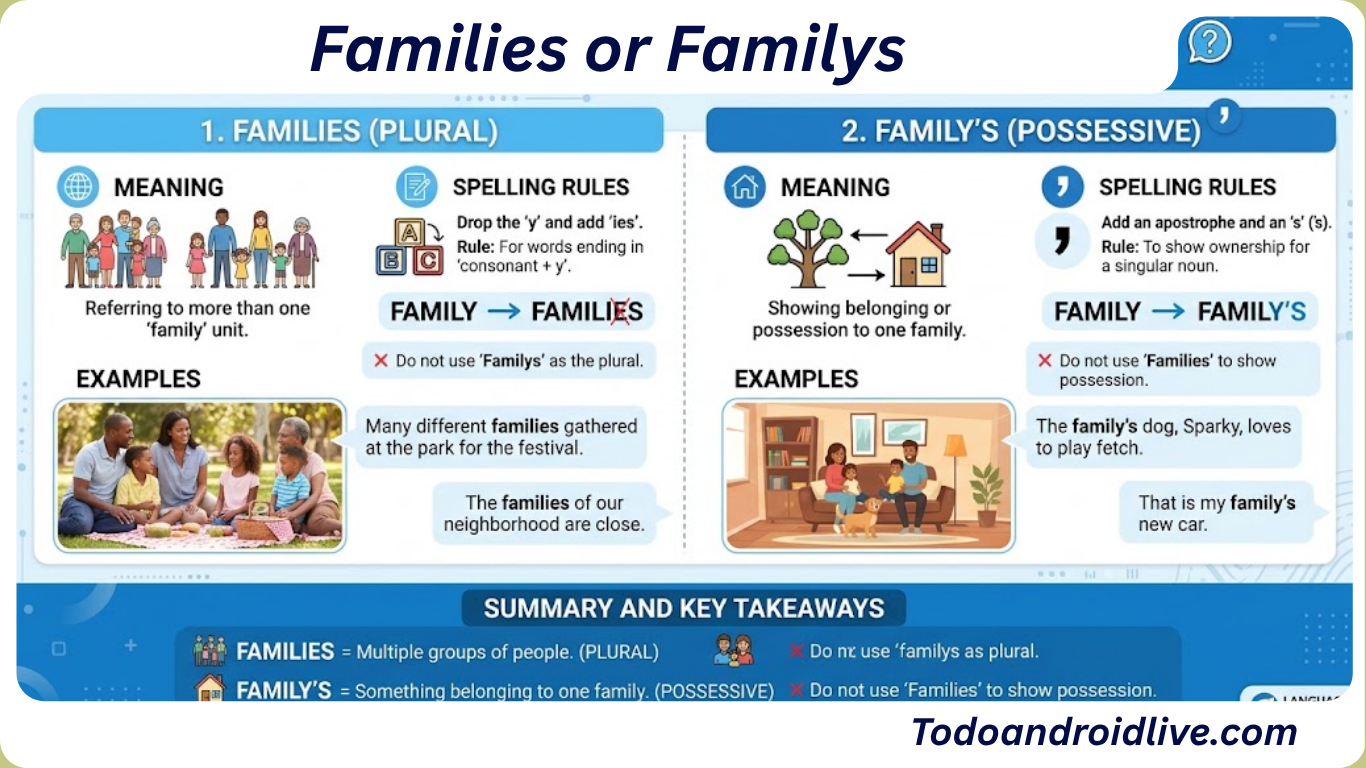
English spelling can be confusing when a single letter or punctuation mark changes the meaning of a word. The words families, family’s, and families’ are good examples. They look similar, but each serves a different purpose in a sentence.
For example, you might write about several families living in the same neighborhood, describe a house that belongs to one family, or discuss traditions shared by many families. Although these situations involve the same basic noun, the correct spelling depends on what you want to express.
Understanding families or familys is useful for students, teachers, professionals, bloggers, and anyone who wants to improve their written English. It can also help when writing emails, school assignments, family history articles, business documents, and online content.
The main distinction is simple: families is the plural form of family, family’s usually shows possession by one family, and families’ shows possession by multiple families. Familys, without an apostrophe or the spelling change, is not the standard plural form.
This guide explains each form, the grammar rules behind it, common spelling mistakes, and practical examples that make the differences easier to remember.
What Is the Difference Between Families and Familys?
The difference between families and family’s depends on number and possession. One form refers to more than one family, while the other normally shows that something belongs to a single family.
Consider these examples:
- Families: Several families attended the community event.
- Family’s: The family’s car was parked outside.
- Families’: The families’ homes were decorated for the festival.
In the first sentence, families identifies multiple groups of related people. In the second, family’s indicates that one family owns or is associated with the car. In the third, families’ indicates that the homes belong to multiple families.
The spelling familys is incorrect when you want to write the ordinary plural of family.
Quick Comparison
| Word | Grammatical purpose | Example |
| Family | Singular noun | My family lives nearby. |
| Families | Plural noun | Three families live nearby. |
| Family’s | Singular possessive | The family’s garden is beautiful. |
| Families’ | Plural possessive | The families’ gardens are beautiful. |
| Familys | Incorrect standard plural | Write families instead. |
The easiest way to choose the correct form is to ask two questions: Are you talking about one family or several? Are you showing ownership or another relationship?
If you are talking about several groups, use families. If something belongs to one family, use family’s. If something belongs to multiple families, use families’.

Why Is Families the Correct Plural of Family?
The correct plural spelling is families because English has a common spelling rule for nouns that end in a consonant followed by the letter y.
When a noun ends in a consonant plus y, the usual plural form changes the y to i and adds -es.
The pattern is:
Also Read: Emigrate or Immigrate: Meaning, Difference, Examples, and Usage
Singular noun → remove y → add ies.
Examples include:
- Family → families
- City → cities
- Baby → babies
- Story → stories
- Country → countries
- Company → companies
- Lady → ladies
- Party → parties
This rule applies because the final y follows a consonant. In family, the letter immediately before y is l, which is a consonant. Therefore, the plural becomes families rather than familys.
What Happens When a Word Ends in a Vowel and Y?
Not every noun ending in y changes to ies. When a vowel comes immediately before the final y, the usual plural form adds s without changing the spelling of y.
Examples include:
- Boy → boys
- Toy → toys
- Day → days
- Key → keys
- Monkey → monkeys
- Journey → journeys
The difference becomes easier to understand when you compare family and boy. The word family ends in consonant + y, while boy ends in vowel + y. Their plural forms follow different spelling patterns.
Does the Rule Apply to Every Word Ending in Y?
The consonant-plus-y rule covers many common nouns, but English also contains exceptions and special cases. Some words have irregular plurals, and certain proper names or specialized terms may follow different conventions.
For everyday writing, however, the rule provides a reliable starting point. When writing about more than one family, the standard form is always families.
What Does Family Mean?
The word family is a noun that commonly describes a group of people connected through birth, marriage, adoption, or other close relationships.
A family may include parents and children, siblings, grandparents, cousins, or other relatives. The exact meaning can depend on the social, cultural, legal, or personal context.
For example:
- My family enjoys spending time together.
- Her family lives in another state.
- The school offers programs for each family.
- Family support can help people manage difficult situations.
The word can also describe a broader group connected by a shared characteristic. In science, for example, a family can refer to a classification group of related organisms. In everyday language, people may also speak of a work family or a family of products.
These meanings do not change the spelling rule. When the noun family refers to multiple groups, its ordinary plural is families.
What Is a Familys Definition in Different Contexts?
The meaning of family can vary depending on how the word is used.
In everyday conversation, it usually refers to relatives or people who share close personal relationships. In legal or administrative settings, the meaning may depend on the specific law, benefit program, insurance policy, or government agency involved.
In genealogy, family often refers to people connected through ancestry and descendants. A family tree records these relationships across generations.
In business, a family business generally refers to a company owned, managed, or passed down by members of a family. The exact ownership structure varies from one business to another.
Understanding the context helps readers interpret the noun correctly, but the plural spelling remains families.
When Should You Use Familys?
Use family’s when you need the singular possessive form of family. The apostrophe followed by s usually shows that something belongs to, is associated with, or relates to one family.
For example:
- The family’s home is near the park.
- We attended the family’s annual celebration.
- The family’s decision surprised everyone.
- A doctor discussed the family’s medical history.
- The family’s business has operated for three generations.
In these examples, each sentence refers to one family. The apostrophe indicates a relationship between that family and the home, celebration, decision, history, or business.
Possession does not always mean physical ownership. A family’s history, traditions, reputation, and circumstances can all use the possessive form.
Familys Meaning in Everyday Writing
The meaning of family’s changes slightly according to the noun that follows it.
In family’s home, the phrase indicates a home associated with one family. In family’s history, it refers to the history of that family. In family’s needs, it describes needs associated with the family as a group.
The same grammatical pattern works in many sentences:
- The family’s favorite restaurant is nearby.
- The family’s plans changed unexpectedly.
- We learned about the family’s ancestors.
- The family’s records were kept in a safe place.
Remember that family’s is not the standard plural form. If you want to say that several families attended an event, do not write family’s attended. Use families attended.
Is Family’s Ever Used as a Contraction?
Yes. Family’s can also represent family is or family has in certain sentences. The surrounding words make the intended meaning clear.
Examples:
- My family’s planning a reunion. This means my family is planning a reunion.
- My family’s lived here for decades. This means my family has lived here for decades.
The apostrophe performs a different grammatical function in these sentences. It does not show ownership; it replaces missing letters in a contraction.
In formal writing, you may choose to write family is or family has in full when clarity is especially important. Both approaches can be correct when the sentence supports the intended meaning.
When Should You Use Families’?
Use families’ when you are talking about possession or association involving more than one family.
To create the plural possessive form, first change family to families. Then add an apostrophe after the final s.
The result is families’.
Examples include:
- The families’ homes were damaged by the storm.
- The school organized a meeting for the families’ representatives.
- The families’ traditions reflected their different backgrounds.
- The families’ concerns were discussed at the community meeting.
- The families’ photographs were displayed in the hall.
Each sentence refers to more than one family and identifies something connected to those families.
Families’ Versus Familys
Compare these two sentences:
The family’s house needs repairs.
The families’ houses need repairs.
The first sentence refers to one family and its house. The second refers to multiple families and their houses.
The number of families changes the spelling. The apostrophe also moves depending on whether the noun is singular or plural.
A useful method is to write the plural first. Once you have families, place the apostrophe after the s to show possession.
Families or Familys: How Do You Choose the Right Word?
When deciding between families or family’s, look at the role of the word in the sentence instead of relying on how it sounds.
Use families when you mean two or more family groups. Use family’s when you mean something belonging or relating to one family, or when the word represents family is or family has.
Consider the following examples.
| Sentence | Correct form | Reason |
| Several ___ joined the program. | Families | More than one family |
| The ___ car needs fuel. | Family’s | One family and its car |
| Many ___ attended the meeting. | Families | Plural noun |
| The ___ history was documented. | Family’s | History associated with one family |
| The ___ gardens were connected. | Families’ | Gardens associated with multiple families |
A Simple Three-Step Test
First, determine whether you mean one family or several families.
Second, decide whether the word simply names a group or shows a relationship such as ownership.
Third, check the punctuation.
- One family, no possession: family
- More than one family, no possession: families
- One family, possession: family’s
- More than one family, possession: families’
This process works for most everyday sentences involving these forms.
Common Mistakes When Writing Families, Family’s, and Families’
Even experienced writers can confuse plurals and possessives. The following mistakes are common in schoolwork, emails, website content, and professional documents.
Mistake 1: Writing Familys Instead of Families
Incorrect: Several familys attended the event.
Correct: Several families attended the event.
The error occurs when a writer adds only s to a noun that ends in consonant + y. The spelling rule requires changing y to i and adding es.
Mistake 2: Using Family’s to Mean Multiple Families
Incorrect: The family’s attended the school meeting.
Correct: The families attended the school meeting.
The sentence refers to several groups, and no possession is being expressed. Therefore, families is the correct form.
Mistake 3: Forgetting the Apostrophe in a Possessive Phrase
Incorrect: The familys home is spacious.
Correct: The family’s home is spacious.
The intended meaning is that one family is associated with the home. The singular possessive form requires an apostrophe before s.
Mistake 4: Putting the Apostrophe in the Wrong Place
Incorrect: The families’s homes were renovated.
Correct: The families’ homes were renovated.
The plural form already ends in s. To make it possessive, add the apostrophe after the existing s rather than adding another s.
Mistake 5: Confusing a Plural With a Possessive
Incorrect: The family’s attended the reunion.
Correct: The families attended the reunion.
Incorrect: The families traditions were celebrated.
Correct: The families’ traditions were celebrated.
The first correction uses a plural noun. The second requires a plural possessive because the traditions are associated with multiple families.
Mistake 6: Applying the Same Rule to Every Word Ending in Y
Incorrect: Two boies played outside.
Correct: Two boys played outside.
The word boy ends in a vowel followed by y, so its plural is boys. Family follows a different pattern because its y comes after a consonant.
Families vs Family’s in Real-Life Writing
Understanding grammar becomes easier when you see how these forms appear in common situations.
In Emails and Workplace Communication
Professional emails often refer to family events, employee benefits, or community programs.
Examples:
- We invite local families to attend the information session.
- The family’s request has been forwarded to the appropriate department.
- The families’ applications will be reviewed separately.
Each example uses a different grammatical form according to the intended meaning.
In School Assignments
Students may write about family history, social relationships, or community life.
Examples:
- Families play different roles in their communities.
- The family’s background influenced the character’s decisions.
- The families’ experiences were included in the research project.
Checking the singular, plural, and possessive forms can improve the accuracy of school assignments.
In News and Online Articles
News articles frequently discuss several households or describe the circumstances of one household.
Examples:
- Families are seeking temporary housing after the flood.
- The family’s statement was released on Monday.
- The families’ concerns prompted a public meeting.
Writers should choose the form that matches the facts being reported.
In Social Media Posts
Informal writing still benefits from correct spelling.
Examples:
- Sending warm wishes to all the families celebrating today.
- Our family’s favorite holiday tradition is back.
- The families’ reunion brought everyone together.
Although social media often uses relaxed language, the standard spelling rules remain the same.
What Is the Difference Between Family and Families?
Family is singular, while families is plural. The singular form usually identifies one group, and the plural form identifies two or more groups.
For example, “Our family is traveling this weekend” refers to one family. “Several families are traveling this weekend” refers to multiple family groups.
In standard American English, a collective noun such as family can take a singular or plural verb depending on whether the group is being treated as one unit or its members are being emphasized. American usage generally favors a singular verb when family acts as one unit.
Also Read:Engrained or Ingrained: Standard Spelling, Definitions, and Complete Usage Guide
For instance:
- My family is visiting tomorrow.
- My family members are arriving at different times.
- Several families are attending the festival.
The choice between family and families therefore involves both number and sentence structure.
What Is the Difference Between Families and Family Members?
Families and family members are related expressions, but they do not mean exactly the same thing.
Families refers to multiple groups of related people. Family members refers to the individual people who belong to one or more families.
For example, “Three families attended the event” identifies three groups. “Twenty family members attended the event” identifies twenty individuals, regardless of how those individuals are distributed among their families.
The distinction matters when writing reports, research findings, event announcements, and family history documents.
A sentence about families may focus on households or groups. A sentence about family members usually focuses on individual people and their roles or relationships.
How Families Relates to Family History and Genealogy
The word families frequently appears in discussions about genealogy, ancestry, and family trees. These subjects involve tracing relationships between people across generations.
Genealogy research may use birth records, marriage records, census information, obituaries, photographs, and other historical documents. Researchers organize these records to understand how ancestors and descendants are connected.
For example:
- Several families contributed records to the local history project.
- The family’s ancestry was traced through historical documents.
- The families’ family trees revealed shared ancestors.
Websites such as FamilySearch and Ancestry offer tools for researching family relationships. Their specific features, access options, and costs may vary.
These topics are related to the meaning of family, but they do not change its grammatical forms. Use family for one group, families for multiple groups, family’s for singular possession, and families’ for plural possession.
How to Remember the Correct Spelling of Families
A few simple habits can help you avoid spelling mistakes.
Remember the Consonant Plus Y Rule
Think of city and cities. The same basic pattern applies to family and families.
When a regular noun ends in consonant + y, the usual plural spelling changes y to i and adds es.
Use the Ownership Test
If you can replace the phrase with “belonging to one family,” family’s may be correct.
For example, the family’s car means the car associated with one family.
If the phrase refers to something associated with several family groups, families’ may be correct.
Read the Entire Sentence
Apostrophes should match the intended meaning. Reading the sentence in full often makes the difference clear.
Compare:
- The families arrived early.
- The family’s arrival was unexpected.
- The families’ arrival times were different.
The first identifies groups, the second uses a singular possessive, and the third uses a plural possessive.
Use a Grammar Checker Carefully
Spellcheck tools can identify many spelling errors, including familys. However, automated tools may not recognize every grammatical problem.
For example, a tool may accept family’s as a correctly spelled word even when families is needed in the sentence. Always review the meaning and grammar rather than relying entirely on software.
Synonyms and Related Words for Family
The best synonym for family depends on the context. Some words describe relatives, others refer to a household, and some describe broader social or professional groups.
There is no single list of interchangeable words that works in every sentence. The following terms are useful alternatives or closely related expressions, grouped by meaning.
Words Related to Relatives and Ancestry
- Relatives
- Kin
- Kinfolk
- Kindred
- Relations
- Kinsfolk
- Kinsmen
- Kinswomen
- Ancestors
- Forebears
- Forefathers
- Progenitors
- Descendants
- Offspring
- Progeny
- Heirs
- Lineage
- Ancestry
- Pedigree
- Bloodline
- Family line
- Family branch
- Kin group
- Extended relatives
- Blood relatives
These terms are useful when discussing genealogy, inherited relationships, or connections across generations. Some are narrower than family: ancestors, for example, refers to earlier generations rather than the entire present-day family.
Words Related to a Household or Close Family Group
- Household
- Home
- Domestic group
- Family unit
- Nuclear family
- Extended family
- Immediate family
- Close relatives
- Immediate relatives
- Married couple
- Parents and children
- Household members
- Dependents
- Next of kin
- Family circle
- Inner circle
- Kinship group
- Domestic unit
- Family network
- Related households
These expressions may be useful in discussions about living arrangements, social services, housing, or family relationships. They are not all exact synonyms: a household can include people who are not related, while immediate family usually refers to a narrower set of relatives.
Words Related to Community and Social Connections
- Clan
- Tribe
- Line
- Dynasty
- House
- Descendant group
- Ancestral group
- Kinship network
- Related group
- Family circle
- Support network
- Caregiving network
- Social unit
- Community
- Affiliated group
- Household network
- Ancestral line
- Family branch
- Relational network
- Kin community
The meaning of these terms varies. A clan or tribe may have cultural, historical, or social significance beyond the basic meaning of family. Dynasty usually refers to a line of rulers or a family that maintains power or influence across generations.
Words Related to Business, Work, and Shared Identity
- Family business
- Business family
- Company group
- Corporate group
- Work family
- Work community
- Team
- Team members
- Organizational group
- Professional network
- Business partners
- Founding family
- Owner family
- Family enterprise
- Shared community
These expressions can be relevant when family is used in a broader or figurative sense. A work family, for example, describes close workplace relationships rather than a group of biological relatives.
Words Related to Care, Belonging, and Close Relationships
- Loved ones
- Dear ones
- Close ones
- Loved relatives
- Dependable relatives
- Supportive relatives
- Caregivers
- Household relations
- Relational group
- Circle of relatives
- Family circle
- Trusted relatives
- Immediate kin
- Close kin
- Kinfolk network
- Personal support group
- Caring community
- Family support system
- Household support network
- Close-knit group
Some terms in this section describe the emotional or practical role a family plays rather than its exact definition. Choose the wording that accurately reflects the people and relationships being discussed.
How to Choose the Best Synonym for Family
Use relatives or kin when referring to related people. Use household when describing people who live together. Use ancestry, lineage, or bloodline when discussing family origins. Use loved ones when emphasizing personal affection, and use family business when describing a company connected to a family.
Also Read:Charlotte Hornets vs Celtics Match Player Stats, Game Recap, and Full Box Score
For formal or legal writing, avoid treating these words as interchangeable without checking the context. A legal definition of immediate family may differ from an everyday understanding of close relatives.
Frequently Asked Questions About Families or Familys
Is familys a real English word?
Familys is not the standard plural spelling of family. The correct form is families. You may encounter familys in search queries, informal online writing, or spelling mistakes, but it should not be used in standard English.
Can family’s mean more than one family?
No. Family’s normally indicates possession or association involving one family, or it represents family is or family has. When referring to multiple family groups, use families. For possession involving multiple groups, use families’.
Is families’ grammatically correct?
Yes. Families’ is the plural possessive form. It indicates that something belongs or relates to more than one family, as in “The families’ concerns were addressed.”
Should I write family is or family are in American English?
In American English, family is generally treated as a singular collective noun when the group is viewed as one unit. For example, “My family is visiting.” When emphasizing individuals, writers can use a plural construction with a phrase such as “My family members are visiting.”
What is the difference between family’s and families’ in a family tree?
Family’s refers to one family, while families’ refers to multiple families. For example, “The family’s ancestry” discusses the ancestry of one family. “The families’ records” refers to records associated with several families.
Is the word family used differently in British English?
The spelling family and its plural families are the same in British and American English. Some collective-noun constructions and verb choices can differ between the varieties, but the basic plural spelling does not change.
Can I use families in a formal research paper?
Yes. Families is appropriate in academic writing, research papers, reports, and professional documents when referring to multiple family groups. Ensure that the word accurately represents the subjects being discussed.
How do I make a family name plural?
For many surnames, the plural is formed by adding s or es, depending on the name’s ending. For example, the Smiths refers to multiple people with the surname Smith. Do not automatically apply the family-to-families rule to surnames; naming conventions may differ.
What is the difference between family history and ancestry?
Family history is the broader study of relatives, events, records, and relationships across generations. Ancestry generally refers to a person’s or group’s origins and ancestors. The terms overlap, but they do not have identical meanings.
Why do people search for families vs family’s?
People may be unsure whether a sentence needs a plural noun or a possessive form. Because the words look similar, it is easy to confuse them. The correct choice depends on the sentence’s meaning, not simply on how the word sounds.
Conclusion
The difference between families, family’s, and families’ becomes clear once you understand number and possession. Family is the singular noun, families is the correct plural, family’s is the singular possessive or a contraction, and families’ is the plural possessive.
The spelling familys should not be used as the ordinary plural of family. When a noun ends in a consonant followed by y, its usual plural form changes y to i and adds es. That is why family becomes families.
For everyday writing, focus on what you want the sentence to mean. If you are discussing several family groups, choose families. If you are describing something associated with one family, choose family’s. If the relationship involves multiple families, use families’.
With these rules in mind, you can write more clearly in emails, school assignments, professional documents, genealogy articles, and online content.